Measuring Phase Noise in Automated Production for Optimum Speed
The Berkeley Nucleonics 7000 Series signal source analyzer brings fully automated phase noise measurement to the production floor, with high-speed modes that trade acquisition time against accuracy on demand. This application note walks through the ATE measurement capabilities, throughput, long-term repeatability, and automated VCO characterization, and closes with a side-by-side comparison against legacy analyzers.
The 7000 Series signal source analyzer
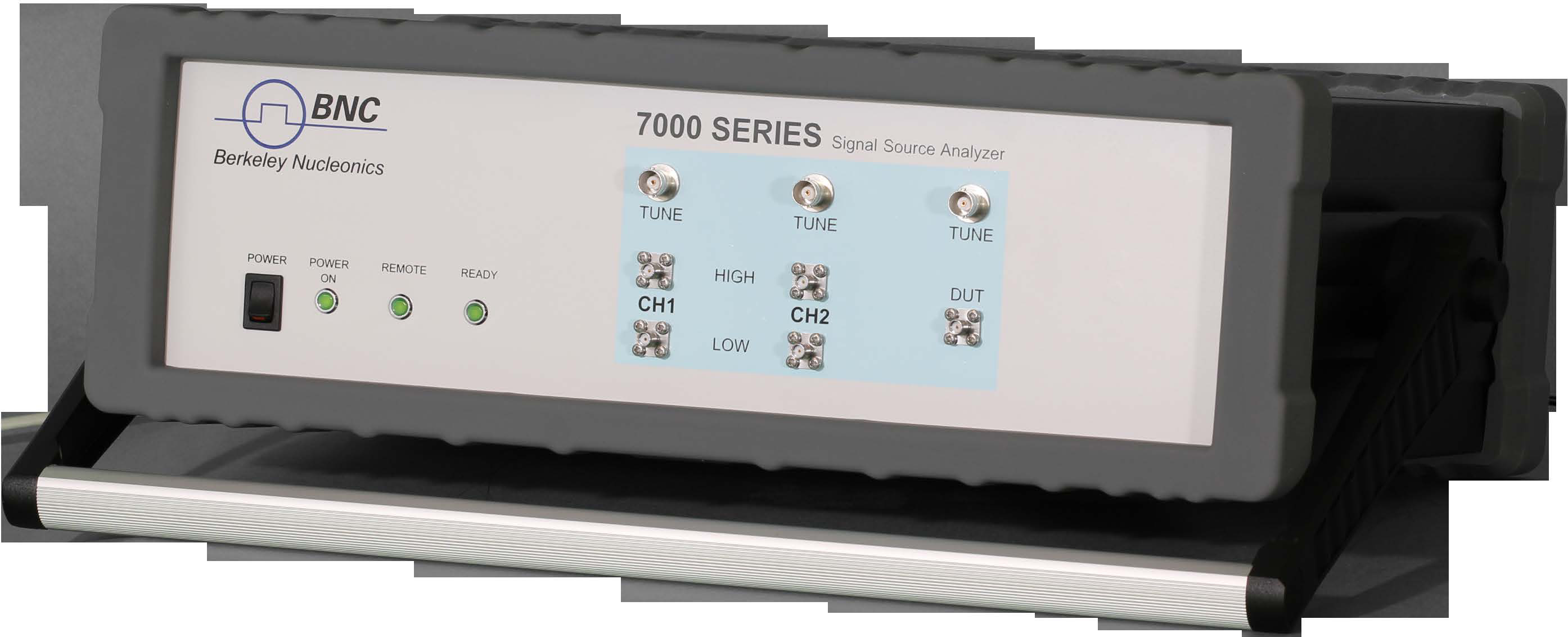
Berkeley Nucleonics has enhanced the 7000 SERIES of fully automated signal source analyzers offering high-speed measurement modes up to 40 GHz that optimize for automated testing, making the 7000 SERIES a very versatile signal source analyzer for both, R&D and production testing.
R&D measurement capabilities
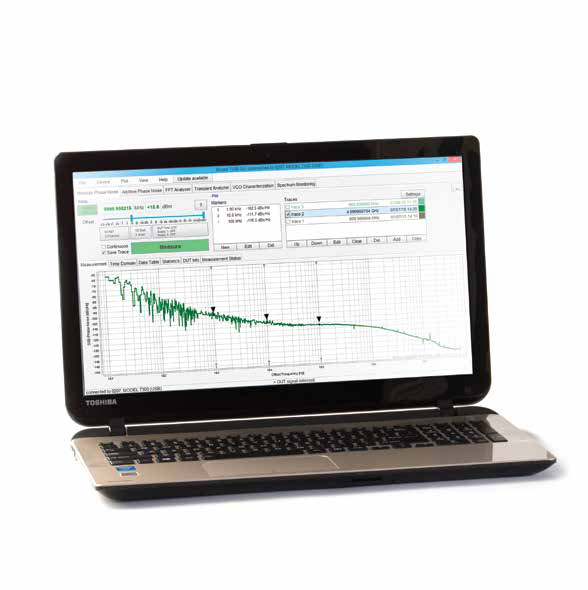
For R&D, the instrument can be controlled with a simple to use desktop application and offers multiple measurement modes such as:
- Phase noise measurements with low phase noise sensitivity - Residual or absolute - CW or pulse modulated signals
- Amplitude noise measurements
- Frequency & phase transient tests (Transient Analyzer)
- VCO Characterization with low-noise internal DC sources
- FFT analyzer
It provides high dynamic range with low system noise floors, while at the same time offering attractive cost of ownership for labs. The instrument is Ethernet, USB, or GPIB controlled and plug-and-play with any standard computer. The entire instrument is enclosed in a compact, fanless 3U 19 inch chassis and weighs 10 kg (22 lbs).
ATE measurement capabilities
Besides the benchtop application, the 7000 SERIES series also offers a strong automated testing (ATE) solution. The unit can be controlled and triggered using SCPI commands via USB, GPIB, or Ethernet. The measurement process itself is fully automatic and very easy to set up. There are example programs available in various programming languages such as VBA, Java, C, Matlab or Labview.
Applications:
- General purpose phase noise tests
- Crystal oscillator and VCO testing
- PLL synthesizer locking and characterization
- Supply noise verification
- Automated production testing
Automated phase noise measurement
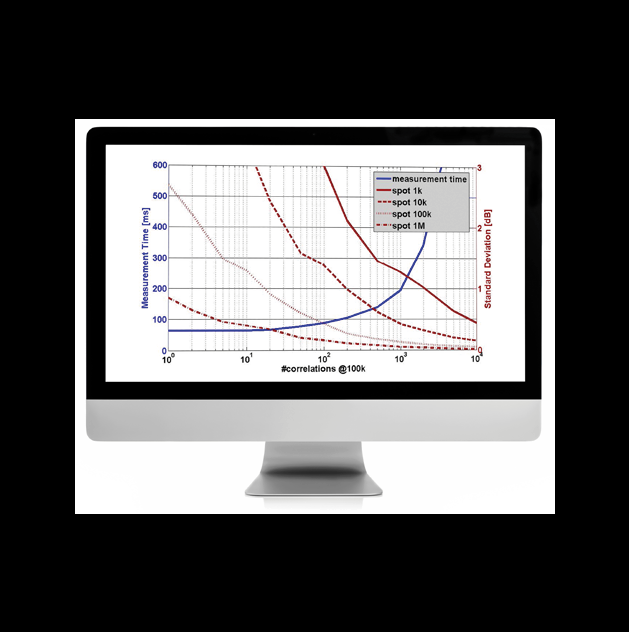
The ATE SCPI command set allows for phase noise plots, spot phase noise values, spurious extraction and calculation of RMS jitter and integral phase noise. Optimized for throughput and repeatability, the phase noise mode allows for accurate measurements in under 200 milliseconds per device under test in a production environment. The critical measurement time consists of setup and acquisition time and the architecture of the 7000 SERIES is designed to minimize the setup time. The acquisition time is set by the user for the optimum trade-off between accuracy and measurement time as shown in Figure 2.
Depending on the tolerable uncertainty window at a specific frequency offset and the minimum offset of interest, the acquisition time has to be adjusted. As acquisition time goes up, the uncertainty levels improve (see Figure 2, green curves) due to more averaging.
Continuous, repeatable operation
Options:
- Very low noise internal synthesizer
- Two independent internal low noise supplies
- GPIB interface
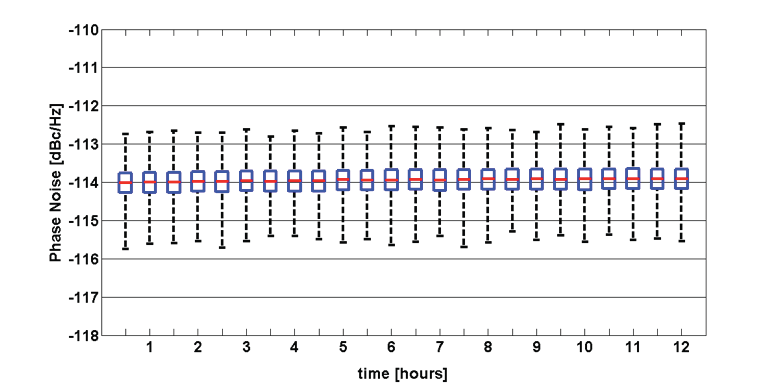
The 7000 SERIES is optimized to run continuously and reliably while delivering consistent and repeatable results for every single measurement. In Figure 3, the measured 100 kHz offset phase noise of a 5.4 GHz DUT over 12 hours is displayed. This corresponds to about 180'000 individual measurements that are grouped into 30 minute windows.
The red line is the median of the group, the blue box depicts all values within the 25th and 75th percentile (IQR) and the black whiskers define the values with the highest deviation. Excellent repeatability and stability over time and temperature variation (approx. 5 degC variation) is observed. In fact no drift or degradation is observed with a 100 % completed measurements.
Automated VCO characterization
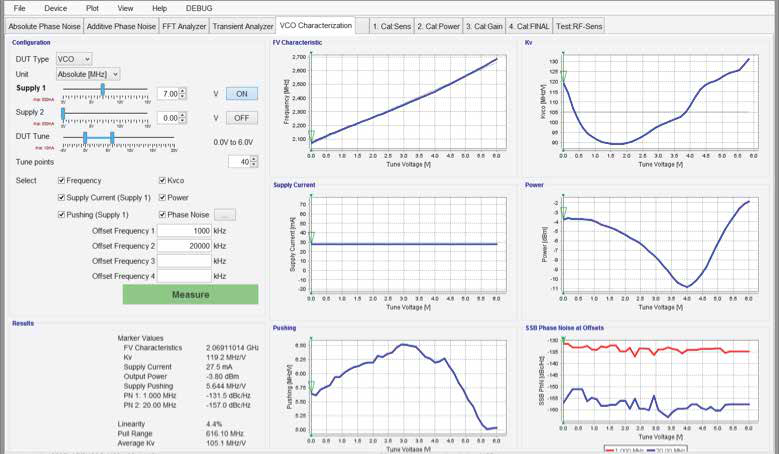
In order to characterize a VCO at least two (low noise) DC sources and one signal analyzer are needed, which can measure frequency, power, and various other parameters as a function of applied control voltage. The 7000 SERIES series with a total of five independently programmable DC voltages to supply and control the device under test can automatically characterize the VCO versus tuning voltage for the following parameters: frequency, tuning sensitivity, output power, current consumption, supply pushing and SSB phase noise at multiple frequency offsets.
The desired VCO parameters are captured in a single sweep. Measurement time per tuning voltage point for frequency, tuning slope, output power, supply current, and supply pushing is 100 milliseconds, and including phase noise at four different offsets in less than 800 ms. Figure 3 shows the full parameter capture of a wideband VCO ranging using the 7000 SERIES graphical user interface.
Conclusion
The Berkeley Nucleonics 7000 SERIES series has been extended with new measurement capabilities that particularly address the automated testing application with high throughput demands. Automated VCO characterizations and phase noise measurements can be triggered and read out remotely through a SCPI protocol interface via USB, GPIB or Ethernet. Phase noise measurements are performed in under 200 milliseconds per DUT with good accuracy and high repeatability.
Developing the product on a fully integrated, low power platform has avoided fan cooling, further eliminating spurious signals and enhancing product reliability. The instrument has multiple built-in accessible control voltages and dual programmable low noise power supplies up to 15 V and >500 mA current each. The ultra low noise internal reference synthesizers prove to be adequate for most applications even when very low close-in phase noise or noise floors are measured. External references can also be applied to maximize the use and flexibility of the instrument.
Phase noise test systems / signal source analyzers
The table below compares the Berkeley Nucleonics 7070/7300 against the Agilent E5052B & E5053A and the Rohde & Schwarz (R&S) FSUP8 / 26 and FSWP7826 with B60 / B4 option.
| Equipment | 7070/7300 | Agilent E5052B & E5053A | R&S FSUP8 / 26 | R&S FSWP7826 w/ B60 / B4 option |
|---|---|---|---|---|
| Frequency range | 5 MHz to 7/26 GHz | 10 MHz to 7/26 GHz | 1 MHz to 8/26 GHz | 1 MHz to 8/26 GHz |
| Offset range | 0.01 Hz to 100 MHz | 1 Hz to 100 MHz | 1 Hz to 30 MHz | 0.01 to 10% RF |
| PhN sensitivity at 1 GHz, 1 average standard / (option LN) / ext refs | ||||
| @ 1 Hz | -52 / -80 / -120 | -60 / - / - | -70 / - / - | -56 / - / - |
| @ 10 Hz | -85 / -100 / -130 | -91 / - / - | -90 / - / - | -88 / - / - |
| @ 1 kHz | -135 / -135 / -165 | -128 / - / - | -127 / - / - | -143 / - / - |
| @ 10 kHz | -145 / -145 / -175 | -137 / - / - | -133 / - / - | -166 / - / - |
| @ 100 kHz | -155 / -155 / -180 | -144 / - / - | -145 / - / - | -173 / - / - |
| @ 1 MHz | -160 / -160 / -180 | -160 / - / - | -162 / - / - | -173 / - / - |
| Measurement speed (ATE, 1 kHz, 1 corr) | 150 ms | >450 ms | ||
| Input power range | -15 to +20 dBm | -15 to +20 dBm | -10 to 30 dBm | |
| Uncertainty: | ||||
| < 100 Hz | <3 dB | <3 dB | <3 dB | <1.5 dB |
| < 100 Hz (verify) | <2 dB | <2 dB | 1 dB typ | <3 dB |
| Internal / external references | Y / Y | Y / N | Y / N | |
| Measurement modes: | ||||
| Absolute phase noise | Y | Y | Y | Y |
| Residual phase & amplitude noise | Y | N | N | Option B64 |
| Pulsed absolute/residual phase noise measurement | Y / Y | N | N | Option K4 |
| Amplitude noise measurement | Q3 / 2016 | Y | N | Y |
| VCO test bench | Y | Y | N | Y |
| Transient measurement | Y | Y | Y | N |
| Interfaces | ||||
| GPIB | Y (optional) | Y | Y | Y |
| USBTMC | Y | Y | Only USB | Y |
| LAN | Y | Y | Y | Y |
| VISA/SCPI | Y | Y | Y | Y |
| Power consumption | 25W | 300W | <500W | 250W |
| Weight | 17.5 lbs | 38.8 lbs | 54 lbs | 48.5 lbs |
| List price | $38,500 / $49,995 | $154,000 | $148,500 | $149,000 |
Talk to an application engineer
Deciding whether the 7000 Series fits your production line or R&D bench is easier with a specialist who knows the trade-offs. Request a quote or demo and we will help you match the analyzer, options, and throughput targets to your device under test. You can also reach us at info@berkeleynucleonics.com or 800-234-7858.
Ask now → Chat with our assistant and get an answer in seconds.