The Mission
Primary screening casts a wide net. A radiation portal monitor at a border crossing, a pager on a patrol officer, or a backpack at a public event will alarm on anything above a threshold. That alarm is a question, not an answer. Secondary screening is where the question gets resolved: an operator with a handheld identifier steps in, takes a spectrum, and determines what set the alarm off and what to do about it.
Most of those alarms are benign. A patient who had a recent nuclear medicine procedure, a shipment of ceramic tile or fertilizer carrying naturally occurring material, a load of granite: all of these trip portals every day. The job of secondary screening is to clear them quickly and correctly, hold the rare genuine threat, and document the decision. When the call is hard, reachback connects the field operator to an expert who reviews the same spectrum remotely. Berkeley Nucleonics builds the instruments and the workflow for both steps.
The Challenge
The core difficulty in adjudication is separating three look-alikes: a real threat, naturally occurring radioactive material, and a medical isotope. A gross-count alarm cannot tell them apart. Only an energy spectrum and an isotope identification can, and the quality of that identification depends on the detector and the algorithm behind it. A weak source, a shielded source, or a mixed field all push an identifier toward an ambiguous result, which is exactly when a confidence-rated answer and a path to expert review matter most.
There is also a documentation and category problem. Identifiers sort results into categories such as special nuclear material, industrial, medical, and NORM, and they assign a confidence level. An operator has to read those categories correctly and know when the instrument's confidence is high enough to act on. When it is not, the workflow has to move the spectrum, the photos, and the location to a reachback analyst without friction. The line below covers the field call and the expert backstop.
Recommended Berkeley Nucleonics Solutions
Secondary screening pairs a handheld identifier in the field with portable spectroscopy for the longer look and a reachback link for the difficult calls.
Handheld identification and adjudication
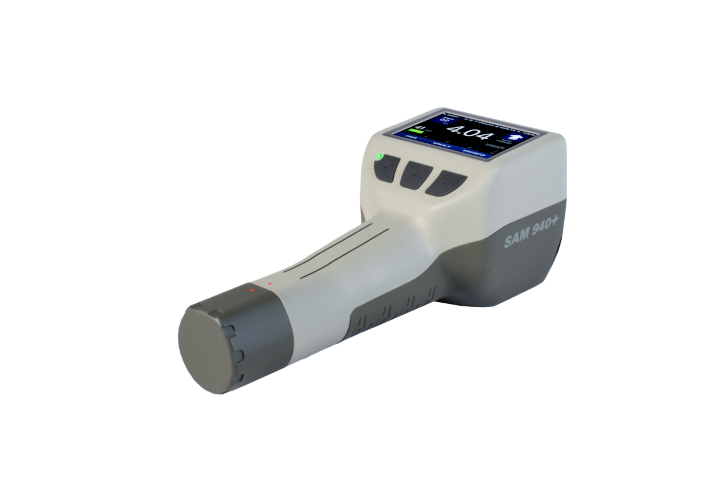
The SAM 940+ is the re-engineered handheld RIID built for fast identification with a reduced operator burden. It is ANSI N42.34 compatible, covers 20 keV to 10 MeV with a 2 x 2 inch NaI(Tl), CeBr3 or LaBr3 gamma detector, sorts results into the SNM, IND, MED and NORM categories, and offers one-click reachback in the ANSI N42.42 data format. An internal CLLBC or CLYC dual-mode crystal, or an external 3He detector, adds the neutron channel that flags plutonium and other neutron emitters.
The SAM 950 is the ruggedized, sealed handheld identifier for harsher conditions: IP65 rated, water and shock resistant, and sprayable for decontamination. It runs a 1.5 x 1.5, 2 x 2 or 3 x 3 inch NaI(Tl) detector, with a 1.5 inch LaBr3 or a 1.5 or 2 inch CeBr3 option where resolution matters, and an optional solid-state or 3He neutron detector. It reports isotope, category and confidence in a typical 2 to 10 seconds, transmits ANSI N42.42-2012 event data by email or WiFi, and is RadResponder enabled. Its touch screen and keypad work one-handed in gloves, and the Android PeakAbout application and a Windows command-center application review the event files.
Portable spectroscopy
When a handheld result is ambiguous and time allows a longer count, the Model 970 portable multichannel analyzer gives the deeper look. It runs up to 4096 channels, works with practically any detector, and its MCA software carries a fully editable 387-isotope library with peak search and identification and quantification by region of interest. Spectra save in a spreadsheet-readable format for an analyst to review. Berkeley Nucleonics previously offered the Model 971 field analysis kit built around the same analyzer; that kit is discontinued. Contact Berkeley Nucleonics for current sample-screening options.
Reachback workflow
Reachback is built into the SAM identifiers. One-click reachback transmits the spectrum, the category and confidence result, appended photos or video, and the GPS location in ANSI N42.42 format, and the SAM 940+, SAM 950 and SAMmobile 150 are RadResponder enabled for the FEMA network. That puts the field operator's exact spectrum in front of a remote analyst, who confirms or overturns the field call before anyone acts on it.
Treat the instrument's category and confidence output as a decision aid, not a verdict. 1. Record the spectrum, the category and the confidence level. 2. Clear an alarm on scene only when the identification is a NORM or medical isotope at high confidence and the reading is consistent with the shipment or the patient history. 3. Send any SNM, IND or low-confidence result to reachback before acting on it, and hold the item or vehicle until the analyst responds. 4. The reachback analyst, or the health physicist your protocol names, adjudicates; the operator documents the decision.
Why It Works
Adjudication is a chain of increasing certainty, and this set is built as that chain. The SAM 940+ and SAM 950 give a category-and-confidence answer in the field within seconds, which clears the routine NORM and medical alarms on the spot. When the field answer is not enough, the Model 970 adds a longer count on a larger detector in a fixed geometry to sharpen the hard cases. Reachback ties the two together, so an analyst sees the same spectrum the operator saw.
The shared ANSI N42.42 data format is what makes the workflow practical. A spectrum captured on a SAM in the field opens on an analyst's screen, archives as an N42 event file, and provides the record an adjudication needs. Threat, NORM or medical: the line separates them by identification and gives a second set of expert eyes when the stakes call for it.
Getting Started
Berkeley Nucleonics can help you stand up a secondary screening and reachback capability, from SAM 940+ or SAM 950 handheld identifiers for field operators to a Model 970 portable analyzer for the longer look and a RadResponder-linked reachback path. Tell us your alarm volume, your operator skill mix, and your reachback partners, and we will match the configuration.
Call 800-234-7858 or email info@berkeleynucleonics.com. To compare identifiers and review the full set of datasheets and guides, visit the Isotope ID & Radiation Detection documentation library.