The Mission
Environmental radiation work covers a wide span of questions, and most of them come down to one thing: how much, and of what. A health physics team runs NORM surveys across a site to find naturally occurring material before it becomes a compliance problem. After an incident, a response unit maps contamination so cleanup crews know where the hot zones are. A regulator characterizes a site or measures effluent to confirm a release stays within limits. A public health lab screens milk, soil, or water for the isotopes that matter after a reactor event.
These jobs ask for two different things from an instrument. In the field, a team needs a fast, simple meter that reports dose and counts and flags contamination on the spot. Back at the bench, an analyst needs spectroscopy: the ability to resolve a peak, name the isotope, and quantify activity in becquerels per kilogram or per liter. A complete environmental program uses both, and Berkeley Nucleonics builds for both ends.
The Challenge
The hard part of environmental monitoring is the low end. Contamination that matters is often only slightly above background, so an instrument that only alarms on strong fields is the wrong tool. Surveying alpha and beta contamination on a surface calls for a thin-window detector. Confirming which isotope is present, and at what activity, calls for an energy spectrum and a calibrated geometry, not a gross count. And sample work, food and water especially, demands a defensible detection limit and a repeatable setup so two runs of the same sample agree.
There is also the matter of moving from a number to a decision. A survey meter tells a crew where to look. A spectrometer tells a lab what they found and how much. The challenge is covering that path end to end, from a rapid field sweep to a quantitative result, with instruments that share a sensible workflow. The line below does exactly that.
Recommended Berkeley Nucleonics Solutions
For environmental monitoring, the right kit pairs a fast field survey meter with a spectroscopy system that can name and quantify what the survey finds.
Field survey and contamination screening
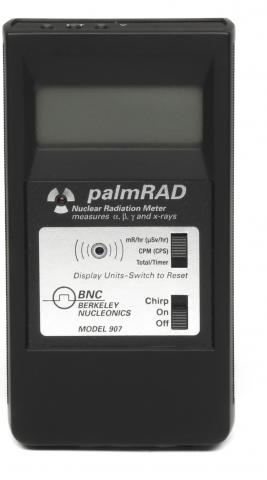
The Model 907 palmRAD is a compact survey meter that detects alpha, beta, gamma and X-ray radiation through a thin (1.5 to 2.0 mg/cm²) mica-window Geiger-Mueller pancake tube with a 1.75 inch effective diameter. It reads in mR/hr, Sv-based units, CPM, CPS and total counts, with an operating range of 0.001 to 100 mR/hr and a sensitivity of 3,500 CPM per mR/hr referenced to Cs-137, which is what NORM and contamination surveying need at the low end. A timed-count mode from one minute to 24 hours supports low-level contamination measurement, and a 9-volt cell runs the meter for at least 200 hours at background, which makes it a dependable field tool for food and water monitoring, soil and water contamination checks and general radiological surveying.
Wide-area survey with isotope ID
When a survey covers ground and needs identification, not just a count, a handheld SAM RIID earns its place. The SAM 940+ identifies isotopes across a 20 keV to 10 MeV range with a NaI(Tl), CeBr3 or LaBr3 detector and sorts results into the SNM, IND, MED and NORM categories, so a surveyor can separate naturally occurring material from anything of concern on the spot. For larger-area characterization, the SAMpack 120 (RD-120) backpack covers ground hands-free, identifies gamma sources across 20 keV to 3 MeV against a 393-isotope library, with an optional neutron detector, and streams GPS-tagged readings to a command center for radiological area mapping.
Spectroscopy and quantitative analysis
For a resolved spectrum and an isotope name in the field, the Model 970 portable multichannel analyzer pairs with NaI(Tl), CsI(Tl), CeBr3 or LaBr3 detectors and runs MCA software with a 387-isotope library, peak search, and quantification by region of interest or peak. It serves air-filter counting, post-remediation sample screening and soil and sediment screening, and it runs four hours on its batteries. Quantification to a regulatory detection limit is laboratory HPGe work; the Model 970 is the screen that decides which samples go there. Berkeley Nucleonics previously offered the Model 971 field analysis kit, built around the same analyzer for food and water screening; that kit is discontinued. Contact Berkeley Nucleonics to discuss current options for food and water screening.
Why It Works
Environmental monitoring lives on the low end of the dose scale, and this set was chosen for that. The Model 907 reaches down to thousandths of a mR/hr and reads alpha and beta through a thin window, so contamination surveys catch what a gross gamma meter would miss. The Model 970 adds the piece a survey meter cannot give: a resolved spectrum, an isotope name and a region-of-interest quantity, which, with a calibrated geometry, becomes an activity estimate.
The workflow holds together because the same Model 970 that screens samples on a bench travels to the field on its own batteries, and the SAM identifiers that map a site export ANSI N42.42 event files for the same review. A team can sweep a site with the 907 and a SAMpack 120, flag a hot spot, pull a sample to the Model 970 for a spectrum and a first quantity, and send to the laboratory what has to go on the record. That path, from fast field screen to laboratory result, is what environmental work needs.
Getting Started
Berkeley Nucleonics can help you assemble an environmental monitoring kit that fits your program, from Model 907 survey meters and SAMpack 120 area survey to a Model 970 spectroscopy bench for sample screening. Tell us your detection limits, sample types, and field conditions, and we will match the configuration.
Call 800-234-7858 or email info@berkeleynucleonics.com. To compare instruments and review the full set of datasheets and guides, visit the Isotope ID & Radiation Detection documentation library.