 Powered by Bioz
1Overview
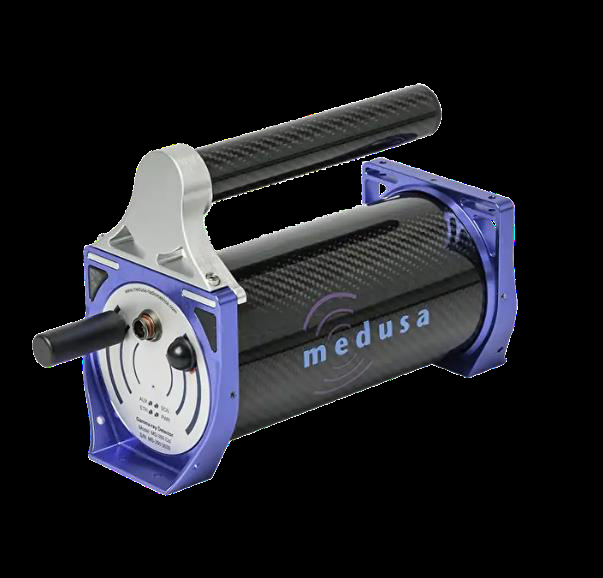
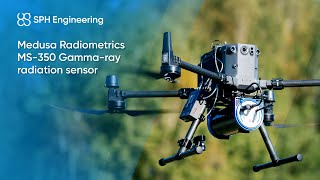
The Medusa MS-Series are passive gamma-ray survey spectrometers built for real-time aerial radiation mapping and survey. They detect natural gamma radiation (potassium-40, uranium-238, thorium-232, and cesium-137) along with total counts. Operation is simple enough for a first-time surveyor, yet the data is rich enough for an experienced one.
Medusa offers a range of easy-to-use survey tools built to make measuring spatial variation in soil a breeze. At the heart of these tools are gamma-ray spectrometers, which passively pick up the natural radioactivity in the top layer of soil. They are designed with simplicity in mind, so it is easy for individuals of all experience levels to get started with minimal effort.
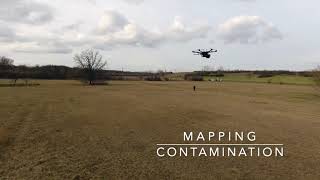
Applications span drone-borne measurements, handheld soil scanning, NORM characterization, and contamination mapping. The series scales from a compact 350 ml crystal up to a 4000 ml configuration, so survey speed and sensitivity can be matched to the platform and the mission.
Features
- Easy to integrate under a drone
- Various scintillator sizes
- Optimized for ease of use
- Integrated data storage and processing
- Life-long feature updates
- Up to 90 km/h mapping speed
Drone or UAV not included. For users prioritizing compact and efficient deployment, the MS-350 sensor is optimized for integration with the DJI M250 RTK drone platform. With flight endurance of up to 30 minutes, this pairing enables comprehensive data collection over extensive areas, ensuring uninterrupted performance for critical survey missions.
2Model Lineup
Five models share the same survey workflow and recording rate. They differ in crystal volume, which sets the trade between mapping speed, sensitivity, and weight. Larger crystals collect more counts per second, so they support higher survey speeds on faster platforms.

| Model | Crystal (CsI) | Mapping speed | Weight | Recording frequency |
|---|---|---|---|---|
| MS-350 | 3×3 in (350 ml) | up to 15 km/h | 2.7 kg / 6.0 lb | up to 5 Hz |
| MS-700 | 3×6 in (700 ml) | up to 20 km/h | 4.7 kg / 10.4 lb | up to 5 Hz |
| MS-1000 | 3×9 in (1000 ml) | up to 30 km/h | 6.7 kg / 14.8 lb | up to 5 Hz |
| MS-2000 | 90×310 mm (2000 ml) | up to 45 km/h | 12 kg / 26.5 lb | up to 5 Hz |
| MS-4000 | 4×4×16 in (4000 ml) | up to 90 km/h | 28 kg / 61.7 lb | up to 5 Hz |
MSB-303 Universal Mounting Plate
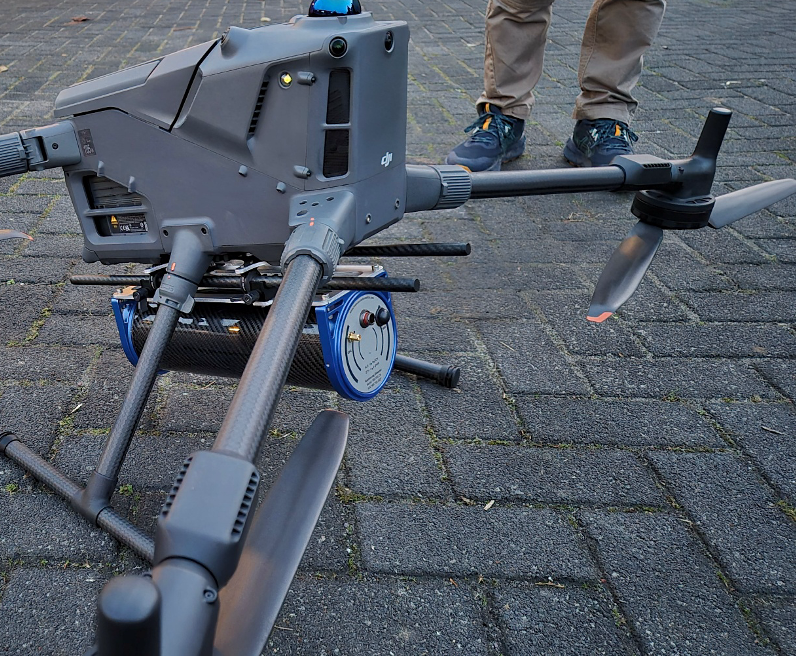
The MSB-303 is a robust two-piece aluminum plate designed to simplify attaching the spectrometer to a drone or survey platform. It replaces the earlier model-specific mounting plates for the MS-350, MS-700, and MS-1000 — one kit now covers all three.
What's included: a generic mounting plate with carbon-fiber rods that attaches to any drone (Part A), and a mounting plate sized to the specific sensor (Part B).
What you need to do: for the DJI M300, M350, and M400, the plate installs directly using the provided screws. For other drone platforms, integration requires mechanical adaptation by your engineering team — typically drilling mounting holes and securing the plate with appropriate fasteners.
Power: on the DJI M300 and M350, the sensor can be powered using the MDC-512 cable; on the DJI M400, the MDC-512b cable. On other platforms, the sensor accepts 5–35 V, and a custom power lead can be configured from an MDC-513 cable to match the drone's power interface.
MSB-303 assembly instructions →
MS-2000
A scanner that is specialized for vehicle-borne mapping, the MS-2000 is an autonomous, low-power, and robust gamma-ray sensor. It is complete with a vibration-dampening mounting system and ultra-rugged housing made of Kevlar-reinforced carbon fiber. Users can mount the MS-2000 on a variety of vehicles such as quad bikes, tractors, cars, and even larger drones.
MS-4000
The MS-4000 is a lightweight airborne gamma-radiation detection system (AGRS) that can be placed within small airplanes or helicopters. It covers a multitude of applications and has been widely used for mineral exploration and remediation surveys by customers involved with geophysical survey companies, geotechnical consultants, and research institutes.
3Specifications
Gamma-Ray Spectrometer
| Parameter | MS-350 | MS-700 | MS-1000 | MS-2000 | MS-4000 |
|---|---|---|---|---|---|
| Scintillation crystal | 3x3'' (350 ml) CsI | 3x6'' (700 ml) CsI | 3x9'' (1000 ml) CsI | 90x310mm (2000 ml) CsI | 4x4x16'' (4000 ml) CsI |
| Typical mapping speed | Up to 15 km/h | Up to 20 km/h | Up to 30 km/h | Up to 45 km/h | Up to 90 km/h |
| Recording frequency | Up to 5 hz | ||||
| Radionuclide analysis | 40K, 238U, 232Th and 137Cs | ||||
Electrical
| Parameter | MS-350 | MS-700 | MS-1000 | MS-2000 | MS-4000 |
|---|---|---|---|---|---|
| Input voltage | 5 – 35 V | 12 - 35 V | |||
| Power consumption | 3 W (average), 6 W (max) | ||||
| Battery | Up to 8 hours | Car Battery | |||
GPS
| Parameter | MS-350 | MS-700 | MS-1000 | MS-2000 | MS-4000 |
|---|---|---|---|---|---|
| Type | uBlox ZED-F9P | ||||
| Accuracy | 1.5 m CEP | ||||
| RTK accuracy | <1 cm | ||||
| Signals | GLONASS, BeiDou, Galileo | ||||
Mechanical
| Parameter | MS-350 | MS-700 | MS-1000 | MS-2000 | MS-4000 |
|---|---|---|---|---|---|
| Dimension | 100 (Ø) x 215 (L) mm | 100 (Ø) x 295 (L) mm | 100 (Ø) x 375 (L) mm | 120 (Ø) x 605 (L) mm | 17(h) x 20(w) 86(l) cm |
| Weight | 2.7 kg / 6.0 lb | 4.7 kg / 10.4 lb | 6.7 kg / 14.8 lb | 12 kg / 26.5 lb | 28 kg / 61.7 lb |
| Operating Temperature | -20 to +65 °C | ||||
| IP rating | IP65 | ||||
Connectivity
| Parameter | MS-350 | MS-700 | MS-1000 | MS-2000 | MS-4000 |
|---|---|---|---|---|---|
| Wi-Fi | 2.4 and 5 GHz | ||||
| Ethernet | 100 Mbps | ||||
| Port | RS-232 | ||||
Data
| Parameter | MS-350 | MS-700 | MS-1000 | MS-2000 | MS-4000 |
|---|---|---|---|---|---|
| Format | JSON, NMEA, CSV | ||||
| Streaming | RS-232, ethernet and Wi-Fi | ||||
| Sensors | Spectrometer, GPS, PTH | ||||
| Internal storage | 16 GB, 500 hours of data | ||||
4Included Software
| Onboard-processing (by mDOS) | Post-processing (by GammAn) |
|---|---|
| Real-time analysis | Full spectrum analysis (FSA) |
| Survey planner | Window analysis (WA) |
| Real-time radionuclide inspection | |
| Sample measurements |
5Applications
- Drone-borne measurements
- Handheld soil scanning
- NORM characterization
- Contamination mapping
- Soil science and precision agriculture
- Geochemical and mineral mapping (prospecting)
- Mineral exploration and remediation surveys
6Support
| Parameter | Specification |
|---|---|
| Online support | Extensive library of support guides |
| Custom support | Optional |
7Mounting Plates & Accessories
The MSB-303 Universal Mounting Plate is Medusa's current mounting solution for the MS-Series and is compatible with the MS-350, MS-700, and MS-1000. It replaces the earlier model-specific plates below, which Medusa has discontinued.
| Component | Weight |
|---|---|
| Part A — carrier/drone plate (aluminum, carbon-fiber rods) | 126 g |
| Part B — sensor plate, for MS-350 | 168 g |
| Part B — sensor plate, for MS-700 | 176 g |
| Part B — sensor plate, for MS-1000 | 202 g |
Reference drone platforms are the DJI Matrice 350 and Matrice 400. Per Medusa, the system is not limited to these — any drone or carrier platform capable of supporting the payload and offering a suitable mounting interface can be used, with possible additional integration work. Materials are aluminum plates, carbon-fiber tubes, and rubber vibration dampers; Part A and Part B connect via a quick-release, twist-and-press coupling secured with stainless-steel fasteners.
Installation involves thread-locking compound on all fasteners, powering down the drone during assembly, and disabling any downward-facing sensor before flight — see the assembly instructions (linked below) for the complete, current procedure.
Replaces (discontinued)
- MS-350 mounting plate (generic)
- MS-350 mounting plate (generic quick-release)
- MS-350 mounting (quick-release, DJI M300/M350)
- MS-700 mounting plate
- MS-700 mounting plate (quick-release)
- MS-700 mounting (quick-release, DJI M400)
- MS-1000 mounting plate
- MS-1000 mounting plate (quick-release)
8Technical Resources
9Videos
Cited in peer-reviewed research
Independent publications citing this instrument, indexed by Bioz. Citation counts and Bioz Stars ratings are shown live and update as new papers are indexed.