11. The Dual-Mode Detection Problem
Radiation portal monitors, handheld radioisotope identifiers (RIIDs), and physics experiments share a common requirement: distinguishing neutrons from gamma rays in real time, with a single compact sensor. The challenge is that most scintillators respond to both radiation types. A NaI(Tl) crystal, for instance, records a gamma photon and a neutron interaction with nearly identical pulse shapes. Separating the two streams requires either a separate 3He or 6Li neutron counter operated alongside the gamma detector, or a dedicated moderator assembly to thermalize fast neutrons before they reach the sensing volume. Both approaches add weight, volume, and complexity.
Elpasolite crystals, specifically CLYC (Cs2LiYCl6:Ce) and CLLBC (Cs2LiLaBr4.8Cl1.2:Ce), solve this at the material level. A single crystal simultaneously captures thermal neutrons and gamma photons, and produces scintillation pulses whose time profiles are distinct enough that digital signal processing can assign each event to one category or the other. The result is a compact, single-readout detector capable of simultaneous gamma spectroscopy and neutron detection, no secondary counter required.
This paper explains the physical mechanism behind that discrimination, defines the figure of merit (FOM) used to quantify its quality, and describes the specific properties of CLYC and CLLBC that make them the preferred choice when dual-mode performance matters.
22. How Pulse-Shape Discrimination Works
2.1 The Scintillation Pulse
When an ionizing particle deposits energy in a scintillator, it excites the crystal lattice and the luminescent centers (Ce3+ in the elpasolites) emit photons over a characteristic time profile. That profile is a sum of components with different decay constants, and the weights depend on how the excitation was produced. In CLYC, a gamma ray creates a fast electron that excites, among other things, core-valence luminescence (CVL): an ultrafast component of about 1 ns in which a valence electron fills a hole in the cesium core band. The alpha and triton from thermal-neutron capture on 6Li are far more densely ionizing, and that dense excitation does not produce CVL, so a neutron pulse is dominated by the slower Ce3+ components at about 50 ns and 1 us. The gamma pulse carries a prompt spike that the neutron pulse lacks, and the fraction of light in the tail is therefore larger for a neutron event than for a gamma event of the same total light.
PSD exploits this difference. Two quantities are measured per pulse: the total integrated charge (Qtotal), which is proportional to the deposited energy, and the charge in a late time window (Qtail), which captures the slow component. The ratio Qtail/Qtotal, sometimes called the tail-fraction or PSD parameter, separates neutron events from gamma events when plotted against Qtotal. The result is a two-dimensional scatter plot with two distinct populations.
2.2 The Figure of Merit
Quantifying how well separated those two populations are requires a single number. The standard definition is:
FOM = S / (FWHMn + FWHMγ)
where S is the separation between the centroids of the neutron and gamma bands in PSD-parameter space, and FWHMn and FWHMγ are the full-widths at half-maximum of each band. For two Gaussian bands of equal width, a FOM of 1.0 places the midpoint between the centroids 2.355 standard deviations from each, so about 1 percent of each population crosses it; a FOM of 1.3 brings that to about 0.1 percent, and above 1.5 the misclassification rate is in the parts-per-thousand range or better, which is the practical target for a fielded instrument. Below a FOM of about 0.8 the bands overlap enough that a cut costs either neutron efficiency or gamma rejection, and gating or moderation has to make up the difference.
Several factors influence the FOM a given crystal achieves in practice. Light yield matters because higher photon output reduces photon-counting statistics, sharpening each band. The ratio of fast-to-slow decay components must differ enough between particle types; if the crystal has only one scintillation pathway, there is nothing to discriminate. Detector noise, photomultiplier transit-time spread, and digitizer sampling rate all broaden the bands and degrade the FOM. Crystal purity and the uniformity of Ce3+ activation also affect how consistently a given particle type produces the same pulse shape.
33. The Elpasolite Advantage
3.1 Crystal Structure and Neutron Sensitivity
CLYC and CLLBC belong to the elpasolite family, characterized by a double-perovskite structure with the general formula A2BB'X6. In both materials, lithium occupies the B' site at high concentration. Lithium-6 has a thermal neutron capture cross section of approximately 940 barns via the reaction:
6Li + n → 4He + 3H (Q = 4.78 MeV)
Both the alpha and triton are densely ionizing. They deposit their combined 4.78 MeV over tracks of a few tens of micrometers, and, as Section 2.1 describes, that dense excitation produces no core-valence luminescence, so a neutron event lacks the prompt component a gamma event carries. The contrast is large enough in CLYC that FOM values well above 1.0 are achievable with standard photomultiplier readout and modest digital filtering.
CLYC achieves this with a composition of Cs2LiYCl6:Ce, where yttrium provides the crystal host lattice and chloride anions enable reasonable transparency at the Ce3+ emission wavelength near 370 nm. The density is 3.31 g/cm3, the refractive index is 1.81, and the decay structure features three distinct components at roughly 1 ns, 50 ns, and 1,000 ns. The light output is about 20,000 photons per MeV, roughly half of NaI(Tl), and the gamma energy resolution is 4.5 to 5.5 percent at 662 keV, which is sufficient for clear PSD at energies above roughly 200 keVee. Hygroscopicity requires hermetic encapsulation, though standard aluminum or stainless housings are well established for this crystal family.
CLLBC extends the elpasolite concept by replacing yttrium with lanthanum and partially substituting bromine for chlorine: Cs2LiLaBr4.8Cl1.2:Ce. The result is a brighter material (photoelectron yield 70 percent of NaI(Tl), about 30,000 photons per MeV) with energy resolution under 3.5 percent at 662 keV. The density rises to 4.08 g/cm3, the emission shifts to about 420 nm, and the decay components lie at 120 and 500 ns, about 150 ns on average, longer than CLYC's fast components. The bromide lattice quenches most of the core-valence luminescence, so discrimination in CLLBC rests on the differing ratio of the Ce3+ components for the two particle types rather than on a prompt spike; the datasheet still rates its neutron/gamma PSD as excellent. The higher light yield sharpens both the PSD bands and the gamma energy resolution, making CLLBC the choice when the instrument must perform isotope identification and neutron detection at good resolution.
3.2 Three Scintillation Channels in One Crystal
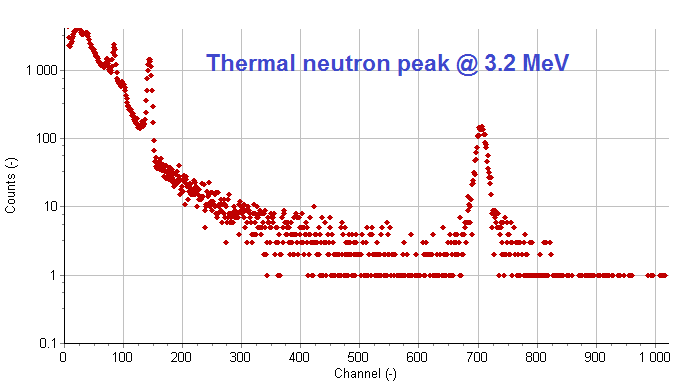
What makes elpasolites unusual is that a single crystal volume supports three distinct detection modes. First, thermal neutrons are captured via the 6Li reaction and produce the high-PSD-parameter events already described. Second, gamma rays scatter and photoabsorb, producing the low-PSD-parameter population. Third, fast neutrons interact through the 35Cl(n,p)35S reaction in CLYC, which gives an energy-dependent fast-neutron response; these events appear at intermediate PSD values and require either moderation or gating to extract cleanly. In most fielded RIID instruments, a thin polyethylene moderator disk (a few centimeters) thermalizes fast neutrons before they reach the crystal, so the detector effectively sees a clean thermal neutron beam and a gamma field simultaneously.
This three-mode sensitivity, governed by a single photomultiplier or SiPM readout, is the fundamental reason elpasolites have displaced 3He tubes in next-generation handheld identifiers. There is no high-pressure gas to handle, no separate preamplifier chain for the neutron counter, and no alignment requirement between two detector heads.
3.3 Comparing CLYC and CLLBC for Practical Use
| Property | CLYC | CLLBC |
|---|---|---|
| Density (g/cm³) | 3.31 | 4.08 |
| Emission peak (nm) | ~370 | ~420 |
| Principal decay components | ~1 ns / ~50 ns / ~1,000 ns | ~120 ns / ~500 ns |
| Light yield | about 20,000 ph/MeV (roughly 50 relative to NaI(Tl)) | about 30,000 ph/MeV (70 percent photoelectron yield) |
| Refractive index | 1.81 | 1.90 |
| Hygroscopic | Yes (hermetic housing required) | Yes (hermetic housing required) |
| PSD capability | Excellent (datasheet); fast-neutron response via Cl-35 | Excellent (datasheet) |
| Gamma energy resolution | 4.5 to 5.5% at 662 keV | Under 3.5% at 662 keV (3.2% typical) |
| Primary driver to choose | Established RIID heritage, fast-neutron response | Higher light output, better resolution |
| Primary applications | RIID, portal monitors, physics | RIID, high-resolution dual-mode |
44. Digital PSD Implementation
4.1 Charge Integration Windows
A PSD-capable digitizer or multichannel analyzer implements PSD in firmware using programmable charge integration windows. When a pulse arrives, the digitizer captures the full waveform at a sampling rate typically between 125 MHz and 500 MHz. A short integration gate (commonly 50 to 80 ns wide) captures the prompt component of the pulse; a longer gate extending 500 ns to several microseconds captures the total charge including the slow tail. The ratio of late-window charge to total charge is computed per event and stored alongside the energy value, forming the two-dimensional scatter histogram shown in Figure 1.
Gate timing is the primary tunable parameter. If the short gate is too narrow it clips the gamma peak and reduces separation. If the long gate extends unnecessarily, dark current noise and pile-up at high count rates degrade both bands. For CLYC, where the slow component extends to 1 microsecond, a 1.2 microsecond total gate with a prompt gate of a few tens of nanoseconds is a reasonable starting point; for CLLBC, whose components average about 150 ns, a total gate near 1 microsecond is the starting point, with the same tradeoff against pile-up. Both materials benefit from validated gate settings at the specific count rate and detector geometry of the application.
4.2 Applying the PSD Cut
Once the scatter plot is populated, a threshold is set in PSD-parameter space (the dashed red line in Figure 1). Events above the cut are classified as neutrons; those below are gamma. The threshold position involves a tradeoff: moving it upward reduces gamma misclassification into the neutron count but lowers neutron detection efficiency. In regulatory contexts such as ANSI N42.34 or IEC 62327, specific sensitivity and selectivity requirements constrain where the cut can be placed. Instrument firmware typically offers a user-adjustable sensitivity setting that moves this threshold, with the default factory setting targeting the standard's minimum neutron sensitivity.
For high-count-rate environments (portal monitors processing tens of thousands of events per second), digital pile-up rejection is essential before the PSD algorithm runs. A pulse that represents two overlapping events will produce a spurious PSD value and appear in a region of the scatter plot between the two bands. Pile-up rejection circuitry, or software that flags pulses with anomalous rise times, keeps these events from polluting the classification.
55. System-Level Design Considerations
5.1 Readout Selection: PMT or SiPM
Both photomultiplier tubes and silicon photomultipliers work with CLYC and CLLBC, but the choice affects PSD performance. PMTs with bialkali photocathodes have good quantum efficiency near the 370 nm emission of CLYC and good single-photon timing resolution. Transit-time spread in the 0.5 to 1.5 ns range is the main PMT contribution to pulse-shape blurring. For CLYC the discriminating feature is the 1 ns core-valence spike, which a PMT with 0.5 to 1.5 ns transit-time spread smears but does not erase; the charge in the prompt gate still differs between the two event classes, and the slower Ce3+ components set the tail.
SiPMs offer compact, rugged geometry, low supply voltage, and immunity to magnetic fields. The primary concern for PSD applications is SiPM dark count rate: at room temperature, dark pulses occur at of order 100 kilocounts per second per square millimeter, device dependent, and they pile onto the slow tail, increasing apparent Qtail for events occurring shortly after a dark pulse. Careful threshold setting and coincidence timing can mitigate this, and at low temperatures dark count rate drops rapidly. CLLBC, with its higher light yield, is more tolerant of SiPM dark noise than CLYC in the same geometry.
5.2 Crystal Volume and Count Rate
Larger crystals improve detection efficiency but increase the probability of multiple simultaneous interactions and make pulse pile-up more frequent at high gamma fluxes. RIID applications typically use 1-inch to 2-inch diameter crystals. Portal monitors may use arrays of 2-inch or 3-inch cylinders. At high count rates in a 2-inch CLYC crystal, pile-up begins to smear the PSD scatter plot and the FOM degrades. Digital pile-up rejection in the MCA or external shaping cuts the effective duty cycle in exchange for cleaner separation at high flux.
5.3 Moderator Geometry for Fast-Neutron Applications
The 6Li(n,t)α reaction has its peak cross section for thermal neutrons. In most real-world neutron threat scenarios (special nuclear materials in shielded configurations, illicit trafficking), neutrons arriving at the detector have energy distributions extending from thermal up to several MeV. A few centimeters of polyethylene in front of the crystal converts a significant fraction of fast neutrons to thermal. The moderator thickness involves a tradeoff: very thick moderators thermalize more fast neutrons but attenuate the gamma flux of interest (high-energy gammas from SNM) and increase size and weight. A common compromise for handheld instruments is 1 to 2 cm of polyethylene.
CLLBC's higher density (4.08 vs. 3.31 g/cm3 for CLYC) also gives it marginally higher gamma stopping power per unit volume, an advantage when the same crystal must deliver good gamma spectroscopy efficiency alongside neutron detection.
66. Performance in Context
6.1 How Elpasolites Compare to Alternative Approaches
Before CLYC became commercially available, the standard dual-mode approach paired a NaI(Tl) or LaBr3(Ce) gamma detector with a separate 3He proportional tube or a 6Li-doped glass scintillator. Helium-3 tubes offer essentially zero gamma sensitivity (with appropriate discrimination electronics) and very high intrinsic neutron detection efficiency, but supply constraints, size, and the complexity of a two-detector module drove the industry to pursue single-crystal alternatives. 6Li-glass, listed in the ScintIQ materials portfolio, is non-hygroscopic and fast (60 to 75 ns decay), but its relative light yield of 4 to 6 limits gamma spectroscopy quality. It is well-suited to purely neutron-counting applications where gamma rejection (rather than coincident gamma spectroscopy) is the goal.
CLYC and CLLBC uniquely occupy the space where good gamma spectroscopy and reliable PSD coexist in a single volume. LaBr3(Ce) offers better intrinsic gamma resolution (3.0% at 662 keV) than either elpasolite, but it has no useful neutron discrimination capability and contains La-138 (a natural radioactive isotope) that adds a background line to its own spectrum. CLLBC substitutes a fraction of the La3+ with Li+ and mixed halide, gaining neutron sensitivity while preserving much (though not all) of the high light yield that makes LaBr3(Ce) attractive for resolution. The resulting gamma resolution of CLLBC is better than CLYC and better than standard NaI(Tl), placing it between NaI(Tl) and LaBr3(Ce) in resolution but ahead of both in dual-mode capability.
6.2 Regulatory and Standards Context
Instruments destined for homeland security, border protection, and nuclear safeguards applications must typically satisfy ANSI N42.34 (handheld RIIDs) or ANSI N42.35 (portal monitors). These standards define minimum neutron sensitivity in counts per second per unit neutron emission rate from a Cf-252 source at a specified distance, alongside alarm false-positive rates at realistic gamma background levels. The minimum neutron sensitivity requirements in N42.34 are achievable with CLYC crystals in the 1-inch to 2-inch range when paired with a polyethylene moderator and a properly set PSD algorithm. CLLBC, with its higher light yield, can meet the same requirements with somewhat tighter FOM margins, providing additional headroom for maintaining performance as the crystal ages or at elevated temperatures. Specific sensitivity numbers depend on detector configuration and must be validated against the published standard for each instrument design.
77. ScintIQ Configuration for PSD Applications
Berkeley Nucleonics offers CLYC and CLLBC as part of the ScintIQ custom detector program, configured with hermetic metal housings, ruggedized potted optical coupling, and matched readout electronics. Standard configurations pair the crystal with a PMT and voltage divider assembly, with SiPM-coupled variants available for applications where magnetic immunity or compact geometry is required. The bMCA-Ethernet multichannel analyzer provides a networked digital MCA with pile-up rejection and programmable shaping for the gamma channel; PSD gating runs in a PSD-capable digitizer or MCA specified with the detector.
Key considerations when configuring a system for PSD work include crystal size (larger volumes improve efficiency but require careful pile-up management), enrichment level of the lithium (96 percent 6Li for CLYC and 95 percent for CLLBC are the datasheet standards), and housing window material (quartz UV windows are preferred over standard borosilicate for optimal transmission at the 370 nm CLYC emission peak). Hermetic epoxy-sealed assemblies are also available for lower-cost, non-field-service applications.
For applications that require both the best achievable gamma resolution and reliable dual-mode discrimination, CLLBC is the recommended starting point. Where the fast-neutron response and the longer track record in fielded RIID instruments matter more than the last point of resolution, CLYC remains the established choice.
Natural lithium contains 7.6 percent Li-6. ScintIQ CLYC is grown with 96 percent Li-6 enrichment and CLLBC with 95 percent, which is what gives both crystals their thermal-neutron efficiency; crystal sizes are specified at order.
88. Summary
Pulse-shape discrimination in CLYC works because gamma-induced electrons excite the crystal's ultrafast core-valence luminescence and the densely ionizing alpha and triton from 6Li capture do not, so a neutron pulse lacks the prompt spike and carries a larger tail fraction; in CLLBC the same ratio method separates the two classes through the differing weights of the Ce3+ components. Integrating the charge in a prompt versus a delayed time window, then taking the ratio, separates the two event classes in a two-dimensional scatter plot. The figure of merit, defined as centroid separation divided by the sum of band widths, reaches values in well-configured elpasolite systems that place misclassification rates well below practical concern.
CLYC provides a proven, cost-effective path to dual-mode detection with established RIID heritage. CLLBC extends that capability with higher light yield and better gamma resolution, making it the preferred material when simultaneous isotope identification and neutron detection at high spectroscopic quality are both required. ScintIQ configurations from Berkeley Nucleonics cover both materials with matched readout electronics, hermetic packaging, and support for integration into ANSI-compliant instrument designs.
Contact the Berkeley Nucleonics Scintillation Team
For detector configurations, enrichment options, PSD firmware support, or custom CLYC/CLLBC assemblies:
Email: info@berkeleynucleonics.com
Phone: 800-234-7858
For a broader treatment of scintillation physics, material selection, and detector design, see the Berkeley Nucleonics educational resource: Nuts & Bolts of Scintillation Detectors (opens in new window).