Why neutrons matter
Field radiation detection rests on gamma rays. They are abundant, they carry isotope-specific energy signatures, and a good identifier reads them well. Gamma rays are also attenuated by dense material, so a weak or heavily packaged source presents a reduced gamma signature. That is the case that concerns interdiction teams, and it is where a second signature helps: plutonium, one of the two classes of special nuclear material (SNM), emits neutrons by spontaneous fission, as do neutron sources such as Cf-252 and AmBe. Highly enriched uranium emits few neutrons, so a neutron channel is a plutonium and neutron-source channel, not a universal SNM detector.
Neutrons behave differently from gamma rays. They carry no charge, so the dense high-Z material that attenuates gamma rays has little effect on fast neutrons, and a neutron count is an independent signature of a neutron emitter. For counter-smuggling, border security and safeguards work, that second signature is why a neutron channel belongs in the instrument. The rest of this note explains how neutrons are detected and which Berkeley Nucleonics platforms offer it.
The detection problem
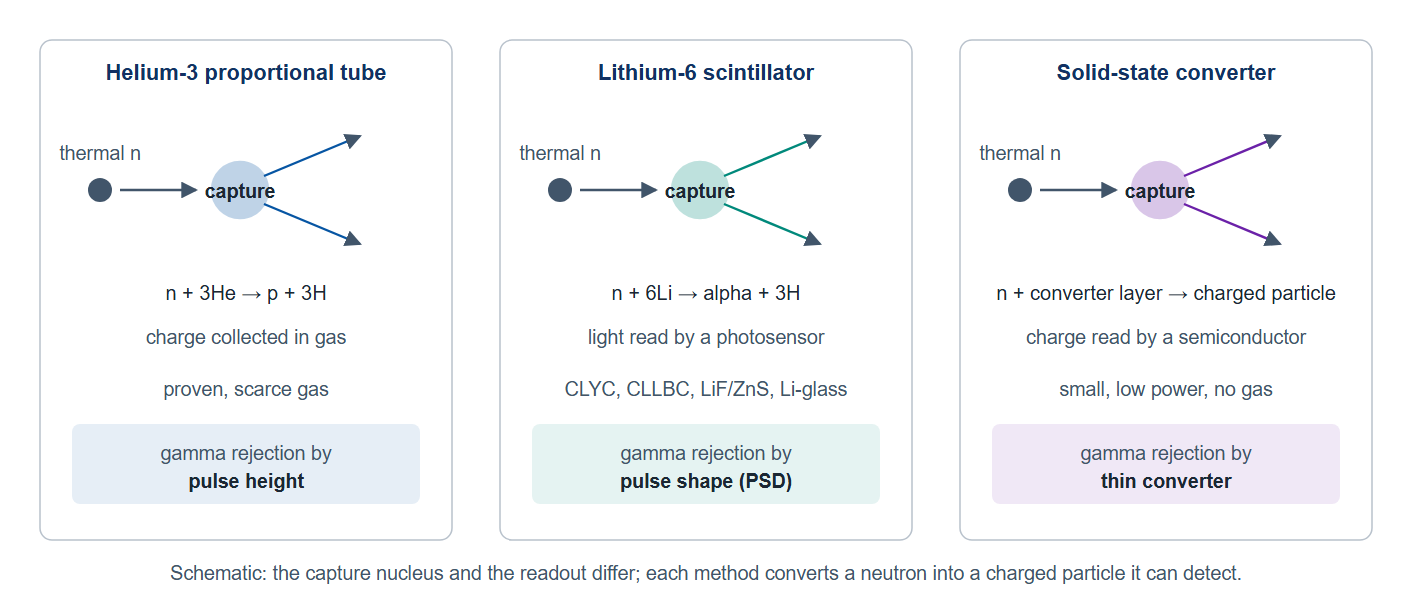
Neutrons cannot be detected directly the way a gamma deposits energy in a crystal. They have to be captured by a nucleus that then emits something charged and detectable, an alpha particle, a triton, or a fission fragment. Fast neutrons from a source are also far easier to capture once slowed down, so most detectors surround the active material with a hydrogen-rich moderator that thermalizes the neutrons first. The detection methods below differ mainly in which capture nucleus they use and how they read out the resulting charged particle.
Helium-3 proportional tubes
The long-standing benchmark is the helium-3 proportional tube. A thermal neutron captured by a He-3 nucleus produces a proton and a triton that ionize the gas, giving a clean, easily counted pulse. He-3 tubes are highly efficient, have excellent intrinsic gamma rejection, and are well understood, which is why they remain a standard option. The catch is supply: helium-3 is a scarce byproduct of tritium decay, and the global shortage has driven up cost and lead time. That constraint is the main reason the field has invested in alternatives.
Lithium-based scintillators: LiF/ZnS and CLYC/CLLBC
Lithium-6 is another strong neutron capture nucleus, releasing an alpha and a triton. A common implementation layers LiF with ZnS(Ag) phosphor, where the captured-neutron reaction produces a light flash read by a photosensor. It is a rugged solid layer with no scarce gas, and it serves well in portable and personal instruments. The PM1703GNA-II MBT uses a LiF/ZnS neutron layer alongside its gamma detector.
The elpasolite crystals CLYC and CLLBC take the idea further. A single crystal detects both neutrons (via lithium capture) and gamma rays, separating the two by the shape of the light pulse, a technique called pulse-shape discrimination. That delivers gamma spectroscopy and neutron sensitivity from one compact detector, with no separate tube, and CLYC also responds to fast neutrons through the 35Cl(n,p) reaction. Berkeley Nucleonics offers CLYC and CLLBC as the internal neutron detector options on the SAM 940+, in 1.5 x 1.5 and 2 x 2 inch sizes.
Solid-state neutron detection
A newer approach uses a solid-state semiconductor device with a neutron-converting layer, capturing neutrons and reading the resulting charged particle electronically. The appeal is a small, low-power package free of pressurized gas. The SAM 950 and the SAMmobile 150 offer a solid-state neutron detector with a 4 square centimeter active area, 20 percent thermal neutron efficiency and a gamma rejection ratio of 1 in 10 million; on the SAMmobile 150 it tiles up to 20 detectors.
Gamma rejection: the figure that makes a neutron count trustworthy
A neutron channel is only useful if it does not also fire on the intense gamma flux that often accompanies a source. Gamma rejection, sometimes stated as a gamma-to-neutron misidentification ratio, measures how well the detector ignores gammas while counting neutrons. A figure such as 1 in 10 million means the detector registers a false neutron count only once for every ten million gammas it sees. High gamma rejection is what keeps a neutron alarm meaningful in a real field environment, where gamma rates can be high and an unshielded source would otherwise swamp a poorly discriminated channel.
Comparing the methods
Each method trades efficiency, gamma rejection, supply security, and package size differently. The table gives the practical picture; the model-specific figures follow in the next section.
| Method | Capture nucleus | Strengths | Considerations |
|---|---|---|---|
| He-3 tube | Helium-3 | High efficiency, excellent gamma rejection, proven | He-3 supply shortage; cost and lead time |
| LiF/ZnS scintillator | Lithium-6 | Rugged solid layer, no scarce gas, fits portable and personal units | Lower efficiency than a tuned tube |
| CLYC / CLLBC | Lithium-6 | Gamma and neutron in one crystal via pulse-shape discrimination; CLYC also responds to fast neutrons | Specialist crystal; hermetic housing required |
| Solid-state | Converter layer | Small, robust, low power, no pressurized gas | Active area sets efficiency; newer technology |
Which BNC models offer neutron detection
Neutron capability spans the line, from a solid-state channel in a handheld to gamma-plus-neutron coverage on backpack and vehicle systems.
| Model | Neutron capability |
|---|---|
| SAM 940+ Handheld RIID | Internal CLLBC or CLYC dual-mode crystal (1.5 x 1.5 or 2 x 2 inch), or an external 3He detector |
| SAM 950 Ruggedized Isotope Identifier | Optional solid-state detector (4 cm², 20 percent thermal efficiency, gamma rejection 1 in 10⁷) or 3He |
| SAMpack 120 Backpack | Optional solid-state or 3He neutron detector (gamma and neutron configurations) |
| SAMmobile 150 Mobile System | Optional solid-state neutron detector, the same specification as the SAM 950, tileable up to 20, or 3He |
| PM1703GNA-II MBT PRD | LiF/ZnS neutron detection alongside CsI(Tl) gamma |
Specifying neutron the right way
If your mission includes interdicting shielded SNM, treat neutron detection as a requirement, not an option, and weigh the supply question. He-3 still sets the performance benchmark, but lithium-based scintillators and solid-state detectors give supply-secure paths that fit smaller, lighter instruments. A dual-mode CLYC or CLLBC crystal can deliver both gamma spectroscopy and a neutron count from one detector when package size is tight.
To match a neutron configuration to your operational picture, talk to a Berkeley Nucleonics specialist at info@berkeleynucleonics.com or 800-234-7858. See also the companion notes NaI vs LaBr3 vs CeBr3 Detectors and How to Choose an Isotope Identifier, and browse the full line in the documentation index.