The Detection Challenge in High-Energy Physics
High-energy physics experiments impose requirements that no single scintillator satisfies perfectly. Electromagnetic calorimeters at large colliders must stop GeV-scale showers in the smallest possible transverse footprint, which means density and radiation length are the primary figures of merit. Time-of-flight and positron annihilation systems instead prioritize decay time, pushing into the single-nanosecond or even sub-nanosecond regime. Radiation hardness compounds both demands: cumulative doses in forward calorimeter sections or in-beam detectors can reach tens of kilogray over a multi-year run.
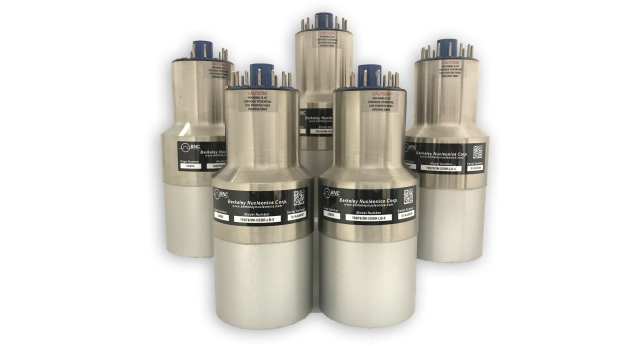
The choice of scintillator therefore depends on the role it plays in the apparatus. A crystal that excels in a sampling calorimeter may be a poor fit for a time-of-flight wall. Getting this right at the start avoids a reconfiguration later. Berkeley Nucleonics works with each research group to identify the correct material, crystal geometry, surface treatment, and readout, then delivers finished detector assemblies ready for integration.
Calorimetry: Density, Radiation Length, and Radiation Hardness
Electromagnetic calorimetry is where PbWO₄ (lead tungstate) has no practical rival on the density axis. At 8.28 g/cm³ and a radiation length of approximately 0.89 cm, a compact crystal tower stops a 50 GeV shower in a crystal that is roughly 23 cm long. The dominant fast decay is about 7 to 10 ns. Light yield is very low, about 0.3 to 0.4 percent of NaI(Tl), and it rises as the crystal is cooled, so calorimeter systems stabilize crystal temperature and use high-gain, low-noise readout. PbWO₄ is non-hygroscopic, which simplifies mechanical integration in large arrays, and its radiation hardness is the reason it was chosen for large collider electromagnetic calorimeters.
LYSO(Ce) offers a different balance: density 7.2 g/cm³, decay time 50 ns, and a relative photoelectron yield of 76 percent of NaI(Tl). That advantage of roughly 200-fold in light output over PbWO₄ (76 against 0.3 to 0.4, so 190 to 250 times) translates directly to better intrinsic energy resolution at moderate energies. LYSO(Ce) is the choice where energy resolution and timing both matter and the dose environment is less severe. It is also used in compact calorimeter and timing-layer R&D where coincidence time resolution is the design driver.
BGO (bismuth germanate) at 7.13 g/cm³ is the historical workhorse. Decay time is 0.3 microseconds, which limits its use in high-rate environments, but its zero afterglow and non-hygroscopic character make it attractive for lower-rate experiments and for anti-Compton shields around germanium spectrometers. Light yield is 15 to 20% relative to NaI(Tl). BGO remains a practical, cost-effective choice where timing is not a constraint.
| Property | PbWO₄ | LYSO(Ce) | BGO |
|---|---|---|---|
| Density (g/cm³) | 8.28 | 7.2 | 7.13 |
| Emission peak (nm) | ~420 | 420 | 480 |
| Decay time | 7–10 ns | 50 ns | 300 ns |
| Rel. light yield (vs NaI=100) | 0.3–0.4 | 76 | 15–20 |
| Refractive index | ~2.2 | 1.82 | 2.15 |
| Hygroscopic | No | No | No |
| Primary strength | Highest density, fast, radiation hard | High density, fast, bright | High density, no afterglow, non-hygroscopic, rugged |
Fast Timing: BaF₂ and YAP(Ce)
Time-of-flight particle identification and positron lifetime spectroscopy push decay time requirements below 5 ns, often well below. Two ScintIQ materials serve these applications.
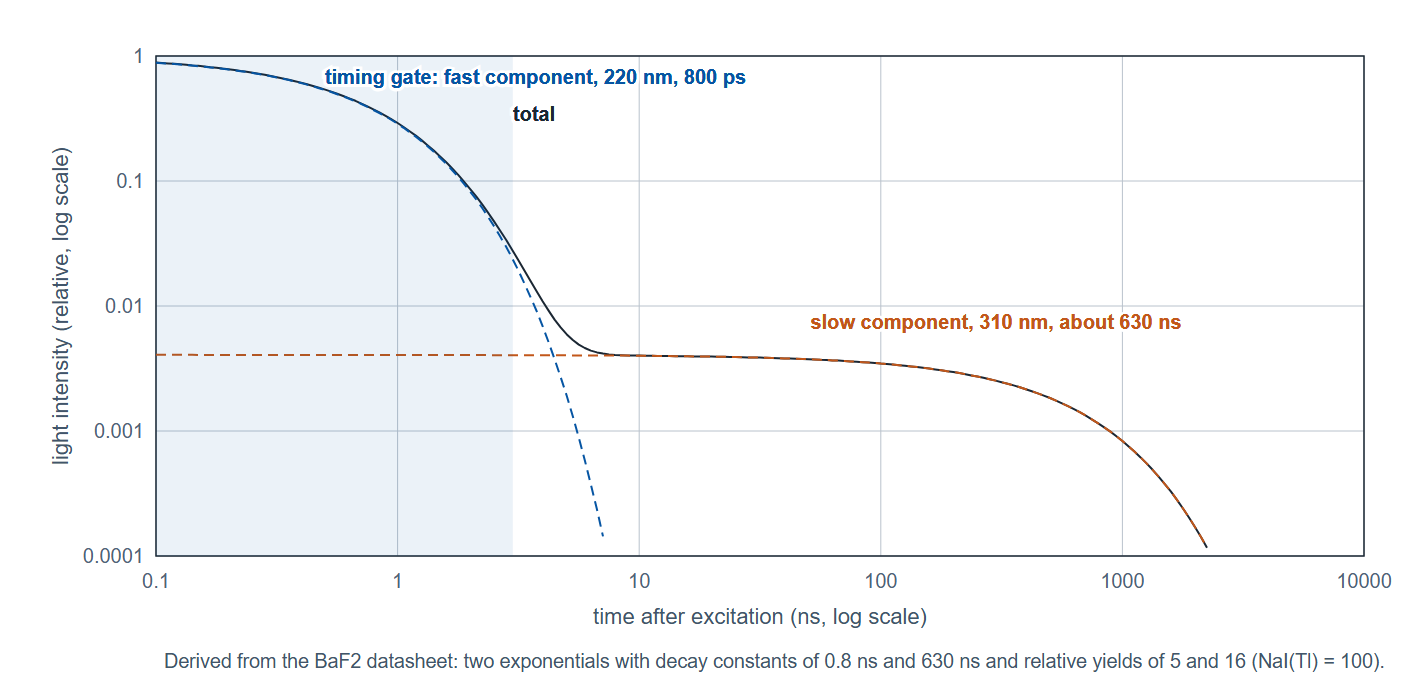
BaF₂ (barium fluoride) has an ultrafast emission component at 220 nm with a decay time of 0.8 ns. No other commercially available inorganic scintillator is faster. A slower component at 310 nm and about 630 ns also exists and must be managed in the readout design (solar-blind photomultipliers suppress it). Density is 4.88 g/cm³, refractive index 1.54 at 220 nm, and the material is non-hygroscopic. Light yield is roughly 5 percent of NaI(Tl) for the fast component and 16 percent for the slow component. BaF₂ is the standard choice for positron lifetime measurements and time-of-flight walls, where a single detector with a quartz-window PMT delivers about 150 ps FWHM timing resolution at 1 MeV.
YAP(Ce) (yttrium aluminum perovskite) combines a 27 ns decay time with a density of 5.55 g/cm³ and a relative light yield of 35 to 40%. Emission is at 350 nm. The material is non-hygroscopic, mechanically robust, and compatible with standard borosilicate PMT windows. YAP(Ce) is useful in fast-coincidence setups where BaF₂ is overkill and in electron microscopy beam diagnostics where a rugged, hard (Mohs 8.5), low-Z crystal with adequate photon yield is needed. It also sees use in positron annihilation lifetime spectrometers as a compact, fast detector element.
| Property | BaF₂ | YAP(Ce) |
|---|---|---|
| Density (g/cm³) | 4.88 | 5.55 |
| Emission peak (nm) | 220 (fast) / 310 (slow) | 350 |
| Decay time | 0.8 ns (fast) / ~630 ns (slow) | 27 ns |
| Rel. light yield (vs NaI=100) | 5 (fast) / 16 (total) | 35–40 |
| Refractive index | 1.54 | 1.94 |
| Hygroscopic | No | No |
| Primary strength | Sub-ns fast component, non-hygroscopic | Fast, robust, low Z |
Configurations and Selection Guidance
Berkeley Nucleonics supplies ScintIQ materials as bare polished crystals, as hermetically sealed assemblies, and as fully integrated detector modules with voltage divider, preamplifier, or SiPM readout board. For large array builds, crystals are sorted and matched to tight geometry tolerances to ensure uniform response across the array.
Readout pairing recommendations
- PbWO₄ and BGO: standard bialkali or green-extended PMT. Avalanche photodiodes are used in high-magnetic-field environments. SiPM is an emerging option for compact modules.
- LYSO(Ce): SiPM readout is well matched to the 420 nm emission and the SiPM's compact form factor suits the tight array pitch typical of modern calorimeters. PMT readout is also standard.
- BaF₂: solar-blind PMT (with a CaF₂ or quartz window) for pure fast-component readout, suppressing the 310 nm slow component. If both components are needed, use a quartz-window bialkali PMT.
- YAP(Ce): a bialkali PMT with a borosilicate or quartz window; the 350 nm emission is below the SiPM efficiency peak near 420 to 450 nm, so SiPM readout costs efficiency.
Radiation hardness notes
PbWO₄ and BGO have established track records in high-radiation environments at major collider facilities. LYSO(Ce) radiation hardness is not published on its datasheet and is characterized for the specific dose rate and particle spectrum of the target application. BaF₂ and YAP(Ce) are used in beam-adjacent roles; radiation tolerance for specific geometries is available on request.
electromagnetic and hadronic calorimeter arrays, time-of-flight walls, positron annihilation lifetime spectrometers, anti-Compton suppression shields, charged-particle hodoscopes, and beam loss monitors.
Work with the ScintIQ Team
High-energy physics detector projects often have long lead times and tight geometry budgets. Early engagement with Berkeley Nucleonics allows the application team to advise on crystal growth schedules, array sorting, surface treatment, and readout integration before the design is locked. Contact us to discuss your requirements, request a quote, or obtain sample crystals for detector R&D.
Email: info@berkeleynucleonics.com
Phone: 800-234-7858
For background on scintillator physics and material selection, see the Nuts & Bolts of Scintillation Detectors technical reference.
ScintIQ crystals are grown and finished with our long-standing scintillation partner in the Netherlands (Scionix Holland). CsI(undoped) is not in the ScintIQ datasheet set; contact Berkeley Nucleonics for availability and lead time.