 Powered by Bioz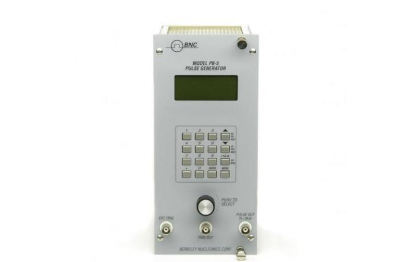
1Description
"This is our best pulser."
The Model PB-5 provides unprecedented performance in a precision pulse generator. It includes a full-featured, highly flexible ramp generator, parameter programmability and flash memory.
As a precision pulse generator, the PB-5 surpasses or equals all existing designs in the important performance areas of resolution, linearity and stability. The pulse repetition rates, which are variable over a broad range, go up to 0.5 MHz. The higher rates are required when testing for MCA and PHA linearity because of the high number of data points required for a statistically valid test.
The built-in ramp generator allows you to control ramp duration, the number of ramps and ramp limits. Now you can test the entire range of your system or just a portion of that range. This ramp generator and precision pulse generator combination allows you to tackle the most demanding applications.
The 4x16 LCD display, keypad, and a spinner knob provide a user interface that is easy to use. The RS232 interface is also standard along with memory that will store and recall nine pulse settings. Parameters can be selected and changed by spinner knob and/or keypad push-buttons.
The PB-5 is the successor to the industry standard PB-4 pulse generator.
2Features & Applications
Features
155 µV resolution · ±10 ppm jitter · 100% programmable
- Excellent linearity, stability and resolution
- Built-in ramp generator
- High rep rates
- Free LabVIEW driver
Applications
- Multi-Channel Analyzer (MCA) testing
- Nuclear circuit testing
- Pulse Height Analyzer calibration
- Pile-up and saturation tests
- Rise-time and bandwidth characterization
- NIM module system integration
- Radiation detector testing
3Specifications
| Rep Rate | 2.0 Hz to 500 kHz |
| Width | 100 ns to 1 ms |
| Delay | 250 ns to 10 ms |
| Rise Time | 50 ns to 10 µs (10% - 90%) in 8 steps |
| Decay Time | 0.5 µs to 1.0 ms (100% - 37%) in 11 steps |
| Pulse Type | Flat-top or Tail pulse
|
| Polarity | Positive/Negative |
| Ext. Trigger | 0 to 500 kHz, +100 mV to +3.5 V, threshold adjustable |
| Modes |
|
| Remote | RS232 at 9600 baud |
| Power Required | +24 V, 170 mA -24 V, 150 mA +12 V, 450 mA -12 V, 5 mA |
| Mechanical | Triple-width AEC NIM module 4.05” wide x 8.70” high in accordance with TID-20893 (Rev 3.) |
| Weight | 2 lbs. 13 oz. net, 6 lbs shipping |
| Portable power supply available | See BNC Model AP-3 Portable NIM Power Supply |
4Amplitude
| Amplitude | 0.0 to 10.0 V (0 to 5 V into 50 ohms) Scalable in energy units (keV) |
| Resolution | 155 µV |
| Jitter | ±10 ppm |
| Attenuation | 1, 2, 5, 10, 20, 50, 100, 200, 500, 1000 |
| Integral non-linearity | ±15 ppm |
| Temperature stability | ±5 ppm per °C from 20 °C to 45 °C |
5User Interface & Remote Operation
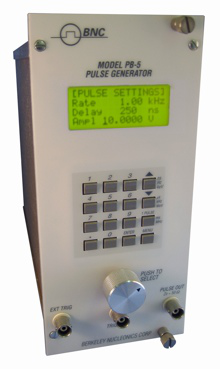
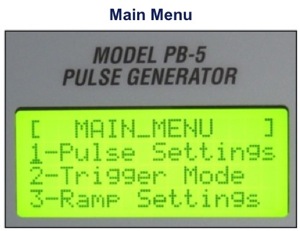
All PB-5 parameters are set from the front panel or over the standard RS-232 remote interface. The 4x16 LCD display presents a menu system for pulse settings, trigger mode and ramp settings; values are entered with the keypad or dialed in with the spinner knob. Nine complete pulse setups can be stored and recalled from memory.
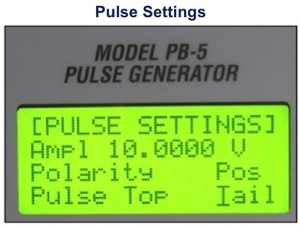
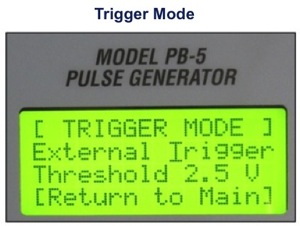
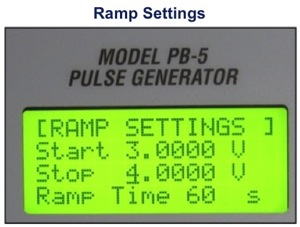
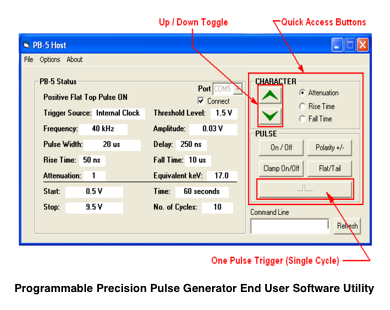
A free LabVIEW driver is available for the PB-5, and the PB-5 Host end-user software utility provides full remote control of pulse parameters, attenuation, ramp cycles and single-cycle triggering from a PC over RS-232 at 9600 baud.
6Compliance

The PB-5 carries the CE mark, as shown on the published datasheet.
Cited in peer-reviewed research
Independent publications citing this instrument, indexed by Bioz. Citation counts and Bioz Stars ratings are shown live and update as new papers are indexed.