Mass Spectrometry
A mass spectrometer is a chain of electric fields, and the rails that make them differ widely in what they draw and what they tolerate. A time-of-flight liner or reflectron at 5 to 10 kV draws almost nothing and tolerates ripple in proportion to the resolving power asked of it. An electron multiplier or conversion dynode at 2 to 10 kV draws microamps and is sensitive to noise on its rail. Lens stacks and the DC offsets of a quadrupole are set in volts, to a fraction of a volt, at no current, and the quadrupole itself runs on RF. The high-voltage work around the instrument is different again: conditioning electrodes, qualifying feedthroughs and insulators, and burning in assemblies on a production line all draw real current and ask for a supply that can source it, survive a flashover and come back up at a controlled rate. Figure 1 draws the ripple floor against the peak widths.
Ripple reaches the spectrum through ion energy. In a linear time-of-flight stage the flight time varies as the inverse square root of the acceleration voltage, and the mass is computed from the square of the flight time, so a fractional ripple on the voltage appears one for one as a fractional spread in the computed mass. That turns the datasheet ripple specification, 0.01 percent of nominal voltage plus 100 mV peak to peak, into a mass budget: on the Berkeley Nucleonics HVX-10000-200 the floor is 1.1 V on 10 kV, or 110 ppm, which is one-sixth of the peak width of an instrument resolving m/Δm = 1,500 (670 ppm) and larger than the peak width at m/Δm = 10,000 (100 ppm). Table 1 gives the same figure for each voltage class. Drift enters the same way: stability of 0.01 percent of nominal over 8 hours and a temperature coefficient of 0.01 percent per kelvin are 100 ppm each on the mass axis.
| Voltage class | Models | Ripple floor, p-p | As a fraction of nominal | Equivalent peak width |
|---|---|---|---|---|
| 1.5 kV | HVX-1500-1400, HVX-1500-2000 and FLO variants | 0.25 V | 167 ppm | m/Δm = 6,000 |
| 5 kV | HVX-5000-400, HVX-5000-600 | 0.6 V | 120 ppm | m/Δm = 8,300 |
| 10 kV | HVX-10000-200, HVX-10000-300 | 1.1 V | 110 ppm | m/Δm = 9,100 |
| 20 kV | HVX-20000-25 | 2.1 V | 105 ppm | m/Δm = 9,500 |
| 30 kV | HVX-30000-17 | 3.1 V | 103 ppm | m/Δm = 9,700 |
The table says where the line is. An HVX-Series supply holds a time-of-flight acceleration or liner rail for an instrument whose resolving power is a few thousand, and it is not the supply for one resolving ten thousand or more, where the ripple floor alone is a full peak width. Lens stacks, quadrupole DC offsets and multiplier bias draw microamps, below the 0.01 percent of nominal at which the current loop engages (20 µA on the HVX-10000-200), and are set in steps the 16-bit resolution of a kilovolt-class supply cannot reach (153 mV on a 10 kV model); they are served by the instrument's own low-current bias modules. Where an analyzer rail needs 10 ppm stability, the sector and high-resolution case, the Berkeley Nucleonics PNChp precision supply is the right tool, with stability of 0.001 percent of nominal over 8 hours and ripple of 0.001 percent of nominal plus 50 mV.
Where the HVX-Series belongs
Time-of-flight acceleration, liner and reflectron rails within the mass budget. For an instrument resolving a few thousand, an HVX-5000-400 or HVX-10000-200 holds the rail at 120 ppm or 110 ppm of ripple with 16-bit setting, 0.05 percent load regulation for a 10 to 90 percent load step and a response of under 1 ms to within 0.1 percent of nominal. Polarity is electrically reversible on these models, so one supply serves positive-ion and negative-ion methods, with one condition: the output discharges in 60 s typical and up to 120 s at no load, so a polarity change is made between methods, not within one.
Electrode conditioning. A new or vented analyzer is brought up in voltage until microdischarges stop, and the supply has to deliver current into each discharge, limit it, and recover. The current limit is set in 16-bit steps from 0.01 percent of nominal, Arc Detection reports each flashover and can switch the output off, and Ramp Control raises the voltage again at a set gradient from 1 V/s upward. The time-tagged event log records every arc, which is the conditioning record.
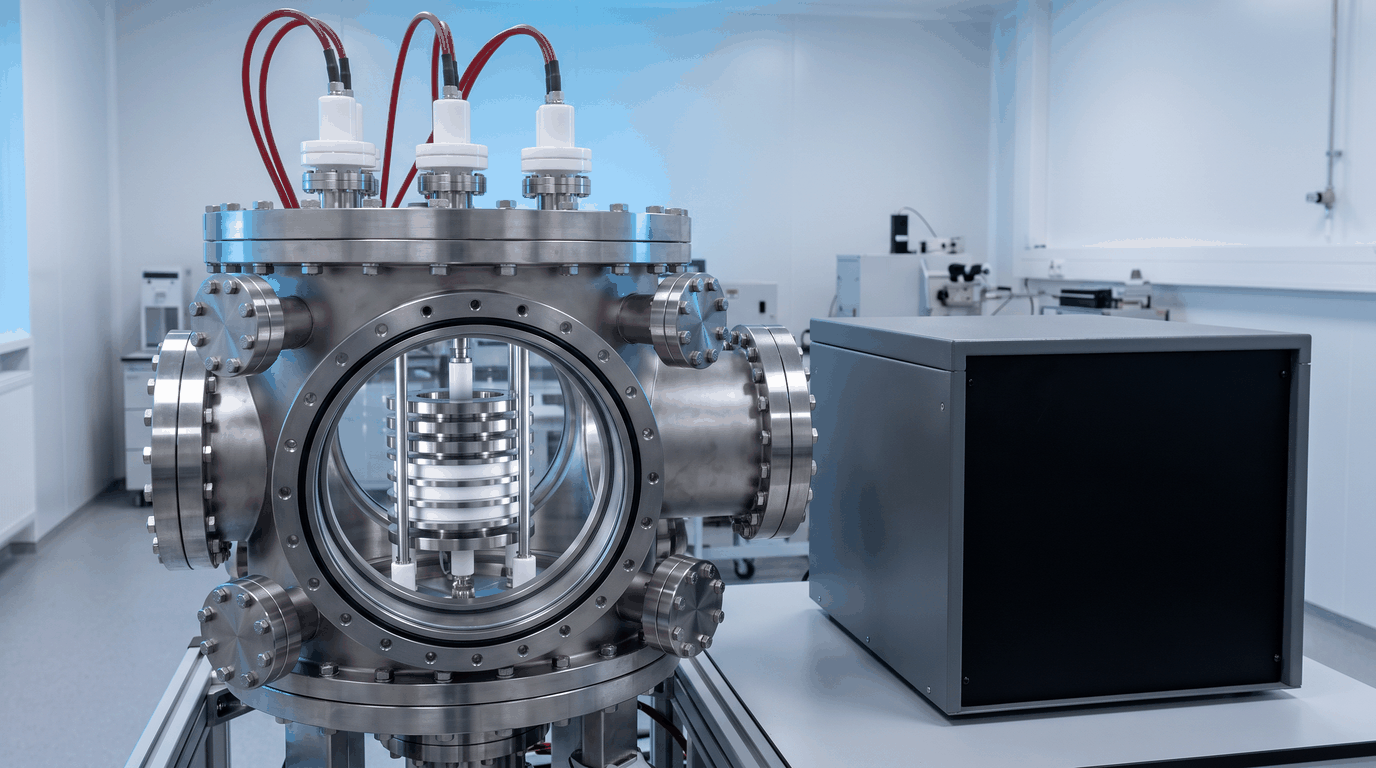
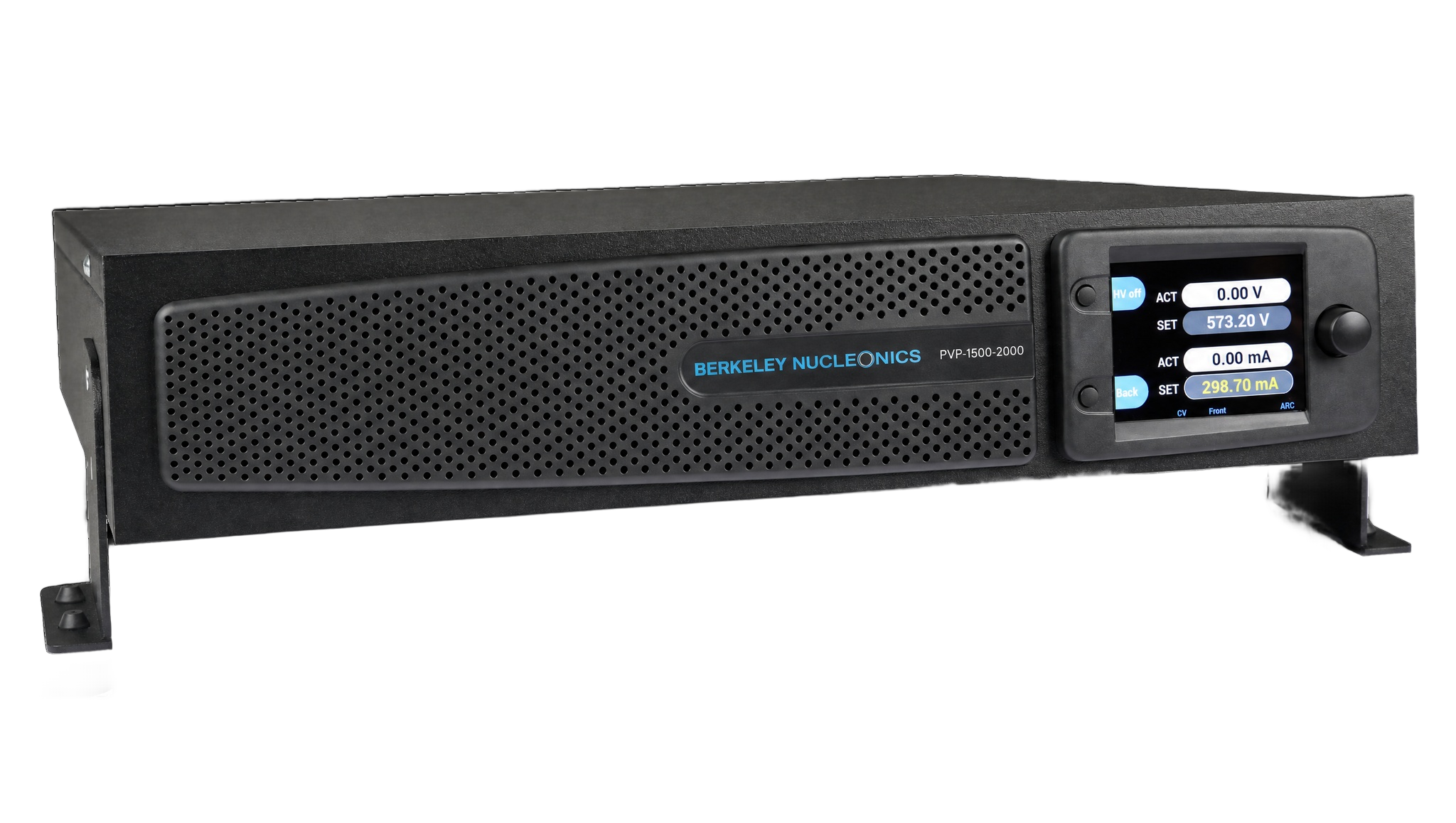
High-voltage qualification and burn-in. Feedthroughs, insulators and source assemblies are held at a test voltage above their working voltage, a 10 kV feedthrough at 20 kV for instance on the HVX-20000-25, with the current limit protecting the item and the actual current shown on the display. On a production line the same supply steps through the test sequence over Ethernet with SCPI, and the 2U enclosure (89 mm high, 534 mm deep overall) racks into the test station.
Rails referenced away from earth. The HVX-1500-1400 FLO and HVX-1500-2000 FLO are floating-output models for a stage that cannot share the instrument's ground reference. The datasheet does not state how far they may be referenced from earth; confirm that figure against the stage's potential before ordering.
Which HVX-Series models and options fit
Table 2 places each need against the model whose ratings and ripple floor fit it, and names the right tool where that is not an HVX-Series supply.
| Need | Recommended | Rating and fit |
|---|---|---|
| Time-of-flight acceleration or liner rail to 10 kV, resolving power a few thousand | HVX-10000-200 | 10 kV, 200 mA, polarity reversible; 110 ppm ripple floor |
| Acceleration or post-acceleration rail to 5 kV, resolving power a few thousand | HVX-5000-400 | 5 kV, 400 mA, polarity reversible; 120 ppm ripple floor |
| Electrode conditioning and high-voltage qualification to 20 or 30 kV | HVX-20000-25 or HVX-30000-17 | 500 W, positive or negative, with Arc Detection and Ramp Control |
| Source and assembly burn-in at 1.5 kV or 5 kV with current | HVX-1500-2000 or HVX-5000-600 | 3 kW class, polarity reversible |
| A rail referenced away from earth | HVX-1500-1400 FLO or HVX-1500-2000 FLO | 1.5 kV floating output; float rating to be confirmed |
| Lens stacks, quadrupole DC offsets, multiplier bias | The instrument's low-current bias modules, not an HVX-Series model | Microamp loads set in sub-volt steps |
| Analyzer rail needing 10 ppm stability | PNChp precision supply, not an HVX-Series model | 0.001 percent of nominal over 8 hours |
Two options matter here. Arc Detection detects a flashover, reports it and can switch the output off. Ramp Control sets the gradient of every rise and fall from 1 V/s to ten times the nominal voltage per second. Both are field-retrofittable. Ethernet and RS232 with SCPI, the external interlock input and the time-tagged event log are standard, and each unit ships with a 3 m high-voltage cable.
Recommended configuration
For a time-of-flight development bench resolving a few thousand, an HVX-10000-200 in the reversible configuration on the acceleration or liner rail, with Ramp Control so the rail rises at a set gradient and Arc Detection so a flashover is logged and the output dropped. For analyzer conditioning and production qualification, an HVX-20000-25 with both options, driven over Ethernet with SCPI so each test voltage, current reading and arc event is logged with the serial number under test. For the ion optics and the detector, keep the instrument's own bias modules, and for an analyzer rail that must hold 10 ppm, specify a PNChp.
Limitations. The ripple floor of 0.25 V to 3.1 V peak to peak by model is fixed by the specification and is filtered at the load where a quieter rail is needed. The smallest current the supply regulates is 0.01 percent of nominal, so a microamp load runs in constant-voltage mode with the current limit as protection only. A polarity reversal waits for the output to discharge, 60 s typical and up to 120 s at no load.
Talk to an application engineer
Berkeley Nucleonics can help you match an HVX-Series model and option set to the rails in your mass spectrometer and the test work around it. Call 800-234-7858 or email info@berkeleynucleonics.com. Specifications: HVX-Series datasheet, PNC and PNChp datasheet.
For a quick question, chat with an engineer at berkeleynucleonics.com.
Ask now → Chat with our assistant and get an answer in seconds.