The Mission
Aerospace and defense programs span an enormous frequency range and a wide spread of form factors. One day the work is broadband microwave test in a lab, the next it is a signal source that has to be embedded inside a subsystem and survive a real platform. The common requirement is wide, reliable coverage paired with the flexibility to move from benchtop instrument to integrated module without changing vendors or signal pedigree.
The Challenge
Programs need coverage that reaches the upper microwave and millimeter-wave bands where modern radar and EW operate, and they need it from sources that are stable and repeatable across temperature and time. They also need an embedded path: a board-level or shielded module that drops into a subsystem with the same signal quality as the bench instrument used to qualify it. Bench and embedded versions with matching datasheets let a program qualify and deploy against one specification.
Recommended Berkeley Nucleonics Solutions
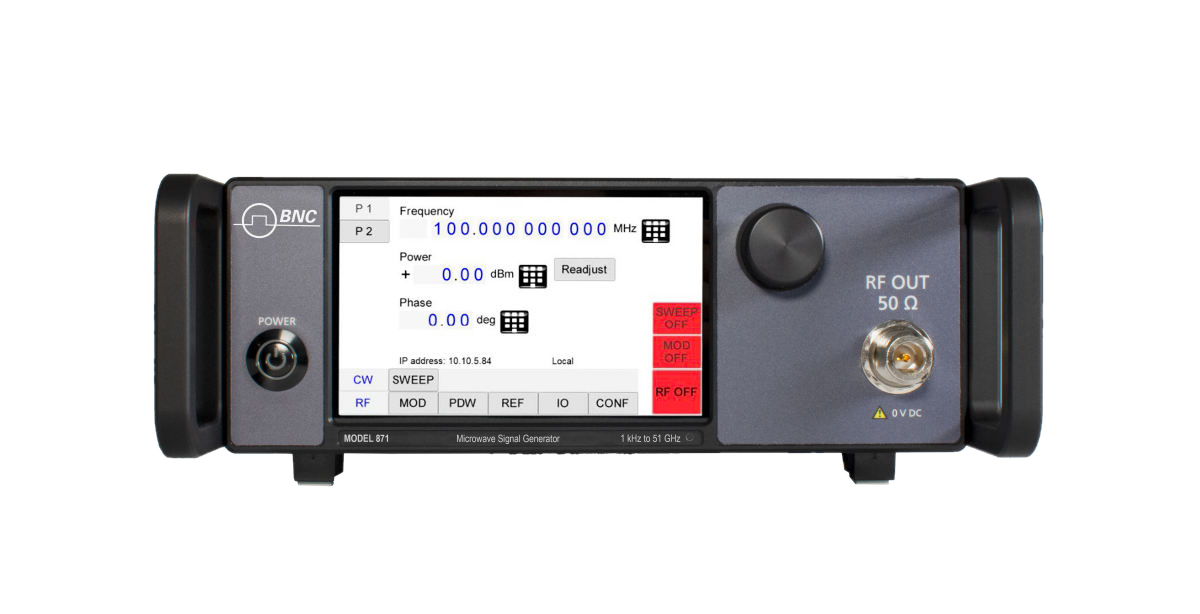
For the widest coverage, the Model 871 reaches 51 GHz phase-coherent and the Model 870A spans 10 MHz to 54 GHz with single or multi-channel configurations, covering radar and EW bands in one instrument. When the source has to live inside a subsystem, the Model 845-OEM is a shielded board-level generator (100 kHz to 26 GHz) with up to +21 dBm of output power with Option HP, for embedded integration.
For compact, portable microwave sourcing, the Model 805-SG packs 10 MHz to 20 GHz (8 kHz with Option 8K) into a module under 2.4 lb with Ethernet, USB and SPI control and a portable battery option, and is a form-factor replacement for the discontinued QuickSyn FSW-0010 and FSW-0020 synthesizers. Figure 1 sets the four against the IEEE radar bands.
Two numbers to check before choosing: level accuracy and the output connector. The 870A holds 0.8 dB (0.3 dB typical) from 300 kHz to 6 GHz between -15 and +15 dBm and 1.3 dB (0.5 dB typical) from 26 to 54 GHz; the 870A-50 outputs on a 1.85 or 2.4 mm connector, the 870A-40 on K and the 870A-12 and 870A-20 on SMA. The 845-OEM holds 1.0 dB (0.3 dB typical) over the same mid-level range and runs from a single 6.25 V supply at 20 W maximum, which is what an embedded installation has to budget for.
Why It Works
The family covers the span aerospace and defense programs care about, from 1 kHz (Model 871 with Option 1K) to 54 GHz, covering the radar, EW and avionics bands. The Model 845-OEM carries the same frequency, level and phase noise specifications as the bench Model 845, so a subsystem qualified against an 845 can ship with an 845-OEM of matching specification. The 805-SG relies on passive cooling through its mounting surface, which suits deployed and space-constrained installations.
Getting Started
Berkeley Nucleonics applications engineers help match the right source, channel count, and options to your test plan. Tell us your frequency span, switching budget, and channel needs, and we will recommend a configuration and arrange a demo.
Contact info@berkeleynucleonics.com or call 800-234-7858. Browse the full family on the RF & Microwave Signal Generators documentation page.