The crystal is the heart of the instrument
Every gamma identifier works the same way at its core. A scintillator crystal absorbs an incoming gamma photon and converts that energy into a tiny flash of light, which a photosensor turns into an electrical pulse. The size of that pulse is proportional to the photon's energy, so a histogram of pulse heights becomes an energy spectrum. The peaks in that spectrum are the fingerprints that identify an isotope.
How sharp those peaks come out depends almost entirely on the crystal material. That sharpness, measured as energy resolution, is what separates a confident identification from an ambiguous one. The rest of this note compares the four families of scintillators used across the Berkeley Nucleonics line, then maps each to the models that offer it.
Reading the resolution number
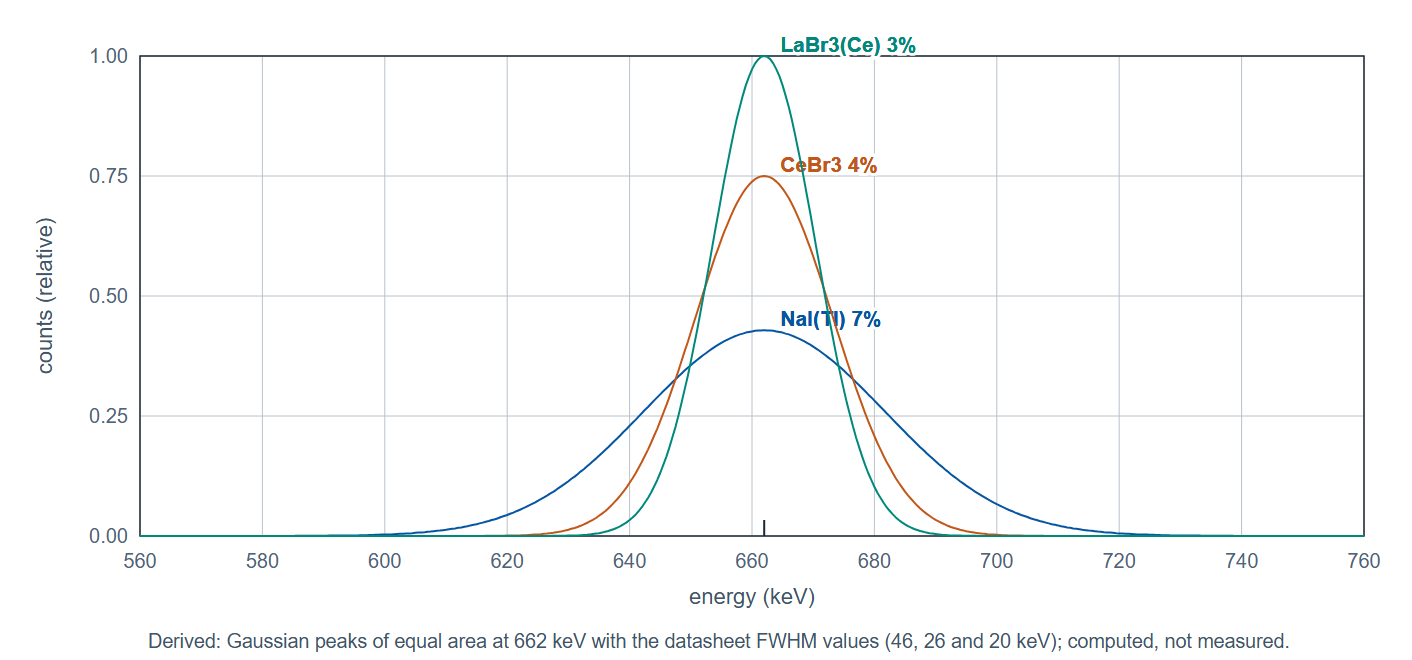
Energy resolution is quoted as full width at half maximum, or FWHM, at the 662 keV line of cesium-137. It is the width of that peak, expressed as a percentage of its center energy. A 7 percent figure means the peak spans about 46 keV; a 3 percent figure narrows that to roughly 20 keV. Lower is better, because narrow peaks separate cleanly even when two isotopes emit lines close together.
Resolution is not the only thing that matters. Light output sets how efficiently the crystal converts energy and affects low-energy performance. Internal background, the crystal's own faint radioactivity, can mask weak sources during long counts. Ruggedness, hygroscopicity, housing and cost all weigh on a field decision. The strongest detector on paper is not always the right one for a given mission.
NaI(Tl): the proven workhorse
Sodium iodide doped with thallium has been the standard gamma scintillator for decades, and for good reason. It offers high light output, mature manufacturing, large available crystal volumes, and a cost well below the high-resolution alternatives. Typical resolution is near 7 percent FWHM at 662 keV. That is coarse compared to the bromides, but more than adequate for the large majority of identification tasks, from NORM screening to industrial source recovery.
NaI(Tl) is hygroscopic, so it must be sealed, and large crystals add weight. Those are engineering details the instrument handles, not reasons to avoid it. When budget, sensitivity per dollar, and a broad detector-size range matter more than separating tightly spaced lines, NaI is the default and often the best choice.
LaBr3 and CeBr3: high resolution when peaks crowd together
LaBr3, lanthanum bromide, delivers excellent resolution near 3 percent FWHM at 662 keV with a fast decay time that supports high count rates. The tradeoff is a higher cost and a small internal background, because natural lanthanum and a trace actinium contaminant emit their own low-level radiation. For most field work that background is negligible, but it can matter during very long, low-activity counts.
CeBr3, cerium bromide, reaches 4 percent FWHM at 662 keV and 3 percent at 1332 keV, with no La-138 and only a small Ac-227 background: 0.002 counts per second per cubic centimeter inside a 100 mm lead shield, against about 2.5 for an unshielded 51 x 51 mm LaBr3 crystal. That makes it the choice when weak-source sensitivity over a long count is the priority. Both bromides serve special nuclear material work and any scenario where a threat line lies close to a benign one. The decision between them comes down to whether internal background or the last fraction of a percent of resolution drives the application.
CLYC and CLLBC: one crystal, gamma and neutron
The elpasolite scintillators CLYC and CLLBC bring a different advantage. They detect both gamma rays and neutrons in a single crystal, using pulse-shape discrimination to tell the two apart. That removes the need for a separate neutron tube and shrinks the detector package. On the SAM 940+, these crystals also push gamma resolution well below NaI: BNC cites typical resolution at 662 keV of CLYC under 5 percent and CLLBC under 3.5 percent, with NaI under 7 percent on the same platform. For missions that need neutron sensitivity without a bulky helium-3 tube, a dual-mode crystal is a compelling option. The companion note Neutron Detection Explained covers how that neutron channel works.
Side by side
The table summarizes the practical tradeoffs. The resolution figures are typical material values; the figure for a given instrument depends on crystal size and readout and is stated on that instrument's datasheet (the SAM 940+ specifies NaI(Tl) under 7, CeBr3 under 5, LaBr3 under 4, CLLBC under 3.5 and CLYC under 5 percent at 662 keV).
| Crystal | Typical FWHM @ 662 keV | Relative cost | Neutron | Notes |
|---|---|---|---|---|
| NaI(Tl) | ~7% | Low | No | Workhorse; high light output; broad size range; hygroscopic. |
| LaBr3 | ~3% | High | No | Highest resolution; fast; small internal background. |
| CeBr3 | ~4% | High | No | High resolution; no La-138, small Ac-227 background. |
| CLYC / CLLBC | CLYC <5% / CLLBC <3.5% (SAM 940+) | High | Yes (dual mode) | Gamma and neutron in one crystal via pulse-shape discrimination. |
Which BNC models offer which crystal
Detector choice is a configuration option on most handhelds in the line, so the right answer is usually a base platform plus the crystal that fits the mission.
| Model | Detector options |
|---|---|
| SAM 950 Ruggedized Isotope Identifier | NaI(Tl) 1.5 x 1.5, 2 x 2 and 3 x 3 inch; LaBr3 1.5 x 1.5 inch; CeBr3 1.5 x 1.5 and 2 x 2 inch |
| SAM 940+ Handheld RIID | Gamma: NaI(Tl), CeBr3 or LaBr3 (2 x 2 inch; 2 x 1 inch CeBr3 or LaBr3). Neutron: CLLBC or CLYC (1.5 x 1.5 or 2 x 2 inch) |
| Model 970 Portable MCA | Practically any radiation detector (two inputs, 0 to 2000 V bias) |
The SAM 950 offers the largest NaI(Tl) crystal in a handheld, 3 x 3 inch, with LaBr3 and CeBr3 options. The SAM 940+ is the choice when a single crystal should cover both gamma and neutron.
Choosing well
Start from the question the instrument has to answer. If the job is broad screening and source recovery on a budget, NaI(Tl) is the default. If the mission turns on separating a threat line from a benign neighbor, or on confident SNM identification, a high-resolution bromide earns its cost. If neutron sensitivity matters and package size is tight, a dual-mode CLYC or CLLBC crystal does two jobs at once.
To pick the right detector for your configuration, talk to a Berkeley Nucleonics specialist at info@berkeleynucleonics.com or 800-234-7858. For the broader selection framework, see How to Choose an Isotope Identifier, and browse every model in the documentation index.