The Mission
A truck rolls over. A warehouse catches fire. A patient walks into an emergency room with a placard the crew cannot read. The first crew on scene does not yet know whether radiation is part of the problem. Their mission is to find out fast, protect themselves and the public, and identify any source well enough to call in the right help. They do this while managing everything else a chaotic scene throws at them.
Berkeley Nucleonics builds radiation instruments for that moment. Survey meters, handheld identifiers, and personal detectors give fire, EMS, and HazMat teams two answers at once: how much radiation is here, and what is producing it.
The Challenge
First-response radiation work has constraints a lab never sees. The responder is often in turnout gear or a HazMat suit, working with gloved hands, limited dexterity, and no time to read a manual. The instrument has to be simple. One button, a clear reading, an unambiguous alarm. Menu navigation under stress costs time the crew does not have.
The crew needs two distinct kinds of information. Dose rate tells them where the hot zones are and how long they can safely stay, which is the heart of keeping exposure As Low As Reasonably Achievable (ALARA). Isotope identification tells them what they are dealing with, which drives the response. A medical isotope from a dislodged source is a very different incident from an industrial radiography source or potential SNM. Sorting that out on scene, and recognizing harmless NORM, prevents both overreaction and dangerous complacency.
There is also the human factor. A first-arriving crew works without a health physicist on scene. The instruments have to present results in terms a crew can act on, mapped to the ANSI threat categories so the readout points toward a response rather than leaving the operator to interpret a spectrum.
Recommended Berkeley Nucleonics Solutions
A first-response radiation kit covers dose-rate survey, isotope identification, and personal protection.
Survey and dose-rate awareness
The Model 907 survey meter is the instrument for mapping a scene. Built around a Geiger-Müller tube, it detects alpha, beta, gamma, and X-ray radiation in a pocket-sized package, so a crew can sweep for hot spots and establish dose-rate boundaries quickly. It is the tool that defines the perimeter and keeps the team inside ALARA limits.
Isotope identification
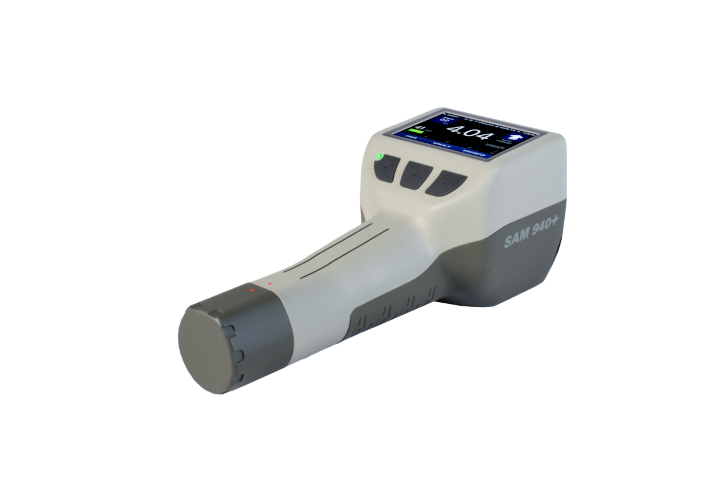
The SAM 950 brings handheld radioisotope identification to the scene with a touch-screen interface that keeps operation simple under pressure, one-hand gloved operation, and a sealed IP65 housing that can be sprayed for decontamination. It detects gamma radiation, with optional neutron detection, and reports an isotope, a category and a confidence level in a typical 2 to 10 seconds, so a crew gets a named isotope and a threat category rather than a raw count. Where a team wants the widest energy range in the lightest package, the SAM 940+ identifies across 20 keV to 10 MeV with a NaI(Tl), CeBr3 or LaBr3 detector, weighs 1.2 kg, and takes an external GM pancake probe for alpha and beta surveys.
Personal radiation detectors
Every responder entering a potential radiation environment should wear a personal detector. The Model 951 nukeALERT is a pager-sized gamma detector that alarms within a second of a responder entering an elevated gamma field, providing a personal safety backstop independent of the survey meter. For crews that need neutron sensitivity and dosimetry on the person, the PM1703GNA-II MBT adds gamma plus neutron detection and dose tracking in a wearable device.
Why It Works
The kit works because it separates two jobs that a single instrument tends to blur. The Model 907 answers how much, fast, with the simplest possible operation, and that survey is what keeps the crew safe and ALARA-compliant. The SAM identifier answers what, mapping the source to an ANSI category so the readout points toward a response instead of demanding interpretation. A responder gets actionable information without needing to be a spectroscopist.
Simplicity is the design principle that ties it together. One-button operation, clear alarms, and category-based results mean the instruments work in turnout gear, under time pressure, with hands that are busy doing other things. The personal detectors run continuously in the background, so the safety alarm never depends on someone remembering to take a reading.
For the cases that exceed a field crew's training, the SAM instruments capture the full spectrum so it can be forwarded to a reachback analyst for confirmation. The crew acts on the dose rate it can see and defers the adjudication of any SNM or threat category to the reachback analyst, with the incident commander holding the scene until the answer comes back.
1. Survey from the approach and set the hot-zone boundary with the Model 907 at the dose-rate limit your protocol names. 2. Identify from that boundary with the SAM identifier, not from the source. 3. Treat a NORM or medical category at high confidence as cleared for the purposes of the initial response, and log it. 4. Forward any SNM, IND, neutron or low-confidence result to reachback before anyone acts on it. The incident commander, advised by the reachback analyst or a health physicist, decides the protective actions.
Getting Started
Berkeley Nucleonics can help your department assemble a radiation kit matched to your response profile, from survey meters and personal detectors to handheld identifiers. Call 800-234-7858 or email info@berkeleynucleonics.com.
To compare models and detector options, see the Isotope ID & Radiation Detection documentation and selection guide.