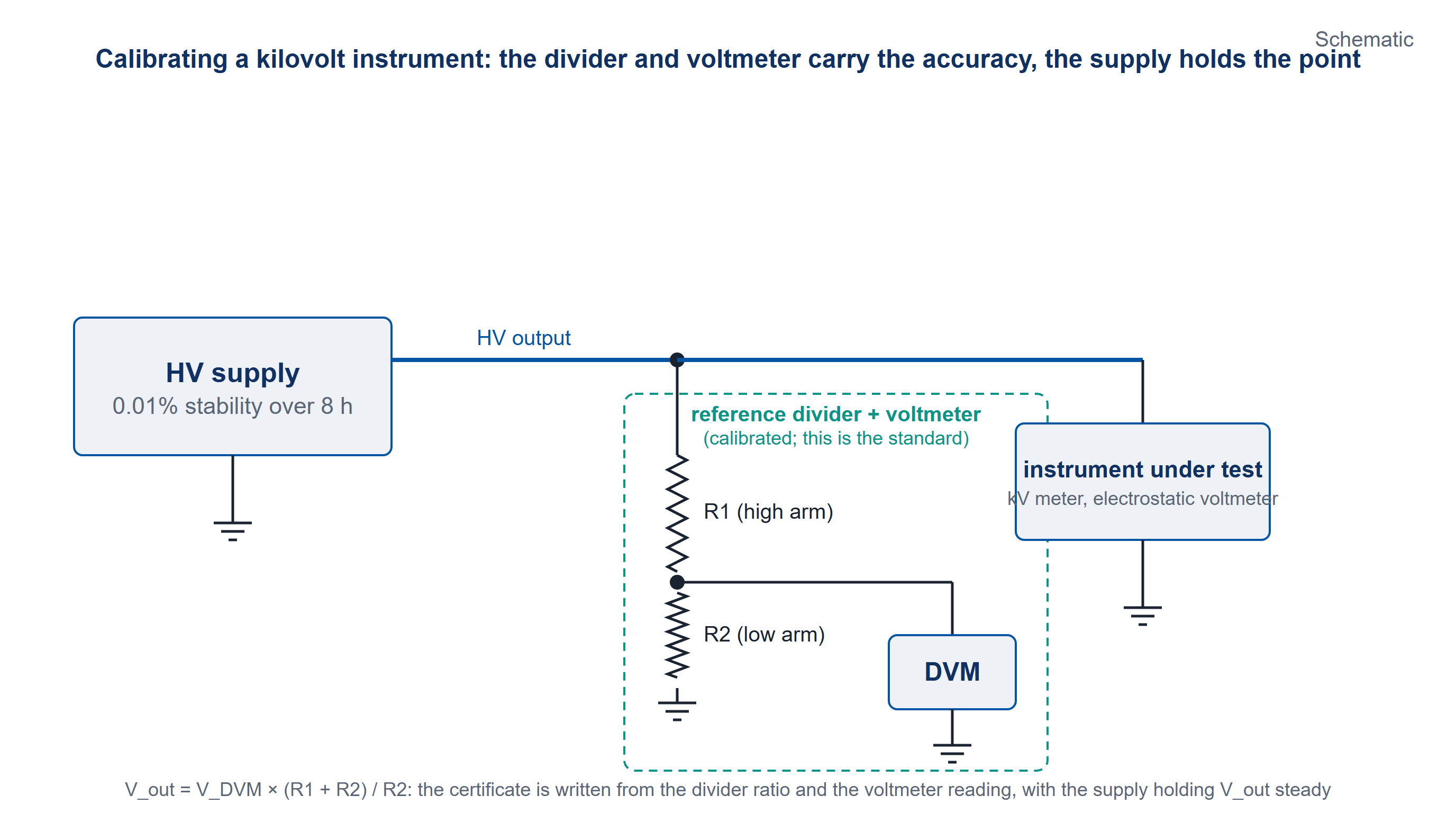
Schematic: a kilovolt calibration. The supply holds the set point on the HV rail; a calibrated reference divider read by a voltmeter gives the reference value, and the instrument under test is connected across the same rail.
Calibration & Metrology HV Source
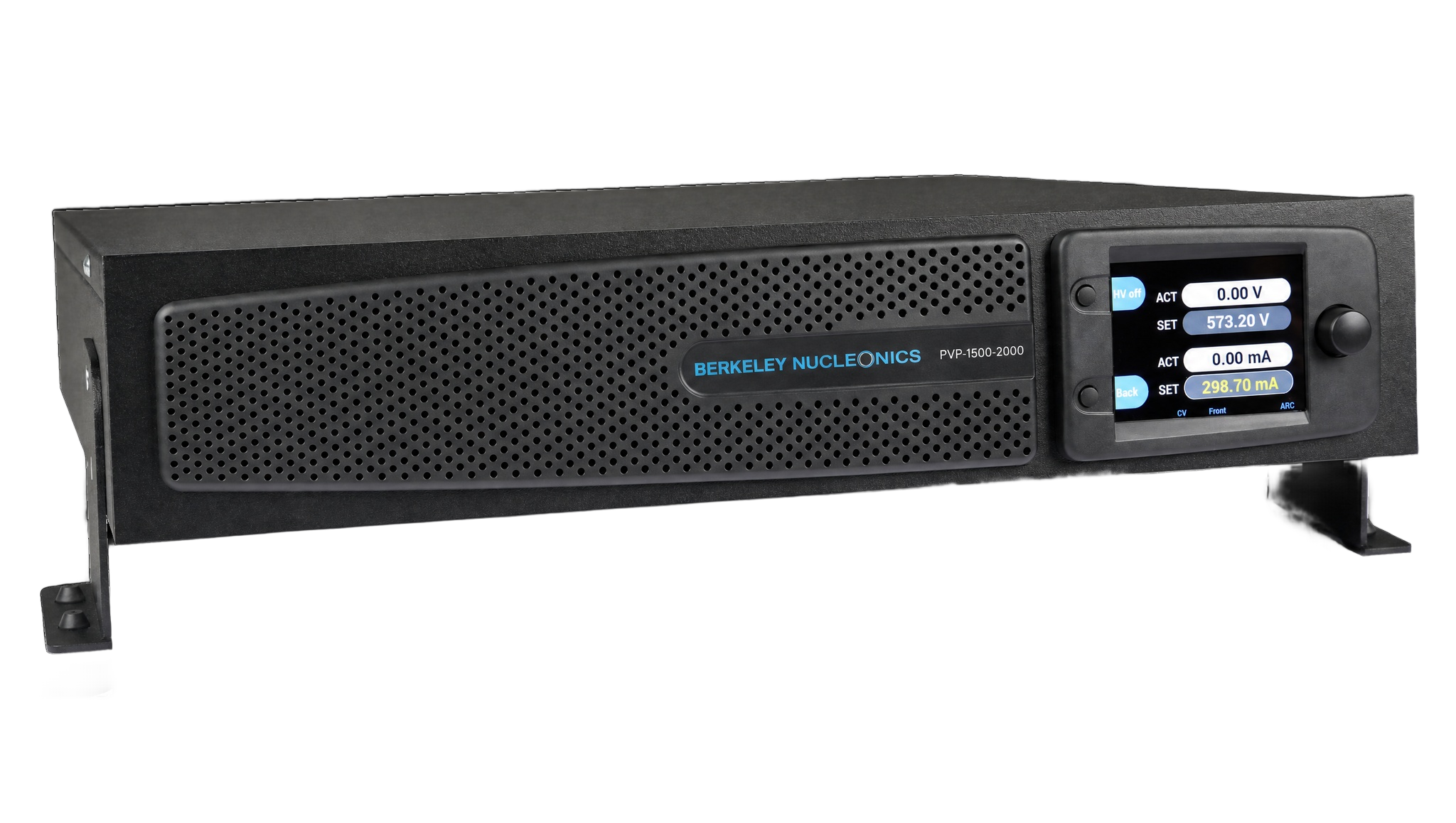
A high-voltage calibration compares the instrument under test against a reference. In kilovolt work the reference is a characterized divider read by a precision voltmeter, and the supply's job is to hold a steady voltage across both while the comparison is made. A reading taken while the voltage is moving is a reading of the drift, so the source has to hold its value for as long as the comparison takes and return to it when the point is repeated.
Three properties decide whether a high-voltage supply suits a calibration bench. The first is setting resolution: a source that can only be set in coarse steps cannot place a calibration point where the procedure calls for it. The second is short-term stability: over the hours a run takes, the output must hold its value. The third is temperature coefficient: a laboratory is climate controlled, but small shifts still happen, and a source whose output follows the room temperature needs re-checking at every point. The absolute accuracy of the calibration comes from the reference divider and the voltmeter reading it, with their calibration certificates, not from the source.
The fourth requirement is low ripple. A divider and voltmeter average ripple to some degree, but an electrostatic voltmeter or a peak-reading instrument does not, and a source with volts of ripple on a kilovolt output adds an error of its own to the comparison. A low-ripple output lets the lab see the instrument under test rather than the source.
How the BNC HVX-Series line solves it
The Berkeley Nucleonics HVX-Series is a fully digitally regulated DC high-voltage supply built around a microcontroller and FPGA control core. That digital regulation is what holds the output steady over a calibration run. The output is set with 16-bit resolution across 0.01 to 100 percent of nominal voltage, so a technician can place the output where a calibration point requires; on a 10 kV unit one 16-bit step is about 0.15 V.
Short-term stability is specified at 0.01 percent of nominal voltage or better over eight hours, which covers a full calibration shift without re-setting the point. Line regulation holds tighter than 0.01 percent of nominal with the mains swinging plus or minus 10 percent, and the temperature coefficient is 0.01 percent of nominal per kelvin or better, so the small movements of a controlled lab do not show up at the output. Reproducibility, the agreement between one setting of a point and the next, is 0.1 percent of nominal, which is why the certificate is written from the divider and voltmeter rather than from the supply's set value. Ripple is held to 0.01 percent of nominal plus 100 mV peak to peak, which is 1.1 V on a 10 kV unit, about one part in ten thousand of the output.
Operation matches the way a metrology bench runs. A 3.5-inch color display with a structured menu handles manual setpoints, while on-board Ethernet and RS232 with a SCPI command set let the supply drop into an automated calibration sequence. The error and event log time-tags every action, which supports the traceability and record-keeping a calibration lab has to maintain. Configurable code protection guards a validated setup from accidental change.
Which HVX-Series models and options fit
For calibration work the choice of model follows the voltage range the lab needs to cover. On the 1.5 kV, 5 kV and 10 kV classes the reversible-polarity models fit well, because one unit presents both positive and negative outputs. The 20 kV and 30 kV models are ordered in one fixed polarity.
| Coverage | Recommended HVX-Series model | Output |
|---|---|---|
| Low-voltage divider and meter checks | HVX-5000-400 | 5 kV, 400 mA, reversible |
| Mid-range HV instrument calibration | HVX-10000-200 | 10 kV, 200 mA, reversible |
| High-range electrostatic and kV meters | HVX-20000-25 | 20 kV, 25 mA, positive or negative |
| Calibration points above 20 kV | HVX-30000-17 | 30 kV, 17 mA, positive or negative |
Positive, negative and reversible variants are available on the 1.5 kV to 10 kV models, so a reversible HVX-5000-400 runs either polarity from one chassis; the HVX-20000-25 and HVX-30000-17 are positive or negative. A divider and voltmeter draw well under a milliampere, so the current rating of any model is far above what a calibration bench needs, and the choice follows voltage alone.
Recommended configuration
A practical source for a high-voltage calibration bench is the reversible HVX-10000-200. At 10 kV with both polarities in one chassis, it covers divider, meter and electrostatic-instrument calibration points up to 10 kV with 16-bit setting, 0.01 percent eight-hour stability and a 0.01 percent per kelvin temperature coefficient. Read the output through a calibrated reference divider and voltmeter, and run the supply from the on-board Ethernet and SCPI interface so every set point and reading is logged.
Where the lab also certifies instruments above 10 kV, add a HVX-30000-17 in the polarity the work needs. Both units mount in a 19-inch rack at 2U or stand on the bench with the integrated adapter, and both ship with a 3 m high-voltage cable and plug. The pair covers calibration points from 1 V, the 0.01 percent setting floor of the 10 kV unit, to 30 kV, with the same 0.01 percent eight-hour stability on both.
Berkeley Nucleonics applications engineers can match a HVX-Series configuration to your voltage points, polarity needs, and automation environment. Call 800-234-7858 or write info@berkeleynucleonics.com to scope a source for your lab.
For a quick question, chat with an engineer at berkeleynucleonics.com.