The Mission
A border crossing, a seaport, a stadium gate. These are the places where screening for illicit nuclear or radiological material happens, and the places where it is hardest to do. The mission is interdiction: detect special nuclear material (SNM) and radiological sources in the flow of people, vehicles, and cargo, identify what triggered the alarm, and resolve it before the threat moves on. Officers need an answer in seconds, not a lab result an hour later.
Berkeley Nucleonics builds detection and identification instruments for exactly this work. Customs and border agents, port security teams, and event protection details use the SAM family of identifiers and personal detectors to screen traffic, run down alarms, and decide what to do next.
The Challenge
The hard part is not detecting radiation. The hard part is interpreting it. Naturally occurring radioactive material (NORM) is everywhere: kitty litter, ceramic tile, granite, fertilizer, bananas, and medical patients who have recently had a nuclear procedure all set off simple detectors. A screening line that stops every NORM source loses its throughput, and the alarm loses its meaning. The instrument has to identify the isotope, recognize NORM for what it is, and reserve the operator's attention for the alarms that matter.
Two things make the problem harder. Highly enriched uranium is a weak gamma emitter, and dense packaging attenuates any gamma signature further. A neutron channel adds a second, independent signature: plutonium emits neutrons by spontaneous fission, and the dense high-Z material that attenuates gamma rays has little effect on fast neutrons. A border instrument that pairs gamma identification with neutron sensitivity flags a class of threat a gamma-only detector misses. It does not make a weak uranium signature stronger, which is why screening distance, dwell time and secondary inspection still matter.
Scale is the third pressure. Screening a crowd, a rail yard, or a vehicle lane is a coverage problem, and no single form factor covers all of it. The answer is a layered posture: personal detectors on every officer, handheld identifiers for the alarm, and larger-area systems for crowds and vehicles.
Recommended Berkeley Nucleonics Solutions
Match the instrument to the layer of the screening posture.
Handheld identification
The SAM 940+ is the workhorse handheld radioisotope identifier for primary and secondary screening. It detects gamma and neutron radiation, identifies across the ANSI, SNM, IND, MED, NORM, and custom categories, and covers an energy range of 20 keV to 10 MeV with a 2 x 2 inch NaI(Tl), CeBr3 or LaBr3 detector, with an internal CLLBC or CLYC dual-mode crystal or an external 3He detector for the neutron channel. When an alarm needs an identity, the 940+ provides it.
The SAM 950 is the ruggedized, sealed, IP65 identifier for the harshest field conditions, with gamma detection, optional solid-state or 3He neutron detection, and a choice of NaI(Tl) up to a 3 x 3 inch crystal, or 1.5 inch LaBr3 and 1.5 or 2 inch CeBr3 where resolution matters. Its touch screen, Android application and one-click ANSI N42.42-2012 reachback give teams a smartphone-style workflow in a water and shock resistant housing.
Wide-area and crowd coverage
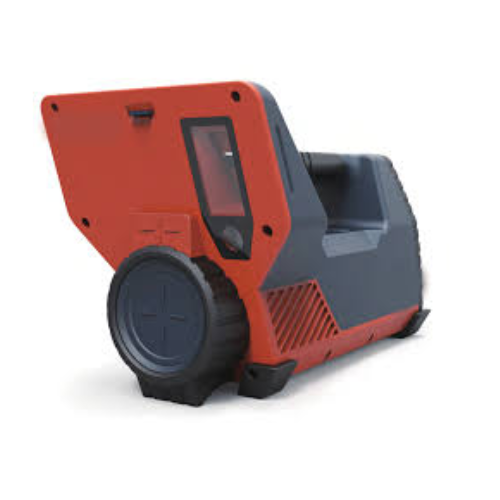
The SAMpack 120 (RD-120) is a human-portable backpack system for screening crowds, event venues, and large open areas on foot. It carries a 3 x 3 inch or 2 x 4 x 8 inch NaI(Tl) detector, or LaBr3 and CeBr3 options, with an optional neutron detector, and lets an officer walk a perimeter or a queue without revealing that screening is underway.
Vehicle screening
The SAMmobile 150 (RD-150) is a vehicle-mounted radiation detection system for mobile and lane screening. Its large NaI detectors and GPS mapping let a patrol vehicle or a fixed lane screen passing traffic and log where every reading was taken.
Personal detection for every officer
The Model 951 nukeALERT personal radiation detector gives each officer a pager-sized gamma alarm that runs all shift and signals within a second of entering an elevated gamma field. For teams that need gamma and neutron in a personal device, the PM1703GNA-II MBT adds neutron sensitivity and dosimetry to the personal layer.
Why It Works
The posture works because each layer does one job well and hands the next layer a cleaner problem. Personal detectors on every officer extend coverage to every lane an officer works. The SAMpack 120 and SAMmobile 150 extend that reach to crowds and traffic, where a handheld alone cannot keep up.
When an alarm fires, the SAM identifiers resolve it. Isotope identification across the ANSI, SNM, IND, MED, and NORM categories is what lets an officer clear a NORM nuisance alarm in seconds and escalate a genuine SNM signature instead. Neutron detection across the SAM line adds the signature that dense shielding does not remove, which is the channel that flags plutonium and other neutron emitters.
The last piece is reachback. A field identification is a decision aid, not a verdict. The SAM instruments capture the full spectrum and the GPS-tagged context of an alarm, so an officer can forward the data to a remote reachback analyst for adjudication before committing to a response. The field team detects and screens; the reachback analyst confirms; the chain of custody holds.
1. Confirm the alarm with a second count at the same position. 2. Identify with a handheld from the closest safe distance and record the spectrum, category and confidence. 3. Clear only a high-confidence NORM or medical result that matches the cargo or the traveler's documentation. 4. Send every SNM, IND, neutron or low-confidence result to reachback and hold the conveyance until the analyst responds. The reachback analyst adjudicates; the officer on scene documents.
Getting Started
Berkeley Nucleonics can help you build a screening posture that fits your border crossing, port, or event, from personal detectors on every officer to vehicle and wide-area systems. Call 800-234-7858 or email info@berkeleynucleonics.com to talk through your concept of operations.
To compare models and detector options, see the Isotope ID & Radiation Detection documentation and selection guide.