
EW & SIGINT
Electronic warfare and signal intelligence work lives at the edge of the spectrum. The emitters that matter are often short, agile, and deliberately hard to find. A frequency-hopping radio dwells on a channel for milliseconds. A radar pulse may last a fraction of a microsecond and then go quiet. A drone control link can appear, move, and disappear before a slow analyzer finishes a single sweep. The operator does not get a second look.
That puts three demands on the instrument at once. It has to see a wide slice of spectrum without scanning, so nothing slips through between sweeps. It has to capture and characterize a signal fast enough to read its structure: center frequency, modulation, and the pulse parameters that fingerprint a radar. And it has to do all of this in the weather, far from a lab bench, in something a team can carry.
The harder problem is interpretation. Detecting energy is the first step. Knowing what the energy is, fast enough to act, is the job. Pulse parameters, demodulation, and a clean record of the raw signal are what turn a detection into intelligence.
How the ICX-FieldHawk line solves it
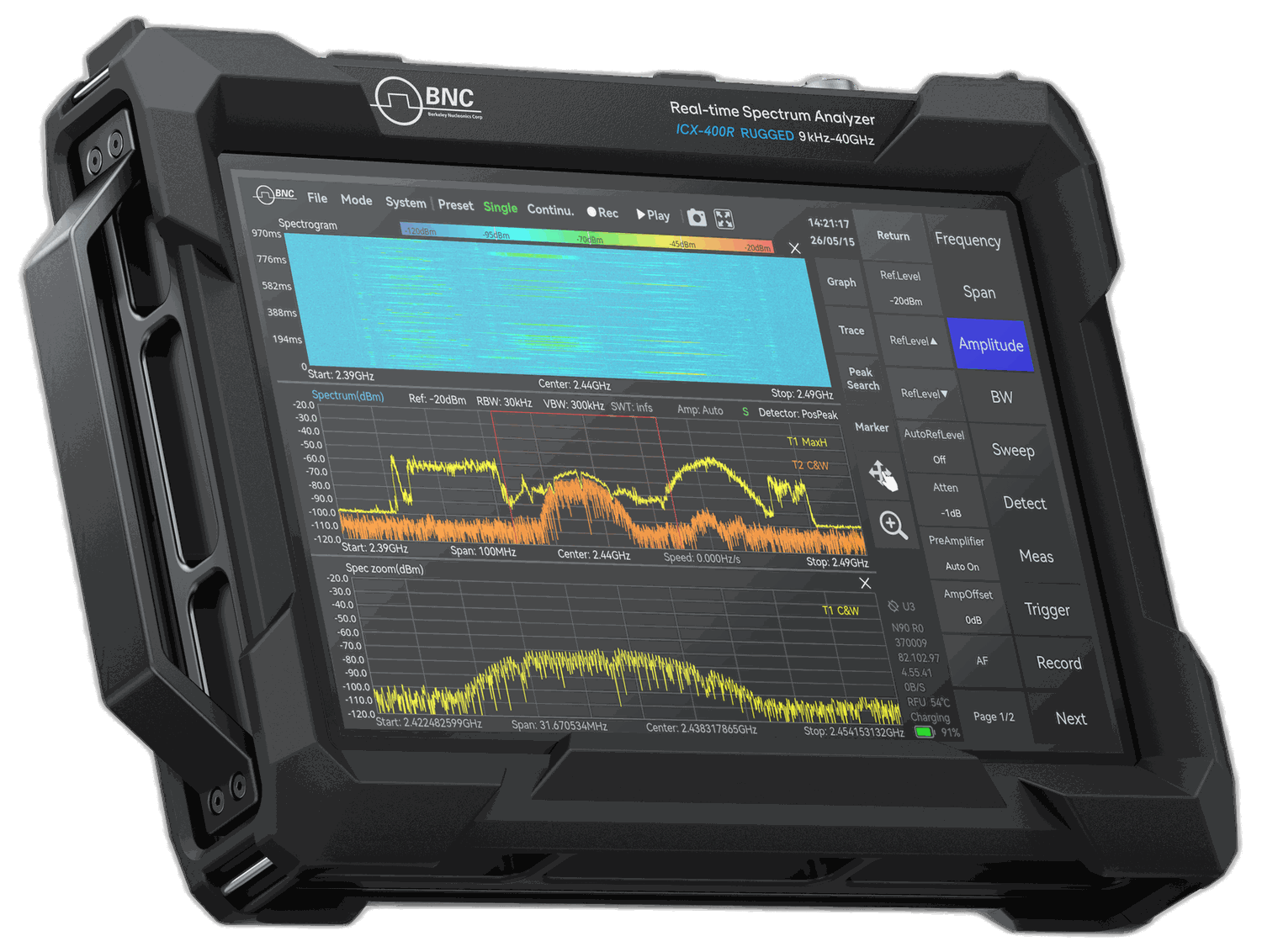
The ICX-FieldHawk receivers are built around wide real-time bandwidth, so the instrument watches a large span continuously rather than stepping through it. The density display reveals the faint, the brief, and the intermittent: signals that a swept analyzer would miss between passes. Anything that lasts at least the guaranteed duration, 0.512 µs at the shortest transform, is captured in full.
On top of that live view, the SpectraCore software adds Pulse Detection as option 72. Its table lists each pulse’s top and base level, rise and fall time, width, repetition interval and duty cycle, with the minimum, maximum and mean PRI and width across the record. For pulsed emitters and radar work, that is the difference between seeing a flash and reading a signature. Digital Demodulation (option 71) covers 2ASK, 2FSK, 4FSK, GMSK, BPSK, QPSK, 8PSK and 16 to 256 QAM, so an operator can move from detection to identification on the same screen.
Then there is the record. The ICX-FieldHawk line supports IQ record and playback at up to 100 MHz bandwidth into 128 Mbyte of built-in memory, or continuously at up to 25 MHz, capturing the raw complex samples of an event for later analysis. A signal that lasted a few milliseconds in the field can be replayed, demodulated, and dissected at length back at the bench. This matters for counter-UAS development, where the control and video links are short, hopping, and worth studying frame by frame. Capture once, analyze as long as you need.
Which models and accessories fit
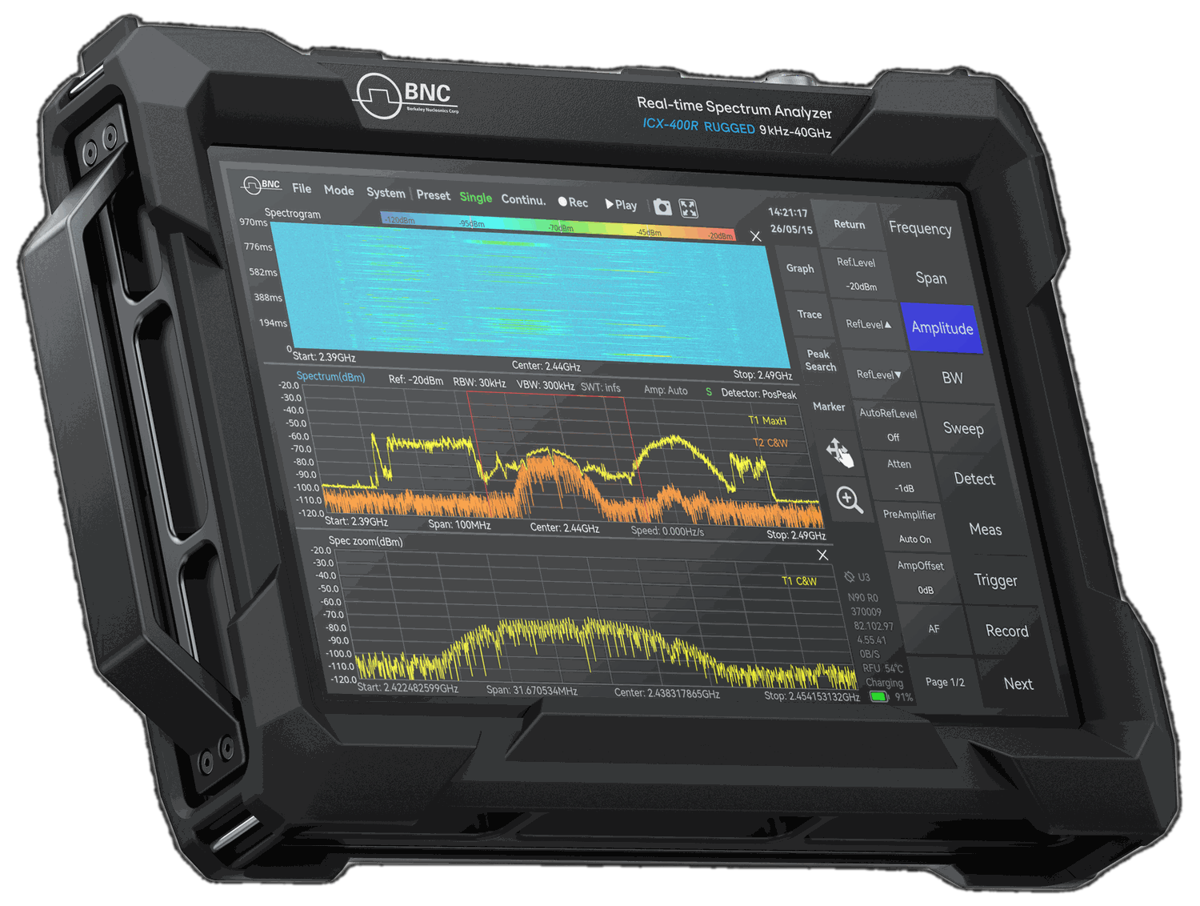
For dismounted EW and SIGINT field work, the recommended platform is the ICX-FieldHawk-R: the same measurement engine in an IP68 impact-protected chassis with corner bumpers, operating from 0 to 50 °C as standard and to -20 °C (T1, option 40) or -40 °C (T2, option 41). An instrument specified for the conditions on the day is the one that is in use rather than in its case.
Where the receiver needs to disappear into a larger system, the ICX-Series USB core module is the right tool. It integrates into SDR platforms, vehicle racks, and custom processing chains, exposing the same real-time engine through a programmable interface. C-UAS prototypes, distributed sensor nodes, and embedded direction-finding builds start here, with the ICX-200U to 20 GHz or the ICX-400U to 40 GHz, in USB or Gigabit Ethernet form.
For directional work, pair either receiver with the RFA-3100-N directional antenna. It covers 500 MHz to 10 GHz with 5 dBi typical gain, a front-to-back ratio above 15 dB, a 20 dB amplifier that can be bypassed, and built-in azimuth, pitch and roll readout, so an operator can take a bearing on an emitter and separate it from background traffic. Detection confirms that a signal exists; the antenna gives it a direction.
| Need | Recommended model | Why |
|---|---|---|
| Dismounted field operations | ICX-FieldHawk-R | IP68 impact-protected chassis, temperature classes to -40 °C, USB PD power |
| SDR / embedded integration | ICX-Series | USB core module for vehicle, rack, and C-UAS prototype builds |
| Direction finding | RFA-3100-N | Directional gain for bearing and angle-of-arrival work |
Recommended configuration
A capable two-piece kit starts with the ICX-FieldHawk-R for dismounted operations and an ICX-Series reserved for vehicle and bench integration, both running SpectraCore with Pulse Detection (option 72) and IQ record enabled. Add an RFA-3100-N for directional sweeps and bearing. This pairing covers live wideband awareness, pulse parameter measurement, raw capture for after-action analysis, and a clear path into C-UAS and SDR development.
Frequency coverage, real-time bandwidth, and onboard processing options should be matched to your threat set. Contact a Berkeley Nucleonics applications engineer at info@berkeleynucleonics.com or 800-234-7858 to scope the right ICX-FieldHawk configuration.
For a quick question, chat with an engineer at berkeleynucleonics.com.