Automated Pulsed Phase Noise Measurements
The Berkeley Nucleonics 7000 Series signal source analyzers extend fully automated phase noise measurement to 26 GHz, covering absolute and residual phase noise on both CW and pulsed signals along with transient analysis and VCO characterization. This note summarizes the special measurement capabilities that make the 7000 Series a versatile analyzer for R&D and production testing.
Overview
Berkeley Nucleonics has enhanced the 7000 series of fully automated signal source analyzers and extended the measurement capability to 26 GHz. In addition to measuring absolute phase noise on a large variety of CW sources with offsets from 0.01 Hz to 50 MHz, the 7000 series performs residual and absolute phase noise characterization of CW and pulsed signals, transient analysis and VCO characterization. High speed measurement modes are optimized for automated testing, making the 7000 series a very versatile signal source analyzer for both R&D and production testing. The instrument is simple to use and offers high accuracy and reproducibility combined with measurement speed. It has a high dynamic range with low system noise floors, while offering an attractive cost for labs and production environments. Two models are available that are application dependent: Model 7070 covers 5 MHz to 7 GHz and Model 7300 covers 5 MHz to 26 GHz. The instruments are Ethernet, USB or GPIB controlled and "plug and play" with any standard computer. The entire instrument is enclosed in a compact, fan less, 3U, 19 inch chassis and weighs 10 kg.
Developing the product on a fully integrated, low power platform avoided fan cooling, as well as eliminated spurious signals, ground loops and power line loops. By using an external battery, this unit can be operated anywhere, without needing AC power. The instrument includes multiple accessible tuning voltages, and the dual programmable low noise power supplies each provide up to 15 V and greater than 500 mA current. The ultra-low noise close to carrier phase noise internal reference synthesizers are adequate for most applications, even when very low close-in phase noise or noise floors are measured; however, external references can be applied to maximize the use and flexibility of the instrument. A PC, laptop or tablet serves as the control unit, so no displays are incorporated in the instrument. This minimizes cost and increases reliability.
Special Capabilities
ATE Measurement: In addition to benchtop use, the 7000 series is a strong automatic test equipment (ATE) solution for accurate phase noise measurements below 200 milliseconds per device under test (DUT) in a production environment. The unit can be controlled and triggered using SCPI commands via USB or Ethernet. The measurement process itself is fully automatic and very easy to set up. Example programs are available in various programming languages, such as VBA, Java, C, Matlab or Labview. The ATE SCPI command set allows for phase noise plots, spot phase noise values, spurious extraction, and calculation of RMS jitter and integral phase noise.
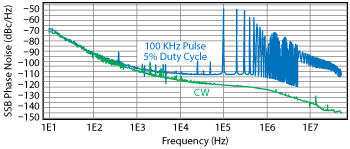
Pulsed Phase Noise: Measuring the phase noise of a pulsed RF system poses unique challenges to the test system, which are met with the BNC 7000 series signal source analyzer. By detecting the pulses (or with external triggering), the hardware adjusts its parameters to increase the reliability and accuracy of the measurement. The current system handles pulse rates up to 1 MHz with duty cycles below 5 percent. Figure 1 shows the measurement of a signal at 2.5 GHz with a pulse rate of 100 kHz and 5 percent duty cycle.
Frequency Transients
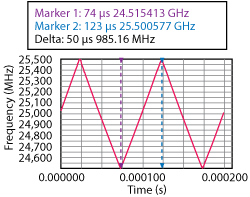
The 7000 series also works like a high performance modulation domain analyzer, providing a view of frequency and phase measurements over time. This intuitive way of seeing data allows frequency switching, jitter or modulation to be viewed directly. In effect, the Model 7000 series becomes a frequency oscilloscope, measuring carrier frequencies versus time up to 26 GHz with 16 ns time resolution. Figure 2 shows the measurement of a 1 GHz bandwidth chirp at 25.5 GHz and 50 µs chirp time. The Model 7300 series observes wide frequency span transients up to 20 GHz bandwidth. With a time resolution of 16 ns and a continuous time span of several hours, a large number of applications can be addressed:
- Frequency hopping systems measuring the frequency droop on individual channels
- Chirp radar analyzing chirp radar performance
- Pulse jitter measuring pulse jitter and viewing the distribution histogram
- Frequency sweep calibration calibrating frequency sweep signals
- Intentional modulation calibrating intentional modulation (FM or FSK)
- PLL and FLL analysis analyzing phase-locked loops (PLL) and frequency-locked loops
- Synchronization clocks discovering phase jumps in synchronization clocks
- Rotational encoders detecting missing periods from rotational encoders
- VCO settling measuring VCO frequency settling times
- Oscillator start-up characterizing the start-up/warm-up of oscillators
Automatic VCO Characterization
At least two (low noise) DC sources and one signal analyzer are needed to characterize a VCO, to measure power, frequency, phase noise, etc. With four independent, programmable, DC voltages to power and control the DUT, the 7000 Series automatically characterizes a VCO for tuning voltage versus frequency, tuning sensitivity, output power, current consumption, supply pushing and SSB phase noise. The desired VCO parameters are captured in a single sweep.
Summary
The Berkeley Nucleonics 7000 series signal source analyzer has been extended with new measurement capabilities. Besides the powerful CW and pulsed phase noise measurements (additive and absolute), transient time domain, fast Fourier transform (FFT) analysis and VCO characterization are also supported. These independent measurement capabilities are easily implemented using the single, intuitive, graphical user interface. For production testing (ATE), a remote SCPI-based programming language is supported with throughput optimized measurement times.
Talk to an application engineer
Berkeley Nucleonics application engineers can help you match the Model 7070 or Model 7300 to your pulsed, CW, transient or VCO measurement needs. Request a quote or demo to discuss your test setup. You can also reach us at info@berkeleynucleonics.com or 800-234-7858.
Ask now → Chat with our assistant and get an answer in seconds.