The Environment Comes First
A borehole logging tool may spend days at 175 °C while being pulled through vibrating drill collars. An industrial density gauge on a cement kiln runs continuously in corrosive dust. A pipeline weld-inspection crawler operates in confined, high-humidity steel tubes. In each case, the detector is the weakest link if it is not chosen and assembled with the operating environment as the primary design constraint.
Two properties matter most: mechanical robustness (crystal hardness, non-hygroscopicity, housing seal integrity) and thermal stability (light yield that does not collapse at elevated temperature, decay constants that remain useful, zero moisture ingress over thousands of hours). Energy resolution matters too, but it is secondary to survival.
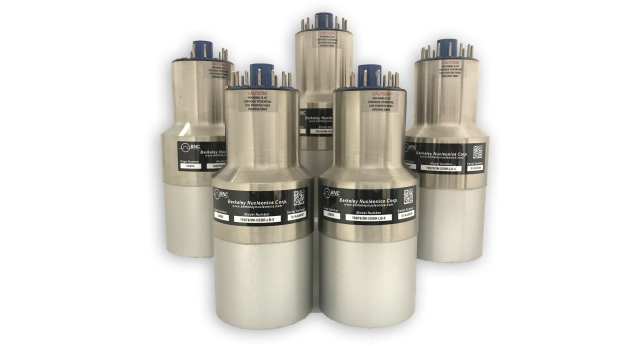
ScintIQ assemblies for downhole and industrial gauging are configured to order: crystal, readout (PMT or SiPM), housing grade, window material, and thermal management are all specified at the time of quote. The four materials below cover the range of use cases.
Recommended ScintIQ Materials
GAGG(Ce): Gd3Al2Ga3O12:Ce
GAGG(Ce) is the choice when density, speed, non-hygroscopicity and SiPM readout must all be satisfied at once. At 6.6 g/cm³ it stops gamma radiation efficiently in a short crystal length, reducing the footprint inside a tight borehole tool. The primary decay time under 90 ns supports high count-rate logging passes. The emission peak at 520 nm falls where silicon photomultipliers are most efficient, so GAGG pairs with a low-voltage SiPM readout without a wavelength shifter; a bialkali PMT is a poorer match in the green, and a high-QE or green-extended tube recovers part of that loss. GAGG does not absorb moisture, so there is no hermetic sealing requirement for the crystal itself, which simplifies the assembly and removes a failure mode in a humid downhole environment.
The GAGG datasheet reports radiation hardness relative to organic scintillators but publishes no operating temperature range, so for a high-temperature sonde the crystal and readout are characterized at the intended temperature before the design is fixed. For combined density and photoelectric-factor tools, GAGG approaches the stopping power of BGO (6.6 against 7.13 g/cm³, with a lower effective atomic number) with faster timing and SiPM compatibility.
BGO: Bi4Ge3O12
BGO is the density choice. It is non-hygroscopic, mechanically hard with no cleavage, and at 7.13 g/cm³ it offers among the highest stopping powers available in a practical oxide crystal, so a small-diameter probe keeps its gamma efficiency. Light yield is modest at 15 to 20 percent of NaI(Tl) and the 300 ns decay constant limits count-rate performance, but neither constraint limits standard density and gamma-gamma logging at typical logging speeds.
BGO's absence of afterglow and of self-activity is operationally important: the detector adds no background tail to the formation density calculation. Temperature is its limit. The datasheet's useful range is -40 to +100 °C, and light yield falls steeply as the crystal warms, so BGO serves moderate-temperature tools and surface gauges rather than the hottest sondes.
CsI(Tl): cesium iodide, thallium-doped
CsI(Tl) fills the mid-range: denser than NaI(Tl) at 4.51 g/cm³, only slightly hygroscopic (a sealed or lightly protected housing is sufficient), rated for -40 to +125 °C on its datasheet, and with an emission peak at 550 nm that is well matched to silicon photodiodes and SiPMs. This makes CsI(Tl) the natural choice for compact, low-power downhole tools where a PMT high-voltage supply is impractical, or where the tool designer wants to eliminate the PMT's sensitivity to magnetic fields.
In industrial gauging applications, CsI(Tl) is widely used in level gauges, density gauges, and belt-weigher detectors, where moderate resolution and excellent photodiode compatibility translate directly into simpler electronics and lower total system cost. The 0.6 / 3.4 µs dual-decay structure means pulse integration time matters; most gauging electronics handle this by using a long integration gate rather than pulse-shape discrimination.
NaI(Tl): sodium iodide, thallium-doped
NaI(Tl) remains the most widely deployed scintillator in logging, from surface gauges to high-temperature wireline and measurement-while-drilling tools. Its relative light yield of 100 (the reference point for the field) and 230 ns decay constant produce clean, well-resolved spectra with straightforward electronics. Large volumes grow economically, and supply chains are mature.
Its limitation is hygroscopicity: NaI(Tl) must be hermetically sealed, and the seal, the window and the optical coupling have to hold at the tool's pressure and temperature. Those are the engineering problems logging tool designers have worked on longest, which is why NaI(Tl) carries the longest history of any scintillator in high-temperature wireline and measurement-while-drilling tools. Light yield and resolution fall as the crystal warms, so a hot-hole NaI(Tl) assembly is specified with its temperature coefficient and the gain correction the tool electronics apply.
Selecting the Right Material
The table summarizes the four materials against the selection axes for logging and gauging. Specifications are from the ScintIQ material datasheets.
| Property | GAGG(Ce) | BGO | CsI(Tl) | NaI(Tl) |
|---|---|---|---|---|
| Density (g/cm³) | 6.60 | 7.13 | 4.51 | 3.67 |
| Emission peak (nm) | 520 | 480 | 550 | 415 |
| Decay constant | under 90 ns | 300 ns | 600 ns / 3.4 µs | 230 ns |
| Light yield | about 50,000 ph/MeV | 15–20 (NaI = 100) | 45 (NaI = 100) | 100 (reference) |
| Hygroscopic | No | No | Slightly | Yes |
| Preferred readout | PMT or SiPM | PMT | SiPM / photodiode | PMT |
| Temperature | Not published | To +100 °C (datasheet range) | To +125 °C (datasheet range) | Longest high-temperature logging history; gain corrected with temperature |
| Primary use case | High-density fast logging, SiPM sondes | Density / gamma-gamma logging at moderate temperature | Industrial gauging, low-power tools | Wireline and MWD logging, surface gauges |
Light yield falls with temperature in every one of these crystals, and the values above are room-temperature values. NaI(Tl) is the crystal with the longest history above 125 °C, with the tool electronics correcting gain against a measured temperature coefficient; CsI(Tl) is rated to 125 °C and BGO to 100 °C on their datasheets; GAGG(Ce) has no published range. A high-temperature sonde is specified with thermal characterization of the specific crystal and readout combination.
Assembly and Housing Considerations
A scintillator crystal alone is not a borehole detector. The assembly must address pressure, temperature cycling, vibration, and optical coupling simultaneously. ScintIQ downhole assemblies are configured at the time of order and typically include:
- Housing grade. Stainless or titanium housings rated to the required pressure and temperature envelope. Pressure ratings are specified at order for the application.
- Window material. MgF2, quartz, or borosilicate glass, selected to match the crystal's emission wavelength and the operating temperature range.
- Optical coupling. High-temperature silicone optical grease or solid coupling elements, selected for the tool's temperature range.
- Hermetic seal. Required for NaI(Tl) and any hygroscopic crystal. Non-hygroscopic materials (GAGG, BGO) simplify the seal specification, reducing cost and failure-mode count.
- Shock and vibration tolerance. Crystal mounting, potting, and spring-loaded retention are application-dependent. The applications team can advise on retention methods for MWD (measurement while drilling) versus wireline versus industrial gauge deployment.
For industrial gauging in fixed installations

Talk to the ScintIQ Applications Team
Detector configuration for well logging and industrial gauging involves a set of tradeoffs that are best resolved in direct conversation. The applications team can help you match crystal choice, readout type, housing grade, and calibration approach to your specific tool geometry, temperature profile, and measurement objective.
Contact Berkeley Nucleonics to discuss your application or request a configuration quote:
- Email: info@berkeleynucleonics.com
- Phone: 800-234-7858
- Web: Use the guided material selector
ScintIQ material datasheets: GAGG(Ce) · BGO · CsI(Tl) · NaI(Tl)
ScintIQ crystals are grown and finished with our long-standing scintillation partner in the Netherlands (Scionix Holland).