RFS-7060-U USB Vector Signal Generator (9 kHz to 6 GHz)
Pocket-sized, USB-powered vector source from 9 kHz to 6 GHz. It delivers 100 MHz of modulation bandwidth, a 16-bit DAC, deep IQ playback, and optional built-in GNSS, all from a single Type-C connection.
Specifications transcribed verbatim from the RFS-7060-U product manual (V1.2). Values apply after a 10-minute warm-up at 25 °C ambient unless otherwise stated. Host software is VectorCore Studio. This product was previously sold as the VSG-Mini-6; the hardware is unchanged.
1Overview
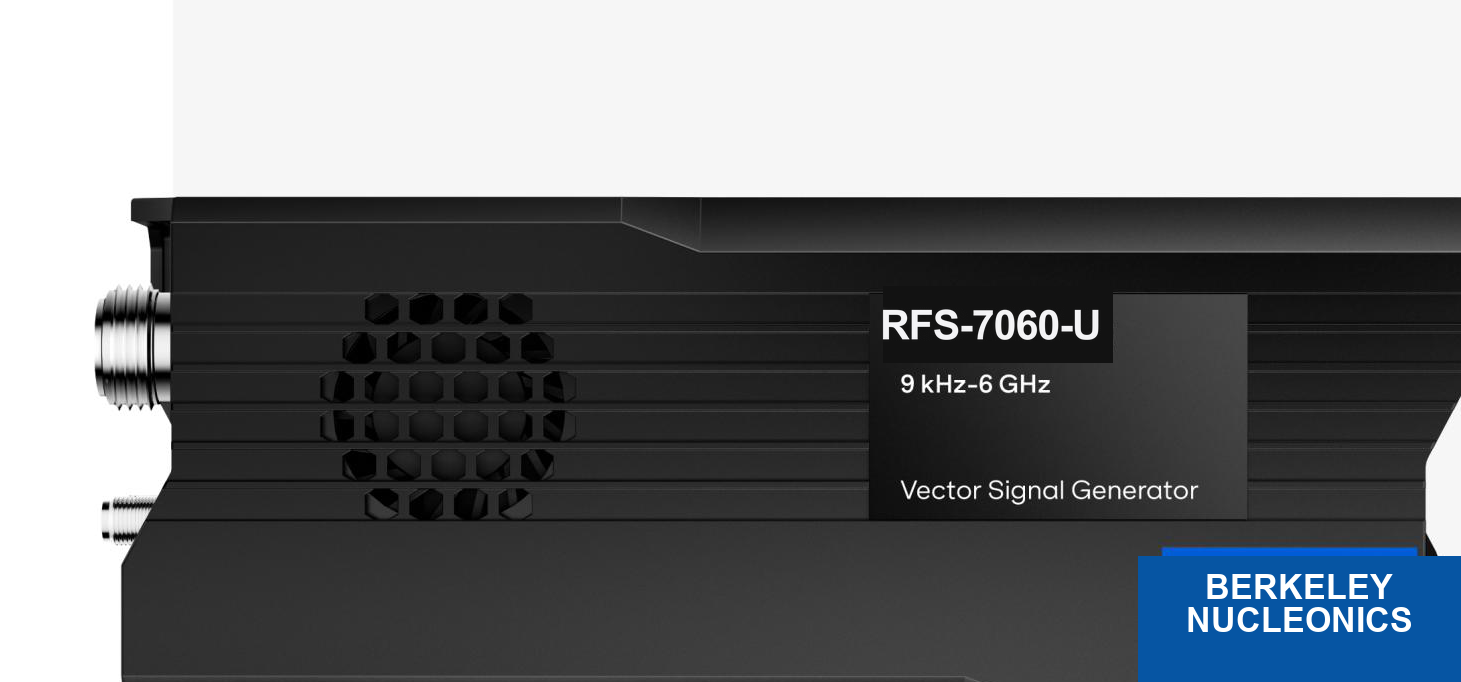
The Berkeley Nucleonics RFS-7060-U is the second vector signal generator in the BNC RF and microwave line, sized to sit beside a laptop rather than fill a rack. It generates continuous-wave, swept, and fully vector-modulated signals from 9 kHz to 6 GHz, and it draws power and data over a single USB Type-C cable.
Inside the compact housing, a 16-bit DAC and an FPGA-based interpolator build clean waveforms with 100 MHz of modulation bandwidth and 125 MB of playback memory. That combination supports single-tone work, frequency and power sweeps, stored IQ playback, and real-time IQ streaming from a host. An optional built-in GNSS receiver disciplines the reference for timing, positioning, and frequency calibration in the field.
The RFS-7060-U suits benchtop R&D, production test, and portable field work where a full-size generator is more instrument than the task needs. It runs on both Windows and Linux, on x86 and ARM hosts, so it fits embedded and automated setups as readily as a desk.
Definitions
Guaranteed: warranted performance, verified by design and production test under the stated specification conditions.
Typical: expected mean performance, not a warranted limit.
Memory depth: 125 MB (32 M samples) of built-in IQ memory.
SSB phase noise: -124 dBc/Hz at 10 kHz offset on a 1 GHz carrier.
Output power: up to 14 dBm maximum; minimum down to -100 dBm or below across the range.
Converter: 16-bit DAC with an FPGA-based high-performance interpolator.
Interface: USB 3.0 / 2.0 over Type-C, with PD power on the same connector.
Timing: optional built-in GNSS for timing, positioning, and frequency calibration.
Hosts: Windows and Linux, on x86 and ARM processors.
3Software and Control
The VectorCore Studio application drives the RFS-7060-U from the host. It organizes the work into clear panels for frequency and power, single-tone output, sweep control, IQ playback, and live analysis, so an operator moves from setup to result without scripting. A documented API supports C/C++, C#, Python, and MATLAB, plus Qt, LabVIEW, and GNU Radio, for automated and cross-platform use. Full operating instructions are in the VectorCore Studio User Guide, shared with the RFS-7060-T.
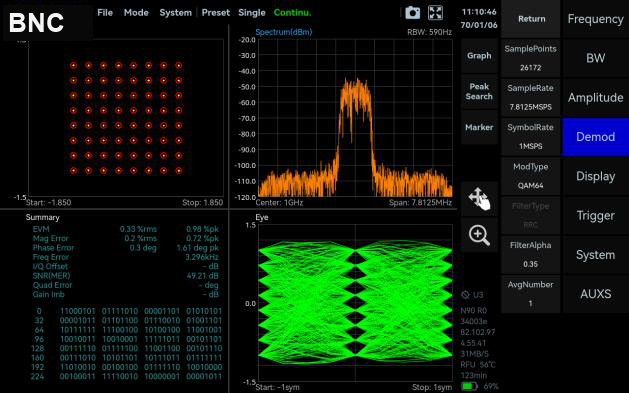
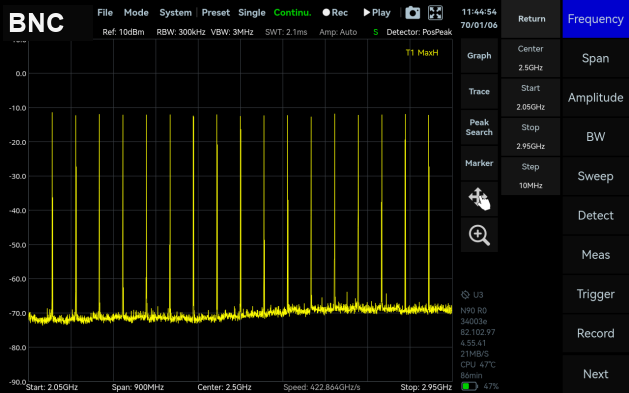
Digital modulation and analysis: constellation, eye diagram, and modulation metrics for QAM and PSK formats.RF frequency sweep across a span, with start, stop, step, and amplitude under direct control.
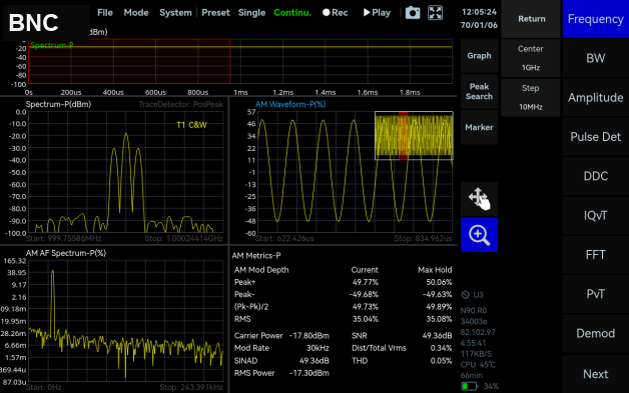
Analog AM and FM analysis: modulation depth, rate, and distortion measured from the generated signal.
4Frequency
Parameter
Specification
Frequency range
9 kHz to 6 GHz
Frequency resolution
0.1 Hz analog tuning, ≤1 uHz digital tuning
LO switching time
≤100 us pre-programmed; ≤50 ms software controlled
Reference clock
Internal or external, manual correction or GNSS calibration is available
Frequency accuracy
TCXO (std.)
<0.5 ppm, manual correction is available
OCXO (opt.01)
<0.2 ppm, manual correction is available
OCXO frequency correction via GNSS
≤0.05 ppm, when GNSS is locked
Aging and temperature stability
TCXO (std.)
≤1 ppm/year, ≤1 ppm
OCXO (opt.01)
≤1 ppm/year, ≤0.15 ppm
Built-in GNSS 1PPS accuracy
±100 ns
5Spectrum Purity
SSB phase noise (dBc/Hz)
Carrier frequency
1 GHz
3 GHz
6 GHz
1 kHz
-115
-105
-98
10 kHz
-124
-114
-108
100 kHz
-126
-116
-110
1 MHz
-138
-128
-122
Harmonics, spurious and EVM
Parameter
Condition
Specification
Harmonics (CW, 0 dBm)
100 MHz
≤-45 dBc
1 GHz
≤-50 dBc
3 GHz
≤-60 dBc
6 GHz
≤-75 dBc
Non-harmonic spurious
1 MHz steps size and 20 MHz observation bandwidth
Spurious levels are ≤-80 dBc for approximately 98% of frequency points
Flash disk × 1, USB 3.0 data cable × 1, USB power cable × 1, Power adapter × 1
Specification conditions. Specifications apply under the following conditions: (1) 10 min warm-up after power-on. (2) Ambient temperature 25 °C (instrument temperature 50 °C). (3) With adequate cooling ensuring both ambient and core temperatures remain within the rated range.