 Powered by Bioz
1Overview
The -SDR option configures any Berkeley Nucleonics ICX real-time spectrum analyzer as a calibrated, wideband software defined radio receiver. Append -SDR to the base part number of an ICX-FieldHawk handheld, an ICX-FieldHawk-R rugged unit, or an ICX-Series USB/LAN module, and the instrument ships ready to serve as the RF front end for SoapySDR, GNU Radio, and your own acquisition code.
The SDR ecosystem and the test instrument have always sat on opposite sides of a boundary. An open SDR gives an engineer every sample and no absolute reference; a spectrum analyzer gives an absolute reference and, usually, no way in. The ICX -SDR option removes that boundary. You get the raw IQ samples that open tooling expects, delivered by a receiver with a calibrated front end and published sensitivity, phase noise, and image rejection figures, the axes where low-cost SDR hardware gives ground, and coverage far beyond what commodity SDR hardware reaches.
Depending on the base model, an ICX -SDR unit covers 9 kHz up to 40 GHz with as much as 100 MHz of gapless analysis bandwidth, streams IQ at up to 125 MSPS, and time-stamps captures against GNSS to within 50 ns with the appropriate option. The same unit remains a full real-time spectrum analyzer: nothing in the -SDR option removes or replaces the standard measurement software.
Because every ICX form factor shares one unified API, code written against a USB module migrates to a handheld or a networked LAN unit without change. Develop on the bench, deploy in the field or in a rack, and keep one software stack throughout.
2What the -SDR Option Adds
The -SDR option is a factory configuration of the base instrument for software defined radio service. It adds open-framework support on top of the standard analyzer software rather than in place of it.
- SoapySDR device support. The SoapySDR driver module (soapy-htra) registers the receiver as a standard SoapySDR device, with the unit's device calibration files staged for the driver, so applications built on the SoapySDR API discover and run it like any other SDR.
- GNU Radio integration. The receiver runs as a source block in GNU Radio 3.9 or later, delivering live IQ into flowgraphs for spectrum display, demodulation, decoding, and custom signal processing.
- Worked example flowgraphs. Install scripts and example chains for analog demodulation, digital demodulation, WLAN decode, and ADS-B aircraft tracking, matching the six signal chains documented in the SDR Integration Handbook.
- The SDR Integration Handbook. A 44-page Berkeley Nucleonics reference covering the SoapySDR hardware abstraction layer in depth, six GNU Radio signal chains, and integration practice, troubleshooting, and quick reference. See the handbook page.
- The full analyzer, unchanged. Every standard measurement mode and function of the base model remains installed and supported (Section 7).
3Ordering & Compatibility
The -SDR option applies to every current ICX product. Order it by appending -SDR to the base part number, for example ICX-400U-SDR. The option does not change the base model's hardware specifications, connectors, or interface options, and it combines with the other ICX options, including OCXO reference, GNSS timing, tracking generator, and temperature classes.
| Base product | Form factor | Frequency coverage | Order as |
|---|---|---|---|
| ICX-FieldHawk | Handheld, 10.1 inch touchscreen | 9 kHz to 9.5 / 40 GHz | ICX-<model>-SDR |
| ICX-FieldHawk-R | Rugged handheld, IP-rated | 9 kHz to 9.5 / 40 GHz | ICX-<model>R-SDR |
| ICX-Series USB | USB Type-C module, no display | 9 kHz to 40 GHz | ICX-400U-SDR |
| ICX-Series LAN | Gigabit Ethernet module, no display | 9 kHz to 9.5 / 40 GHz | ICX-<model>-SDR (LAN variant) |
Which form factor suits SDR work? Integrators building their own systems usually start with the USB module and move to LAN units for remote or distributed deployments. Field teams who also want a self-contained analyzer choose a handheld: it runs the same API and the same SoapySDR support, with a screen for standalone use. The product selection guide compares all models.
4An Open SDR Platform
What makes an instrument software defined? Access to the samples through open, vendor-neutral interfaces. SoapySDR is the open-source hardware abstraction layer that the SDR world standardized on: applications such as GNU Radio talk to one unified API for device discovery, frequency and gain configuration, sample-rate and bandwidth setting, and IQ streaming, while a per-vendor driver translates those calls to the hardware underneath.
For the ICX line that driver is soapy-htra, which bridges the SoapySDR framework to the receiver's native API. Once installed, SoapySDRUtil --find reports the unit as a registered SoapySDR device, and any SoapySDR-compatible application can stream from it, SDR++ among them: the sidebar video shows SDR++ running against an ICX-FieldHawk. The documented host environment for SoapySDR service is Ubuntu 22.04 or later on x86_64 with GNU Radio 3.9 or later; the instrument's own unified API additionally supports C/C++, C#, Python, MATLAB, Qt, and LabVIEW on Windows and Linux.
The diagram below is the whole working principle in one picture. Application code on the host has three ways in: GNU Radio flowgraphs reach the receiver through the gr-htra out-of-tree module and its SoapySDR interface; the standard SpectraCore analyzer software and SCPI remote control take the middle path; and custom programs call the API directly from C/C++, C#, Python, MATLAB, LabVIEW, or Qt. Every path lands on the same unified API, shipped as a Windows DLL and a Linux shared object with a C interface, and identical across the handheld, rugged, and USB/LAN form factors. Below that sits only the transport, USB or Ethernet, and the instrument itself. That single convergence point is why a flowgraph built against a bench module runs unchanged on a handheld in the field, and why there is no separate SDR firmware to maintain: the analyzer and the SDR are the same instrument reached through different doors.
- Vendor neutrality. Code written against the SoapySDR interface is portable: applications do not need to know which receiver sits underneath.
- One API across the family. A flowgraph or acquisition program developed on a USB module runs unchanged on a handheld or a LAN unit.
- Build your own instrument. Teams integrating spectrum monitoring, direction finding, or signal intelligence systems use the ICX as a calibrated front end and write their own application on top, in their own language and user interface.
- AI-assisted development. Because the API is uniform and documented, code generation tools produce working acquisition and control software quickly, which collapses integration schedules from weeks to days.
5GNU Radio Signal Chains
Six complete receive chains have been demonstrated in GNU Radio with the ICX receiver as the RF source, and each is documented step by step in the SDR Integration Handbook. They cover the span from analog audio to packet decode:
- AM demodulation. Carrier acquisition, resampling, and envelope demodulation to recovered audio, demonstrated on a 1 GHz carrier modulated by a 1 kHz tone.
- FM demodulation. Quadrature demodulation to audio, demonstrated with 75 kHz deviation on a 1 GHz carrier.
- QPSK demodulation. Root-raised-cosine matched filtering, symbol timing recovery, and constellation decode of a QPSK data signal.
- 16-QAM demodulation. Matched filtering, AGC, timing and carrier recovery, demonstrated at a 500 kSymbol/s rate on a signal received at -80 dBm.
- WLAN decode. IEEE 802.11a OFDM synchronization, equalization, and MAC frame decode at 2.412 GHz, with decoded packets exported to Wireshark or PCAP.
- ADS-B aircraft tracking. 1090ES frame detection and message decode, publishing ICAO address, callsign, altitude, speed, heading, and position to a live web map.
Beyond the documented chains, the same source block supports custom applications: spectrum monitoring, IQ recording, user-defined signal processing, analog AM / NFM / WFM / CW reception, and digital formats including FSK, PSK, QPSK, and QAM.
6SDR Applications
Where does a calibrated SDR earn its place? Wherever the receiver must feed software that someone else wrote, or software you are about to write.
- Drone detection and geolocation. Paired with directional antennas, ICX receivers detect commercial drone downlinks and locate both the aircraft and its operator, reporting identifiers and position in the field.
- Wide-area spectrum monitoring. Sweep from 9 kHz to 40 GHz, detect and classify emitters, and capture the IQ of signals of interest for machine-learning classification and later decode on GPU infrastructure.
- Distributed and remote sensing. LAN modules deploy as networked sensor nodes for site monitoring, satellite ground station maintenance, and interference hunting, all driven from central software.
- Airborne measurement. Sub-420 gram USB modules fly on drones for antenna pattern measurement and tower surveys, replacing climbs with flights.
- EMC, EMF, and coverage measurement. System integrators embed ICX receivers behind their own EMF measurement, 5G analysis, and network coverage software.
- Research and teaching. Universities run laboratory courses on GNU Radio flowgraphs with a calibrated front end, so student results survive comparison with published figures. The same platform serves the amateur and experimenter community at events such as GRCon.
- Automated test. The unified API drops the receiver into ATE frameworks; with a vector signal generator alongside, one platform transmits, receives, and closes the loop.
7Standard with Every Base Model
The -SDR option adds open access; it takes nothing away. Every ICX base model keeps its full real-time spectrum analyzer capability, and the advanced measurement functions below are standard, not paid add-ons.
- Spectrum measurement suite. Full-span sweep, channel power, occupied bandwidth, X dB bandwidth, adjacent channel power ratio, IM3, and spectrum emission mask.
- Real-time analysis. FPGA-based, gapless and overlap-free FFT with sweep speeds up to 1 THz/s on the module family.
- Demodulation and analysis. AM and FM demodulation, automatic phase noise measurement, and harmonics analysis to the 10th harmonic.
- Recording and playback. Spectrum recording and playback, signal tracking, peak table, and amplitude correction.
- Remote control. Standard SCPI plus the unified API for C/C++, C#, Python, MATLAB, Qt, and LabVIEW on Windows and Linux.
Software options extend the set where needed: basic digital demodulation (2ASK through 256QAM) and pulse detection are orderable options, as are hardware options including the OCXO reference, built-in signal generator, GNSS timing packages, antennas, and extended temperature classes. See the base model datasheets for the full option tables.
8Specifications that Matter for SDR
An SDR front end is judged on what reaches the software: how wide, how fast, how clean, and how precisely stamped in time. The figures below are from the published ICX-Series USB/LAN datasheet; handheld models carry their own datasheets with equivalent tables.
Inside the Receiver
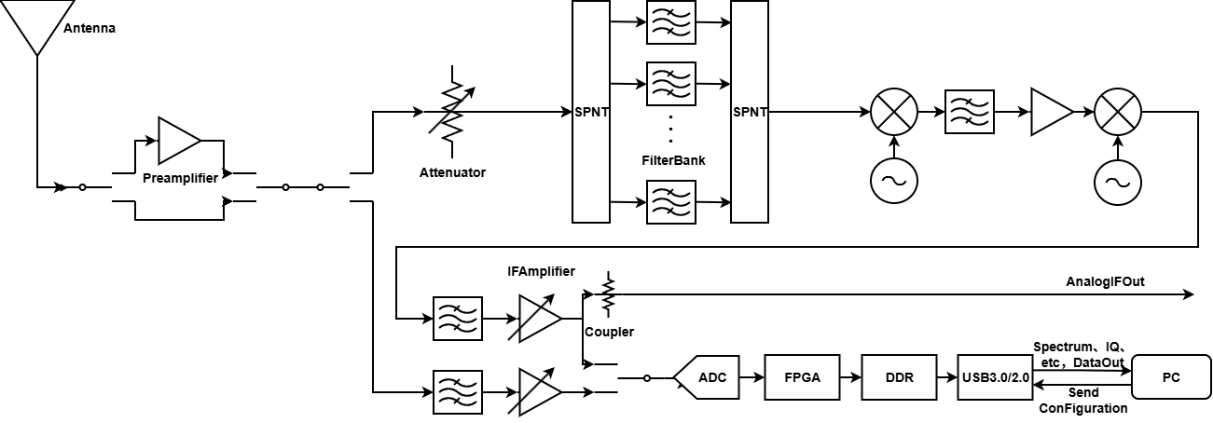
The signal path explains why the numbers below look the way they do. The RF input passes a switchable preamplifier and a step attenuator, then a switched preselection filter bank before downconversion, which is where the image and IF rejection figures come from. The IF stage feeds a coupler with an analog IF output on LAN models, and the digitized path runs ADC to FPGA to DDR memory before streaming to the host over USB 3.0 or Ethernet. Real preselection and calibrated gain stages ahead of the digitizer are exactly what commodity direct-sampling SDR hardware omits.
IQ Streaming and Recording
| Parameter | Specification |
|---|---|
| Burst recording bandwidth | Maximum 100 MHz. The built-in memory depth is 128 Mbytes. |
| Continuous recording bandwidth | Maximum 25 MHz |
| IQ sample rate | Maximum 125 MSPS; decimate factor 1, 2, 4, 8, 16, 32, 64, 128, 256, 512, 1024, 2048, 4096 |
| External trigger response | Maximum frequency response 500 times/s |
| Lowest time resolution (detection analysis) | 8 ns |
Frequency Coverage and Front End
| Model (USB/LAN family) | Frequency range | RF input | Analysis bandwidth |
|---|---|---|---|
| ICX-400U | 9 kHz to 40 GHz | 2.92 mm (F), 50 Ω | 100 MHz |
Sensitivity and Purity
Why it matters for SDR: noise floor bounds the weakest signal your software can decode, and phase noise bounds how tight a constellation your demodulator can recover.
| Parameter | ICX-400U |
|---|---|
| DANL, 90 MHz to 3 GHz (R.L. -50 dBm, RBW 1 kHz) | -159.9 dBm/Hz |
| DANL, 3 GHz to 9.5 GHz (R.L. -50 dBm) | -159.9 dBm/Hz |
| SSB phase noise, 1 GHz carrier, 10 kHz offset | -107.5 dBc/Hz |
| SSB phase noise, 1 GHz carrier, 1 MHz offset | -122.7 dBc/Hz |
Timing and Synchronization
Distributed SDR work, TDOA geolocation, and multi-sensor capture depend on knowing when each sample was taken.
| Parameter | Specification |
|---|---|
| Reference clock | Internal TCXO standard (<1 ppm); OCXO option; external reference input |
| GNSS 1PPS synchronization accuracy | ±100 ns std./opt21; ±75 ns opt22/opt05; ±50 ns opt23/opt06 |
| External trigger | 3.3 V CMOS trigger input and output on all interface variants |
9Resources & Further Reading
Berkeley Nucleonics publishes two reference handbooks on software defined radio, both free:
- SDR Integration Handbook (ICX-FieldHawk). 44 pages: the SoapySDR hardware abstraction layer documented in depth, six GNU Radio signal chains against a calibrated front end, practice and troubleshooting. Also as a PDF download.
- SDR Product Handbook (Choosing a Receiver). 57 pages: SDR architectures, the silicon landscape, dynamic range and phase noise, the software stack, and a vendor-neutral method for specifying a receiver. Also as a PDF download.
Related application briefs: drone spectrum monitoring, spectrum monitoring, EW & SIGINT, RF geolocation & mapping, and R&D & university kits. The ICX technical paper series (BNC-AN-101 to 110) works ten applications in depth, and the free Nuts & Bolts of Real-Time Spectrum Analyzers book covers the measurement fundamentals underneath all of it. Drivers and software are on the Software & Drivers page.
Cited in peer-reviewed research
Independent publications citing this instrument, indexed by Bioz. Citation counts and Bioz Stars ratings are shown live and update as new papers are indexed.