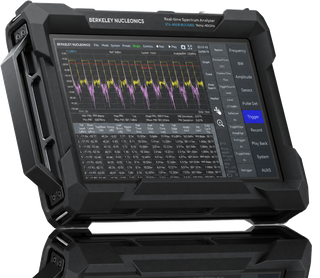
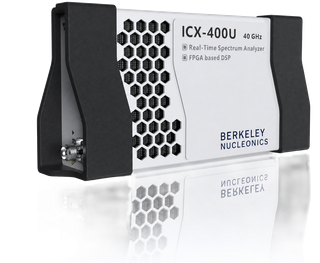
Product data sheets, user manuals, application notes, and briefs for the Berkeley Nucleonics ICX-FieldHawk real-time spectrum analyzers. One measurement platform in three form factors: a handheld instrument, a field-ready unit, and compact USB and networked receivers, all running the SpectraCore analysis software and sharing a common API.
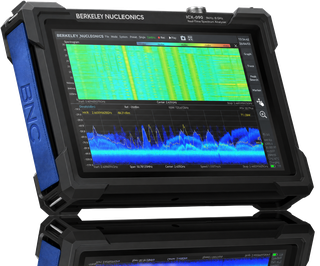
Jump straight to the documentation for a model series.
Specifications and operating overview for each form factor in the line.
Handheld real-time spectrum analyzer, 9 kHz to 40 GHz, with 100 MHz of analysis bandwidth and an FPGA FFT engine.
Field-ready analyzer for outdoor and vehicle work, 9 kHz to 40 GHz, with 100 MHz of analysis bandwidth.
Compact USB and networked receivers, 9 kHz to 40 GHz, driven from a host running SpectraCore.
The -SDR option turns any ICX analyzer into a calibrated software defined radio, with SoapySDR and GNU Radio support.
Compare the three form factors and frequency tiers side by side, with accessories and options.
Operating, measurement, and remote-control reference for each model.
Operating, measurement, and remote-control reference for the handheld models.
Operating, measurement, and remote-control reference for the ICX-FieldHawk-R field-ready models.
Operating reference for the USB and networked receivers, including the unified API.
Operating reference for the 9 kHz to 20 GHz USB and Ethernet models.
The BNC-AN series: measurement technique and system design with ICX receivers.
What separates a measurement from a reading, and six requirements for a programmable analyzer.
Building wide-area monitoring on ICX receivers, with gap-free capture and automated emitter classification.
Detecting commercial drones and locating their operators, with antennas and field geolocation.
Commissioning an earth station with a portable analyzer, from carrier checks to interference hunts.
Capturing IQ in the field and replaying it on the bench with a vector signal generator.
Antenna pattern and airborne radio measurement with lightweight USB modules flown on drones.
EMF safety and RF exposure work, from exposure limits to site survey practice and reporting.
Analyzing 5G NR, Wi-Fi, and Bluetooth in one instrument, with channel measurements and demodulation.
Pre-compliance testing on your own bench, with limit lines, detectors, and emission scan practice.
Designing an ICX module into your own product, with the unified API and system design practice.
Background on real-time spectrum analysis and where it changes the measurement.
Why gap-free capture catches the microsecond bursts a swept analyzer misses.
Catching brief, agile, low-probability-of-intercept signals with density displays and mask triggering.
How the line is deployed, by mission and by industry.
Regulatory monitoring, interference enforcement, and occupancy analysis with recorded evidence.
Pairing GNSS and a directional antenna to find, plot, and chase RF sources in the field.
A sub-200 gram USB module that flies on a UAV, mapping position-tagged RF where the ground cannot reach.
Wide, gap-free capture and fast signal characterization for EW and SIGINT teams on battery power.
Capturing pulsed radar, agile emitters, and buried signals for threat characterization.
Walk-test and drive-test coverage validation to 40 GHz, including the mmWave bands.
Debugging high-order modulation and intermittent errors across Wi-Fi 7, IoT, LTE, and 5G NR.
Catching impulsive bursts and clock spurs during R&D, before a failed compliance slot costs weeks.
Portable receivers with an open API for teaching, prototypes, and published work.
Measuring beam stability, phase noise, and frequency hopping for physics and synthesizer diagnostics.
Longer-form references on SDR integration and receiver selection.
A 44-page reference on running open software against a calibrated analyzer, with six GNU Radio signal chains.
A 57-page reference on the SDR product landscape: architectures, dynamic range, phase noise, and the software stack.
Independent publications citing this instrument, indexed by Bioz. Citation counts and Bioz Stars ratings are shown live and update as new papers are indexed.