 Powered by Bioz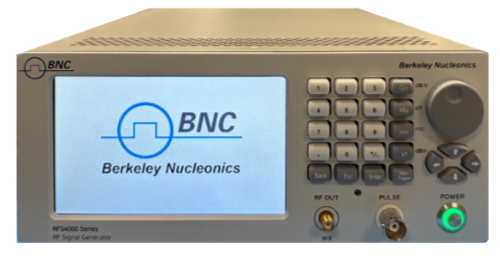
1Overview
The RFS-4220T is a high-performance 22 GHz RF and microwave signal generator with integrated touchscreen control, front-panel controls, LAN or USB control, internal sweep storage, and full remote software access. It combines microwave-class RF performance with a self-contained benchtop chassis designed for direct instrument operation without requiring an external computer.
The RFS-4220T is housed in a benchtop chassis with an integrated touchscreen interface, physical buttons, and a rotary knob. Users can operate the full instrument directly from the touchscreen, from the front-panel controls, or remotely from an included computer application over LAN or USB. All control methods stay synchronized, so a change made from one interface is reflected across the others.
2Key features
- Wide frequency coverage: 0.1 GHz to 20 GHz calibrated, settable to 22 GHz
- High output power up to +15 dBm with fine power control
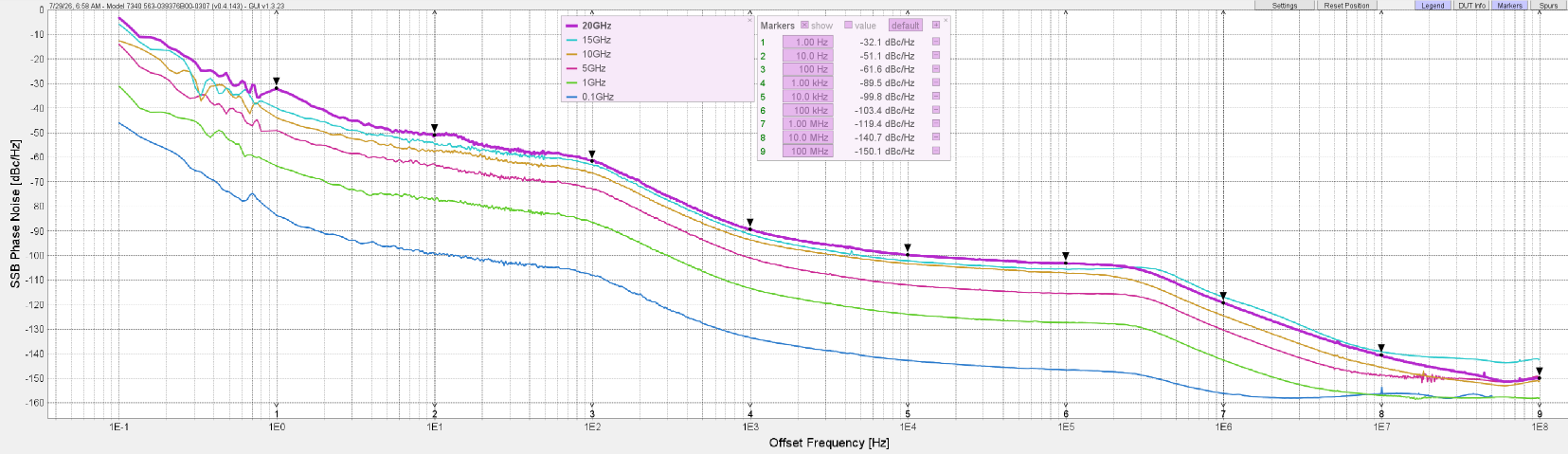
- Low phase noise and excellent spectral purity for demanding RF applications
- Precision frequency control with < 2 Hz frequency step size
- Integrated touchscreen GUI for complete standalone control
- Physical front-panel buttons and rotary knob for full non-touch operation
- Seamless control compatibility between touchscreen, buttons, knob, and remote software
- LAN or USB-based computer control with a matching graphical user interface
- Automatic network device discovery from the computer application
- Toggleable multi-session LAN or USB control for multiple computers on the same instrument
- Internal device storage for saved sweep-list configurations
- Save and recall list sweep CSV files directly on the instrument
- Upload sweep-list CSV files from an external computer
- External 10 MHz reference input for synchronization with lab frequency standards
- External trigger input for synchronized sweep and test operation
- SCPI-based control over LAN or USB
- DC-powered benchtop chassis design
3Specifications
| Specification | RFS-4220T |
|---|---|
| Frequency range | 20 MHz–20 GHz calibrated, settable up to 22 GHz |
| Output power range | -45 to +15 dBm (0–13.5 GHz); -26 to +15 dBm (13.5–22 GHz) |
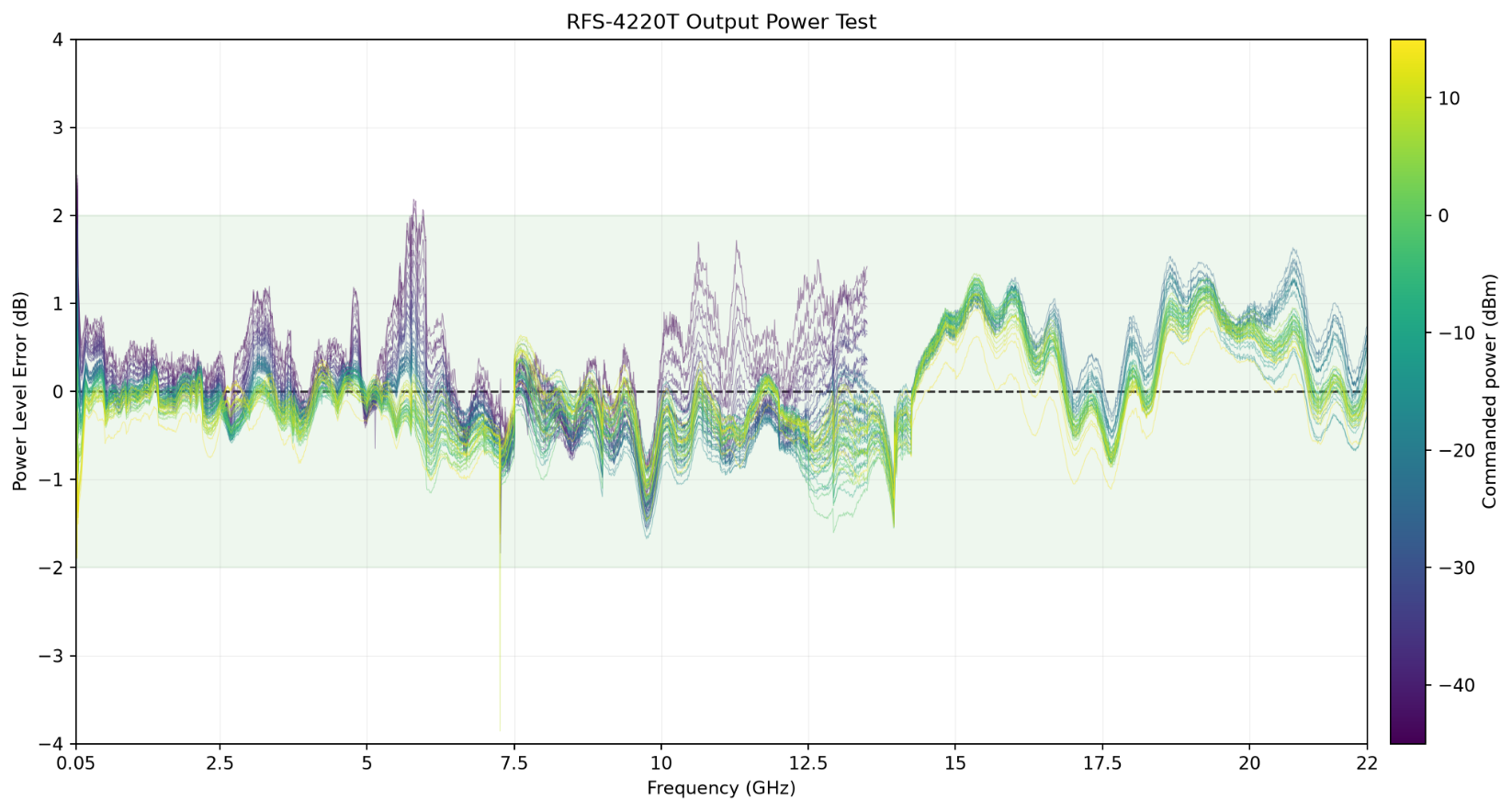
| Power accuracy | ±2.0 dB typical |
| Frequency step size | 1 Hz |
| Harmonic content | < -25 dBc typical |
| Reference source | Internal 10.0 MHz OCXO or external 10.0 MHz reference |
| Internal reference stability | ±10.0 ppb |
| Control interface | Touchscreen, front-panel buttons, or computer application |
| Power supply | 90–264 VAC, 50/60 Hz, 100 VA max |
| Size & enclosure | 8.6 × 4 × 12.25 in (21.84 × 10.16 × 31.12 cm) |
| Weight | 5.6 lbs (2.55 kg) |
Phase Noise
Power Accuracy
4Local touchscreen and front-panel control
The RFS-4220T includes an integrated touchscreen interface that provides full access to instrument operation without requiring a separate PC. Users can configure CW frequency, output power, phase, sweep settings, reference settings, trigger behavior, and saved list sweeps directly from the instrument. The front panel also includes physical buttons and a rotary knob for complete tactile operation, kept synchronized with the touchscreen.
5Remote computer control
The RFS-4220T can also be controlled from an external computer over LAN or USB using a matching graphical software interface, providing the same core control experience as the integrated touchscreen GUI. A device discovery page automatically detects compatible devices on the local network, and toggleable multi-session operation lets multiple computers coordinate control of the same instrument.
6Sweep operation and internal storage
The RFS-4220T supports sweep-list configuration and storage directly on the instrument. Users can create, save, recall, and run list sweep configurations from the touchscreen, stored as CSV files on internal storage, with upload of compatible CSV sweep files from an external computer.
7Reference and triggering
The RFS-4220T includes external 10 MHz reference input capability for synchronization to a shared lab frequency standard, plus external triggering for synchronized test operation coordinated with other equipment in a measurement system.
8Applications
The RFS-4220T is a continuous-wave and swept microwave source with touchscreen, front-panel and remote control. The notes below describe where it fits in each application and which of its capabilities carries the work.
General RF Lab Use
One instrument covers the bench from 0.1 GHz through 20 GHz calibrated and sets as high as 22 GHz, at levels from -45 dBm up to +15 dBm. The touchscreen, the front-panel buttons and the rotary knob each drive the full instrument, so a quick check never waits on a PC to boot. At 5.6 lbs and 8.6 by 4 by 12.25 inches it moves between benches without a cart.
Educational / University Lab Use
A student can produce a calibrated signal in the first minute of a lab session, because nothing has to be installed first. The same unit then teaches remote control properly, since every front-panel function is reachable over SCPI when the course moves on to automation. One box spans VHF through microwave, so a teaching lab does not need three.
Flexible LO Sourcing
Low phase noise and an internal 10 MHz OCXO holding 10 ppb make this a clean local oscillator for mixers, converters and receiver front ends. Feed the external 10 MHz input from the house standard when the measurement has to stay coherent with everything else on the bench. Fine level control puts drive exactly where the mixer wants it.
Up-converting and Down-converting
As the LO behind a mixer, this generator sets the conversion. A 1 Hz step size lets you land an intermediate frequency precisely rather than trimming afterwards, and the OCXO holds it there through the measurement. Harmonics are specified at -25 dBc typical, so plan a filter when a conversion demands a purer tone.
Automated Testing Environments
SCPI over LAN or USB puts every function under program control, and the external trigger input lets the source step in time with the rest of the rack instead of being polled. Sweep lists live in internal storage, so a station recalls a saved CSV rather than rebuilding the sweep at run time. Multi-session control lets more than one host share the instrument without a switchbox.
Production Verification and Test Setups
Automatic network discovery means a replacement unit joins the line without anyone editing an address into a test script. Saved sweep lists make the stimulus identical on Monday and on Friday, which is what makes a production result comparable. Power accuracy of 2.0 dB typical sets a known bound when you write the limits.
Antenna Design
Run a stored sweep list while the antenna rotates, then recall the identical sweep for the next build so two patterns can honestly be compared. Coverage to 22 GHz reaches modern patch, horn and array work in one instrument. Output to +15 dBm supplies useful drive for chamber and near-field measurements.
EMC Testing
For pre-compliance immunity work, the generator steps through a saved frequency list while a monitor watches the product under test. The external trigger keeps each step aligned with dwell and measurement timing, so the log lines up with the stimulus. Knowing the harmonic content is -25 dBc typical tells you when to add a filter and keep a failure attributable to the product rather than the source.
802.11n Development / Testing
This is a CW and swept source, so in a wireless lab its job is the interferer and the local oscillator rather than the modulated waveform. Place a clean tone in the 2.4 GHz or 5 GHz bands to measure receiver desensitization, adjacent-channel rejection and blocker performance. Levels down to -45 dBm let sensitivity work happen at realistic amplitudes.
5G Testing
The same role applies to sub-6 GHz and mid-band 5G development: a stable CW stimulus, a clean LO for a converter stage, or a controlled blocker for receiver characterization. Frequency coverage well past the FR1 bands leaves headroom for harmonic and spurious investigations that stop at the band edge on a narrower source.
Ku-band Satellite Link Testing
Coverage reaches both the roughly 12 GHz downlink and 14 GHz uplink ranges from a single box, which is the awkward span for many bench sources. Note that the output range changes above 13.5 GHz to -26 dBm through +15 dBm, so check the uplink side against your link budget. Lock to a station reference where the measurement has to stay coherent.
X-Band Radar Applications
The 8 GHz to 12 GHz band sits comfortably inside the calibrated range, with the phase noise performance a radar receiver chain expects from its local oscillator. Stored sweeps repeat the same frequency profile across builds and across shifts. The external trigger ties the source to the radar's own timing rather than to a stopwatch.
Line of Sight Link Testing
Point-to-point links need a source that holds a frequency and a level for as long as the test runs, then returns to exactly the same settings tomorrow. The OCXO reference and saved instrument states cover both. Coverage to 22 GHz reaches the licensed microwave bands these links occupy.
Wireless Infrastructure Design
During base station and repeater development the generator serves as the reference tone for gain and flatness, the LO for a conversion stage, or the unwanted signal for isolation and rejection tests. Remote control over LAN keeps it in the rack while the engineer works from a desk. One box covers the cellular bands and the microwave backhaul above them.
Transponder Verification
Interrogate a transponder with a precisely placed carrier, and step through a saved list to confirm the response across its operating range. The 1 Hz step size resolves narrow channel plans, and level control from -45 dBm establishes the threshold at which the unit still answers.
Aerospace / Defense Research
Programs in this space usually need reach, repeatability and a documented reference. Coverage to 22 GHz, an OCXO time base with an external reference input, and SCPI control provide all three from a benchtop chassis that runs on standard mains. Saved sweep lists keep a test reproducible long after the engineer who wrote it has moved on.
Not a modulated-waveform source. The RFS-4220T generates CW and swept signals. Where an application calls for vector modulation or arbitrary waveforms, pair it with a vector signal generator and use the RFS-4220T as the local oscillator, the interferer, or the reference tone.
9Ordering information
| Model | Product | Description |
|---|---|---|
| RFS-4220T | RFS-4220T | RF signal generator, 0.1 GHz to 22 GHz |
| RFS-4220T | SA-8000-3 | Three-year service agreement (optional) |
Cited in peer-reviewed research
Independent publications citing this instrument, indexed by Bioz. Citation counts and Bioz Stars ratings are shown live and update as new papers are indexed.