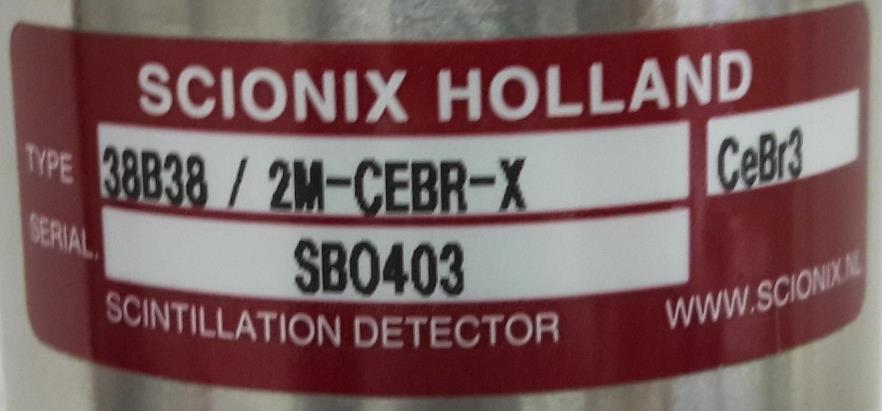
A detector ordered from a catalog is a configuration: a specific scintillator, in a specific size and shape, mounted in a specific housing, coupled to a specific photodetector, with specific options. Every detector manufacturer compresses that configuration into a type number, and no two manufacturers do it the same way. This chapter is about how those schemes are built, how to read one you have never seen before, and what a type number can and cannot tell you.
A fully custom detector built once for one application can be specified on a drawing. A catalog detector ordered hundreds of times cannot. It needs a short string that carries the configuration with it through quoting, purchasing, manufacturing, test, shipping, and twenty years of service history.
Vendors use nomenclature to do several jobs at once, and the jobs explain most of the differences between schemes.
To define the product. The primary job. A structured type number states the crystal, the size, the housing, the readout, and the options in a form both the specifying engineer and the building engineer read the same way.
To route manufacturing. Inside the factory the type number often drives the traveler: which cell grows or receives the crystal, which seal process, which test fixture. Fields that look redundant to a customer are frequently there because a production system needs them.
To carry version control. Detector designs change. A tube goes end of life, a window material is requalified, a divider is redesigned. Many vendors append a revision or dash number so that the physical build behind a given part number is fixed, and a changed build gets a changed number. A customer who reorders "the same detector" and receives a different dash number has been told, in the only place the vendor can reliably tell them, that something changed.
To reference past builds. A large fraction of detector orders are repeats of something built before, sometimes decades before. Vendors keep legacy designators alive for exactly this reason, and will often carry an old code forward inside a modern part number so that a customer's maintenance records still resolve. This is why real catalogs contain codes that look inconsistent with the rest of the scheme. They usually are, and the inconsistency is deliberate.
To scale the catalog. A catalog with a few hundred standard entries and tens of thousands of possible customizations only works if the naming is generative. Structured fields let a new configuration be named without a committee.
Schemes differ in order, delimiter, and vocabulary. They agree, to a remarkable degree, on which attributes are worth encoding. Expect to find most of these nine in any manufacturer's system:
A detector's identity is a point in that nine-dimensional space. Every vendor is describing the same space. They label the axes differently.
This is the part that catches people out, because the codes look similar enough to invite a wrong assumption.
Positional versus delimited. Some schemes are strictly positional, where the third group is always the crystal length whether or not it is stated. Others are delimited and order-tolerant, where a suffix can appear anywhere after the core. Read a scheme's own key before counting fields.
Prefix families versus suffix flags. Most vendors put geometry in a prefix and options in suffixes, but the boundary moves. A magnetic shield may be a prefix letter in one catalog and a slash-code suffix in another. A thin entrance window is sometimes a distinct family and sometimes an option on the standard family.
Published versus internal numbers. The number on the datasheet and the number on the factory traveler are often not the same string. A quotation may carry one, a shipping label another, and a calibration certificate a third. When a customer and a vendor appear to disagree about what was ordered, this is a common cause.
Revision and dash suffixes. A trailing dash number, letter, or year is usually a build revision rather than a performance variant. Treat a changed suffix as a question to ask, not a typographical detail.
Legacy carry-forward. Codes that predate the current scheme survive because customers' records reference them. A vendor is generally right to keep them. A reader is generally wrong to infer the current field rules from them.
Units and material conventions. Millimeters dominate, but inch-class detectors are commonly still named in inches, sometimes in the same string as a millimeter dimension. Material naming varies too. NaI(Tl) may appear as NAI, NaI-Tl, or NAITL depending on what the vendor's order system accepts.
The practical rule follows directly. A code that means one thing in one manufacturer's catalog can mean something entirely different, or nothing at all, in another's. Never decode a part number using a scheme it did not come from. Ask the vendor for their key, and keep it with the purchase record.
To make the rest of the book concrete, the practical chapters use one representative scheme. It is a composite teaching notation drawn from conventions that are common across the industry. It is not any single manufacturer's catalog system, and it should not be used to place an order with anyone. Its purpose is to let Chapters 11, 12, and 14 discuss configurations in a consistent shorthand.
The representative type number reads left to right.
Field 1: Housing style code. A letter or letter-pair indicating the geometry.
| Code | Geometry |
|---|---|
| A | Demountable PMT, separate crystal housing and PMT |
| B | Standard PMT integrated, side viewing |
| BA | B-style with thin entrance window for X-ray work |
| BD | B-style with built-in voltage divider |
| BM | B-style with magnetic shield |
| C | Crystal only, no photodetector |
| CA | C-style with thin window |
| CD | C-style with built-in divider preamplifier |
| D | Crystal with photodiode readout |
| S | Crystal with SiPM array readout |
| SA | S-style with thin window |
| SP | Project-specific custom configuration |
Field 2: Crystal diameter. Millimeters. For square crystals, the side length is given, with a square indicator symbol on drawings.
Field 3: Crystal height or length. Millimeters. For well detectors, the well dimensions are appended in parentheses.
Field 4: Light detector size. Inches diameter for round PMTs and SiPM modules. For arrays, the format is "N x size", for example 4x16mm for a four-die array of 16 mm modules.
Field 5: Quantity of light detectors. Default 1. For dual-end readout on long bars or large crystals, 2.
Field 6: Photodetector type and features. A tube designation for PMTs, or a family code for SiPM arrays.
Field 7: Scintillation material. Chemical formula plus activator: NaI(Tl), CsI(Tl), LaBr3:Ce, GAGG:Ce, CLLBC.
Field 8: Extra features. Optional codes:
| Code | Feature |
|---|---|
| /M | Mu-metal magnetic shield |
| /T | Temperature stabilization |
| /L | Built-in LED pulser |
| /A | Built-in Am-241 alpha pulser |
| /LBG | Low-background construction |
| /Q | Quartz window |
| /TW | Thin window |
| /HV | Built-in HV supply |
| /D | Built-in digital pulse processor |
Field 9: Divider or base style. Numeric code referring to a divider design tied to particular tube types and performance optimizations.
Five examples in the representative notation, to show how the fields combine.
Example 1: Handheld gamma spectrometer.
Type number: S-25S-25-12mm-SiPM-CsI:Tl/A/D
Decoded: S-style SiPM-coupled crystal, 25 mm diameter, 25 mm length, 12 mm SiPM array, CsI(Tl) scintillator, with built-in alpha pulser and digital pulse processor. A typical compact spectrometer for portable instruments.
Example 2: Down-hole well-logging probe.
Type number: BD-25S-100-2-HT-CsI:Na/T/HV
Decoded: BD-style with built-in divider, 25 mm diameter, 100 mm length, 2-inch high-temperature PMT, CsI(Na) scintillator, with temperature stabilization and built-in HV supply. Suitable for the elevated-temperature operating environment described in Chapter 8.
Example 3: Low-background environmental counter.
Type number: B-76S-76-3-LB-NaI:Tl/M/LBG/A
Decoded: B-style, 76 mm diameter, 76 mm length, 3-inch low-background PMT, NaI(Tl), with mu-metal shield, low-background construction, and alpha pulser. The standard 3-inch by 3-inch low-background gamma counter.
Example 4: TOF-PET module.
Type number: S-array-4mm-20mm-12x12-SiPM-LYSO:Ce/D
Decoded: S-style array, 4 mm by 4 mm by 20 mm pixels, 12 by 12 array, SiPM readout, LYSO:Ce scintillator, with built-in digital pulse processor. The standard PET ring module.
Example 5: Dual gamma-neutron handheld.
Type number: S-32S-32-15mm-SiPM-CLLBC/A/D
Decoded: S-style, 32 mm diameter, 32 mm length, 15 mm SiPM array, CLLBC scintillator, with alpha pulser and digital pulse processor, which performs the pulse-shape discrimination for neutron-gamma separation.
Note what the notation deliberately does not carry: no manufacturer's tube part number and no proprietary SiPM family code. Real catalogs do carry those, and they are among the fields most likely to differ between vendors.
Most production detectors fit a catalog designation. Custom configurations get extended type numbers with appended descriptors, and for a one-off with no catalog equivalent a project-specific designator is assigned, often an "SP-" prefix followed by a project code.
Established manufacturers accumulate thousands of unique custom configurations over their operating history. The ability to name a configuration in a way that compresses the right information, and that still resolves twenty years later when a customer asks for another one, is what allows a catalog to scale. It is also why mature schemes look untidy. They are carrying their own history.
BNC in Practice - Always quote the full type number, never just the crystal
A customer who asks for "a 3-inch by 3-inch NaI(Tl) detector" has not specified the deliverable. The same crystal in three different housings, with three different PMTs, with three different divider designs, is three different products with three different prices, three different lead times, and three different operating envelopes. The discipline that prevents misunderstanding is to confirm the full type number in writing before quoting, and to confirm whose scheme it belongs to. Five minutes of disambiguation prevents weeks of remake work. Customers who know detectors expect this discipline. Customers who do not know detectors will appreciate that you walked them through it.
Two things never fit in a type number and always have to be specified separately: the calibration certificate, where each detector ships with measured energy resolution, peak position, and count rate at a stated activity, and the optical surface treatment of the crystal, whether polished, matte, or a custom reflector. Both materially affect performance. Both are agreed in writing before manufacturing starts.
The type number is a label. The complete agreement is the manufacturing drawing plus the calibration specification plus the test record. The next chapter is about what goes into those three documents.
Take it interactively. The quiz lives on its own page. Pick one answer per question, then check your score. Auto-scored, and your answers are saved on this device. About 8 minutes.
Or read the questions and answers inline below (preserved for print and offline use).