


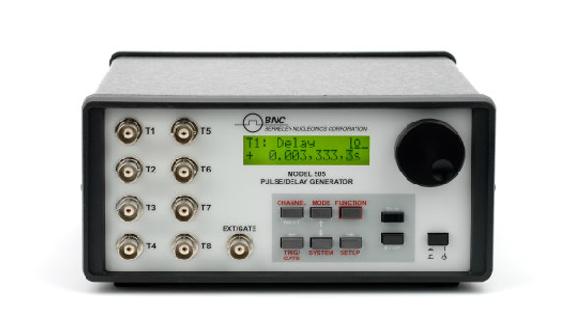
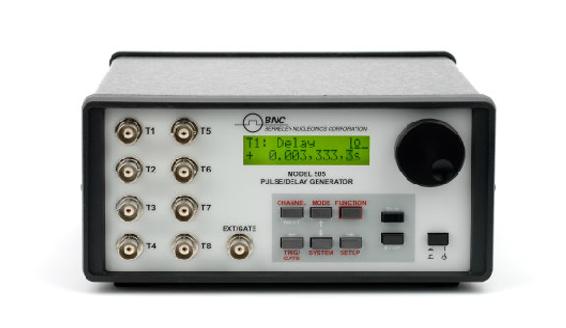

Model 505 expands the previously established boundaries of antiquated pulse generating equipment by adding eight independent channels, multiple modes of operation, and 16 different edges into a single instrument. As a pulse generator, the Model 505 provides rate, delay, width, and output adjustability with each channel. As a digital delay generator, Model 505 provides fine resolution, timing, and low jitter. By allowing external, internal, and 3rd party software to control the 505, this Digital Delay and Pulse Generator can address many application specific requirements.
Overview
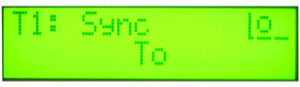
The outputs are synchronized to one another with coherence of 5 ns. A channel’s timing can be referenced to any other channel or to the zero delay point (To). The edges are adjustable in 10 ns steps. Channels can be selectively gated, enabled, or disabled. Each channel possesses separate output level and polarity characteristics along with system level gating capability. Model 505 provides the ability to store custom parameter settings which are able to be recalled for later use.
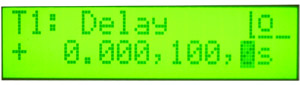
The Model 505 Digital Delay Generator provides 2, 4, or 8 delay and width outputs capable of synchronizing to either external or internal triggers. The Model 505 Digital Delay Generator also offers delay and width resolution of 10 ns.
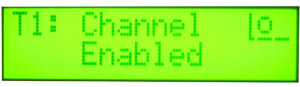
Channels for the Model 505 Digital Delay Generator can be selectively gated, enabled, or disabled with each channel delivering selectable output polarities and an independently adjustable level. These models also allow the selection of a reference to which each channel is synchronized. For example, any channel can be synchronized to an external trigger (To), internal trigger (also To) or the leading edge of any other channel (T1 thru Tn). The channels operate in modes independent of the other channels. Mode availability includes gated, enabled, burst, single shot, normal, duty cycle (divide by N).
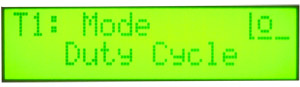
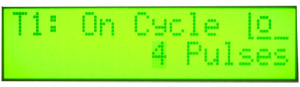
The Model 505 Digital Delay Generator also operates in triggering modes common to all channels. A continuous mode provides pulse periods with 500 ps and 10 ns resolution. This allows orders-of-magnitude finer control of the triggering interval than with a frequency controller. A single-shot mode produces a single pulse with each pushbutton or each external trigger. A burst mode produces a burst of pulses that are selectable from 1 to a million. The duty cycle mode provides M pulses on and N pulses off (divide by N, if desired). The ability to store several complete setups into memory allows recall. The Model 505 Digital Delay Generator supports Ethernet, USB, RS232, and GPIB. The Model 505 Digital Delay Generator offers an adjustable level up to 20 V.
TIMING DELAYS AND WIDTHS
| Delay | 0 to 1000 seconds with 10 ns resolution |
| Width | 100 ns to 1000 seconds with 10 ns resolution |
| Accuracy | 10 ns + .0001 delay |
| Time Base | 50 MHz, 50 ppm crystal oscillator |
| RMS Jitter | < 2 ns |
EXTERNAL TRIGGER/GATE
| Rate | DC to 2 MHz |
| Insertion Delay | < 250 ns |
| Threshold | 200 mV - 15V |
| Trigger Slope | Rising or falling edge, selectable |
| Gate | Active low or active high selectable |
| Impedance | 1000 ohms |
INERNAL REP RATE GENERATOR
| Rate | 0.001 to 2 MHz |
| Accuracy | 5 ns + 0.0001 x period |
| RMS Jitter | < 500 ps |
| Outputs | Adjustable to 20 V |
| Impedance | 50 Ω |
ADJUSTABLE AMPLITUDE
| Slew Rate | > .2 V/ns |
| Amplitude | 1 V - 10 V into 50 Ω load 2 V - 20 V into Hi-Z |
| Peak Current | 150 mA per channel |
| Average Current | 200 mA ave. (total for all channels) |
| Polarity | Positive (active high) or negative |
COMPUTER INTERFACE
| RS232 | 4800, 9600, 19200 & 38400 |
| IEEE 4888 | Standard |
| 19' Rackmount kit | |
| Extended Service/ calibration agreements |

Downloadable resources such as datasheets, firmware, software, drivers and products manuals. Alternatively, you can browse resources directly by visiting our downloads page.
• Product Datasheets
• Product Firmware
• Product Software and Drivers
• Product Manuals
Price List
Price lists are available to our registered users. To view pricing for this and other products, please log in or create a free account.
