A Berkeley Nucleonics Field Handbook
RIIDs in the Field
A Field Handbook for First Responders & HazMat Teams
Berkeley Nucleonics Corporation
Second Edition · 2026
A Message from the President
We wrote this book because there is a gap we have seen again and again: agencies that invest in the right instruments, train on basic operation, and then deploy without a tactical framework for what to do when the alarm sounds. A RIID is not just a detector. It is a decision tool. The field handbook you are holding is our attempt to close that gap, specifically for HazMat teams and first responders who carry the SAM family of handhelds and the RD-120 backpack and vehicle systems into real incidents, not controlled exercises.
Berkeley Nucleonics has been building radiation instrumentation for decades, and this is one of the areas we are most energized about right now. The technology is mature enough to be genuinely reliable in the field, and the operational doctrine is finally catching up. That combination makes this a good moment to get it right. We hope this handbook earns a permanent spot in your truck.
David Brown
President, Berkeley Nucleonics Corporation
Copyright
Copyright (c) 2026 Berkeley Nucleonics Corporation. All rights reserved. No part of this book may be reproduced or transmitted in any form without prior written permission, except brief quotations in reviews. RIIDs in the Field, Second Edition, 2026. Published by Berkeley Nucleonics Corporation, San Rafael, California. SAM, RD-120, and the Berkeley Nucleonics logo are trademarks of Berkeley Nucleonics Corporation; specifications are subject to change, consult the current datasheet for authoritative figures.
Why a Second Edition, and Why Now
Radiological response has moved fast since the first edition. Reachback has become routine rather than exceptional, threat-spectrum libraries have grown, and the line between a HazMat call and a security event keeps blurring. Responders told us the same thing in the field: the procedures held up, but they wanted them tied more tightly to how teams actually work a scene today, from the first alarm to the handoff to a health physicist. This edition rebuilds the SOPs around that feedback.
Now is the moment because the instruments and the doctrine have finally caught up to each other. The hardware is reliable enough to trust in real incidents, and the operational frameworks around identification and reachback are mature enough to teach cleanly. We tightened the prose, refreshed the scenarios, and kept the one rule that has guided this book from the start: a RIID is a decision tool, not just a detector.
Foreword
A radioisotope identification device, a "RIID", is one of the most consequential tools that a HazMat team or law enforcement officer can carry. Pagers and survey meters tell you radiation is present. A RIID tells you what it is. That single shift, from "something is radioactive" to "this is Cs-137 from a disused industrial gauge," is the difference between a wide cordon, a frightened public, and an open-ended event versus a measured, proportional response that ends quickly and safely.
This handbook was written because too many responders carry RIIDs without a tactical playbook for using them. It is not a sales catalog. It is a field manual. The procedures here have been distilled from years of supporting agencies who deploy SAM family handhelds and RD-120 backpack and vehicle systems in real incidents, traffic stops, lost industrial sources, large public events, hospital false alarms, port screening, and post-incident contamination control.
Use this book the way it was designed: keep one in every truck, every command rig, every backpack pouch. Reference it during slow shifts. Tab the pages your team uses most. Make notes in the margins. The best operators are the ones whose handbooks are dog-eared.
Berkeley Nucleonics Corporation
Contents
How to Read This Book
The book divides into three working layers. Part I (Chapters 1-3) builds the foundation: mission and audience, "Radiation in 6 Pages," and "The Detection Ladder," which places RIIDs alongside pagers, survey meters, and portal monitors. New to radiological response? Read Part I first. Years of field time? Skim it to confirm your mental model matches the framework used throughout.
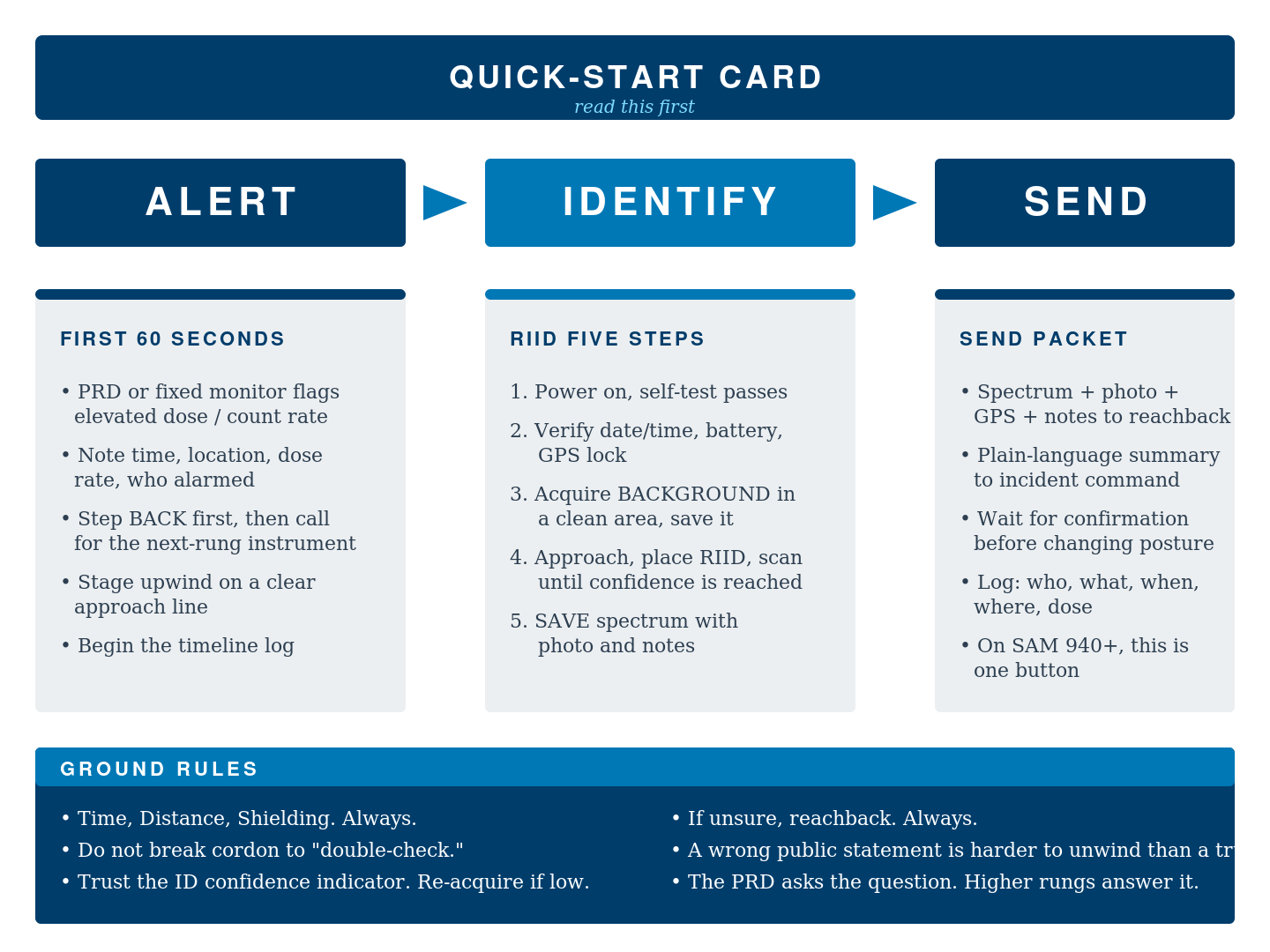
Part II (Chapters 4-5) covers the instruments. Chapter 4 describes the SAM family and the RD-150 system, including detector types, form factors, and how the hardware maps to mission profiles. Chapter 5 walks the operational core: alert, identify, send. These two chapters are the backbone. Experienced SAM users can treat them as reference, jumping to the subsection that matches a configuration question.
Part III (Chapters 6-9) is where the work happens. Four scenario SOPs cover vehicle stops, public events and wide-area search, medical isotopes and NORM scenes, and cargo, ports, and post-detonation response. Each follows the same alert-identify-send structure, so once you drill one, the others feel familiar. The Appendices add isotope quick-reference cards, a reachback worksheet with QA checklists, a glossary and time-distance-shielding aid, a standards crosswalk, and training pathways. Appendix A is the one you will reach for most on scene.
Quick-Start Card (Read This First)