9. SOP-4: Cargo, Ports, and Post-Detonation Response
9.1 Scenario


This SOP covers two mission profiles that share procedures: screening and secondary inspection of cargo at a port, weigh station, or border crossing; and post-detonation work in a contaminated area following a radiological incident or accident.
9.2 Objectives
For cargo screening: 1. Resolve portal monitor alarms quickly without halting commerce unnecessarily. 2. Identify NORM cargo correctly; release per protocol. 3. Identify and isolate true threat material; escalate per federal protocol.
For post-detonation response: 1. Define and maintain a hot-zone perimeter. 2. Identify dominant isotopes in fallout/contamination. 3. Track operator dose; rotate teams. 4. Support federal/state recovery operations as the lead authority changes hands.
9.3 Triggers for SOP-4
- Portal monitor alarm at port, weigh station, or border
- Manifest discrepancy with radiological cargo
- Federal request for HazMat support at a screening event
- Confirmed radiological dispersion device or incident
- Industrial accident involving radioactive sources
9.4 Actions: Cargo Inspection
- Receive portal alarm details: lane, time, peak reading, conveyance description.
- Direct the conveyance to a secondary inspection bay.
- Operator approaches with SAM handheld and survey meter.
- Survey the conveyance perimeter to map the highest dose rate location.
- Run the SAM scan at the highest-rate point.
- Identify, save spectrum, photograph manifest and conveyance.
- Cross-check identification against manifest: - Match → release per protocol. - NORM consistent with cargo type → release per protocol. - Mismatch or unexpected isotope → hold; reachback; coordinate with federal partner if SNM, neutron emitter, or major industrial source.
- Log every event regardless of outcome.
BNC in Practice: Manifest Cross-Check Shortcut
Three quick questions clear most cargo alarms: (1) Does the manifest list a radioactive class? (2) Does the SAM identification match the typical NORM signature for that cargo type (granite, fertilizer, ceramics, oilfield pipe)? (3) Is the dose rate at perimeter consistent with packaging and quantity stated on the manifest? Three yeses, release. One no, hold and reachback.
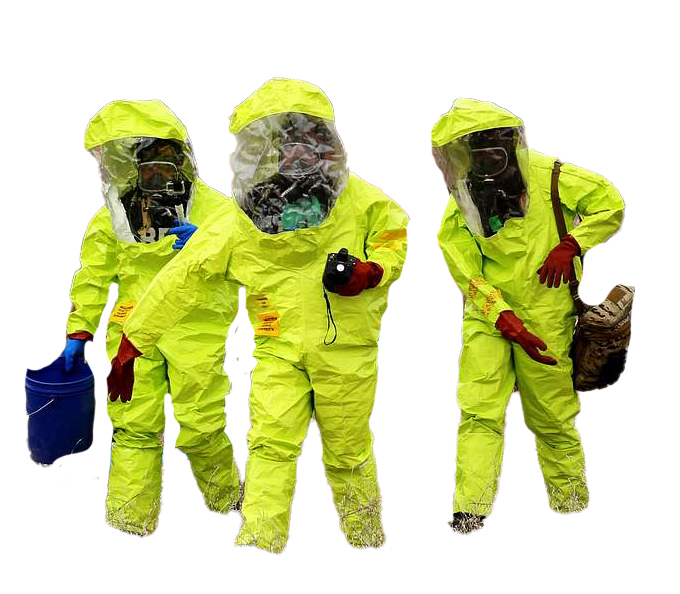
9.5 Actions: Post-Detonation / Contaminated Area
- Stage uphill, upwind, upstream. The perimeter does not start at the visible damage; it starts where dose rate is acceptable for working teams.
- Establish working zones: hot, warm, cold. Survey meters define the boundaries; RIIDs identify the contamination.
- Operators entering the hot zone wear PPE per agency protocol and carry both PRD (continuous monitoring) and RIID (identification on demand).
- Dose tracking is mandatory. Every operator carries a dose meter. Rotation rules are written before entry.
- The RD-120 backpack is the right tool for mapping contamination across a wide area; the SAM handheld is the right tool for confirming hotspots and identifying isotopes at specific locations.
- As federal teams arrive, formal hand-off occurs. HazMat continues to support; the lead transitions per the National Response Framework.
- Decontamination of operators and equipment is run continuously, not at the end of the shift.
- Spectra and dose data are archived in real time to the operations center.
9.6 Decision Points
| Situation | Likely Action |
|---|---|
| Cargo portal alarm + NORM identification + manifest match | Release |
| Cargo portal alarm + medical identification | Verify with shipper; release per protocol |
| Cargo portal alarm + unexplained industrial isotope | Hold; reachback; coordinate licensee |
| Cargo + neutron alarm | Hold; immediate federal coordination |
| Post-detonation high dose rate at perimeter | Pull back; redefine perimeter; await reinforcement |
| Operator approaching dose limit | Rotate immediately; assign to cold zone |
| Equipment contaminated | Decon at warm zone; do not re-enter hot zone with uncertain status |
9.7 Common Pitfalls
- Treating cargo screening as production work. Speed is good; rushing the ID is not.
- Underestimating shielding. A heavily shielded source can produce a small but real signature; trust the spectrum, not the magnitude.
- Skipping rotation discipline post-detonation. Operators take dose they should not have, and downstream teams arrive to a depleted force.
- Letting equipment cross-contaminate. Hot-zone instruments need to stay on the hot side of the line, or be decontaminated explicitly before crossing.
- Confusing federal hand-off with mission end. HazMat almost always continues to support after the lead transitions.
9.8 Reachback Packet for SOP-4
Same content as §6.6, plus:
- For cargo: manifest, container/conveyance number, port of origin, port of destination.
- For post-detonation: operations-center event number, current zone definitions, dose-rate map, operator dose log to date, decon status.
9.9 SOP-4 Checklist (Tear-Out)
CARGO
- Portal alarm details captured
- Conveyance moved to secondary
- Survey meter perimeter sweep
- SAM ID with spectrum saved
- Manifest cross-check
- Reachback if mismatch
- Release or hold per decision tree
POST-DETONATION
- Stage uphill / upwind / upstream
- Hot/warm/cold zones defined and signed
- Operator PPE + dose meter + PRD verified
- RD-150 mapping in progress
- SAM hotspot ID program running
- Rotation schedule active
- Decon at warm zone running
- Spectra and dose data feeding ops center
- Federal hand-off coordinated