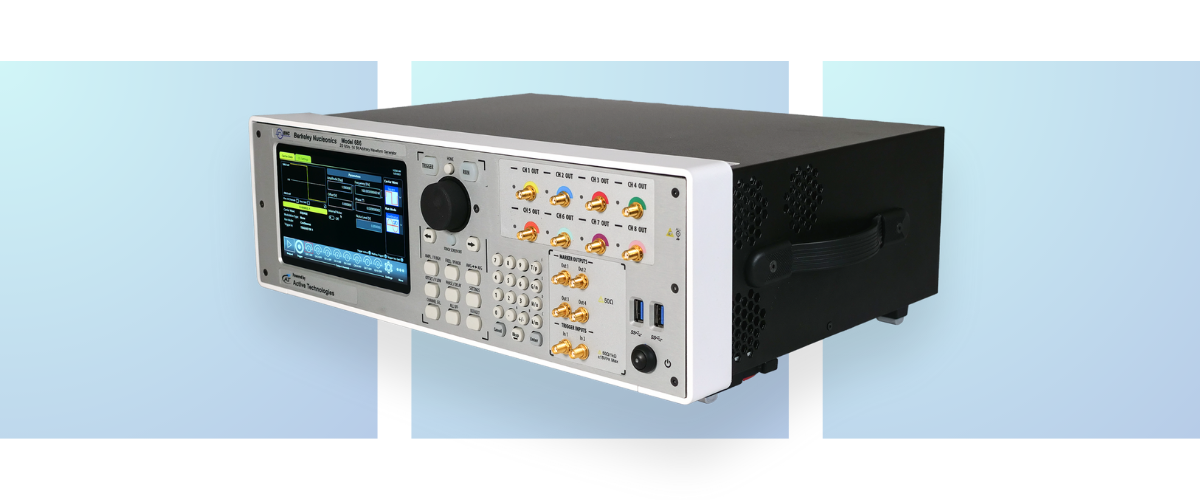
When it comes to testing today’s advanced semiconductor devices, precision and speed are non-negotiable. Test engineers are constantly challenged to replicate high-speed signals with fidelity and control. That’s where the Model 686 Arbitrary Waveform Generator (AWG) from Berkeley Nucleonics comes in. Offering an unmatched blend of speed, resolution, and versatility, it delivers exactly what’s needed for modern semiconductor validation. Let’s take a closer look at what makes this AWG a standout in its class.

Exceptional Speed and Resolution
The Model 686 delivers a real-time sampling rate of 20 GS/s and up to 6.5 GHz sine output, all while maintaining a true 14-bit resolution. That level of performance means you can emulate the kind of signals seen in PCIe Gen3, USB 3.0, and other high-speed digital systems. It’s not just fast—it’s clean, giving you low-distortion waveforms that reveal how your devices behave under real-world conditions.
Sharp Transitions and Signal Strengths
Semiconductor testing often requires precise edge transitions and varied voltage levels. With a rise time of just 50 ps and output voltages reaching 5 Vpp, the Model 686 enables both. Whether you’re testing a fast-switching digital circuit or an analog front end, this AWG gives you the signal sharpness and strength to do it properly.
Synchronized Analog and Digital Outputs
Each unit can output up to four analog channels along with 32 digital lines, all running in tight sync. This is especially useful for mixed-signal testing—like running a baseband signal while toggling control lines or injecting parallel data. Everything lines up in time, so your test results are as reliable as your setup.
Room for Complexity
Test scenarios aren’t always simple. Fortunately, the Model 686 gives you 9 GSamples of memory per channel, letting you load extensive waveform data without breaking a sweat. Complex multi-step test sequences, real-world signal captures, or stress patterns—this AWG handles them with ease.
Built to Scale
As your test requirements grow, so can the Model 686. Connect up to four units via its internal synchronization bus and you’re working with 16 analog and 128 digital outputs—without losing timing accuracy. Great for parallel testing or large-scale IC evaluation.
User-Friendly from the Start
The included Simple Rider software is just what it sounds like—simple. It’s touchscreen-ready and designed to make waveform creation and device control intuitive. Whether you’re setting up pulse trains or working on custom digital patterns, the interface won’t slow you down.
Purpose-Built for Semiconductor Work
From high-speed interface simulation to power device characterization, the Model 686 is well suited for semiconductor labs. You can generate PRBS data streams, control voltage ramps, or emulate noisy environments—all with one box. It’s built to handle whatever modern test benches demand.
A Tool That Grows with You
Beyond semiconductors, the Model 686 is also a staple in photonics, aerospace, and RF labs. That versatility makes it a solid investment—not just for today’s needs, but tomorrow’s challenges too.
Final Thoughts
The Model 686 isn’t just another AWG. It’s a tool that’s been engineered to keep up with how fast the semiconductor industry is evolving. For test engineers who need dependable, high-performance signal generation, this instrument checks every box.