
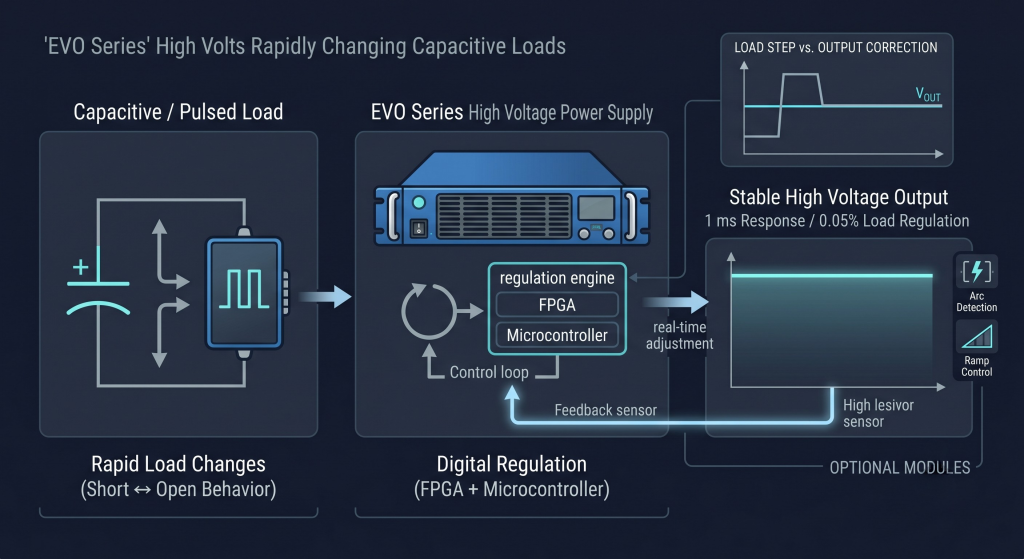
Pulsed-power systems present a high voltage supply with the hardest load profile in the catalog. A capacitive load looks like a short circuit when it is discharged and like an open circuit when it is fully charged. Between those extremes, the load impedance the supply sees is changing continuously, sometimes within a single millisecond. Electro-optic drivers, microchannel plates, time-of-flight instruments, and laser systems all impose some version of this behavior. A supply designed for a quiet resistive load will struggle here. The regulation loop hunts, the output overshoots, or the protection circuitry trips on conditions that are normal for the application.
What a Dynamic Load Demands
The requirements follow directly from the load physics. The supply must source current into a near-short without treating it as a fault. It must back off cleanly as the load voltage approaches the setpoint, without overshoot that stresses downstream components. It must recover quickly when the load steps, because in pulsed systems the load steps constantly. And it must distinguish a genuine arc from an expected surge, since both look like sudden current demand.
These are control-loop problems before they are power problems. Raw wattage does not solve them. Loop speed and load adaptability do.
The EVO Series Under Changing Loads
The EVO Series meets dynamic loads with fully digital regulation. A microcontroller and FPGA handle the control loop, which gives the supply fast signal processing and an adaptable response to changing load conditions rather than a fixed analog compensation tuned for one load type. The published response time on load changes is 1 ms to within 0.1% of nominal voltage. Load regulation from 10% to 90% load is 0.05% of nominal voltage, and ripple is 0.01% peak to peak, so the output stays clean while the load does not.
The series spans 0 to 1.5 kV through 0 to 30 kV DC across its voltage classes, with currents from 0.2 A to 2 A depending on model and 2 kW or 3 kW of output power. For applications where discharge events are an operating condition rather than an anomaly, an arc detection option is available. A ramp control option manages the rate of voltage rise into the load, which is often the difference between a controlled charge cycle and a stressed one. An interlock and configurable I/O terminal integrate the supply into system-level protection.
For repetitive pulsed charging of large capacitor banks at a defined repetition rate and joules-per-second figure, contact BNC applications engineering to confirm the duty profile against the EVO model under consideration.
Pairing With Pulse Generation
In many pulsed systems the EVO supply provides the high voltage rail and a BNC high voltage pulse generator does the switching. BNC pairs EVO models with PVX series pulse generators directly: the 1.5 kV class with the PVX-4151, the 5 kV class with the PVX-4141 and PVX-4000, and the 10 kV class with the PVX-4130 and PVX-4110. One supplier covers the DC source and the pulse electronics, and the interface questions between them are answered before the order is placed.
Specifications Relevant to Dynamic Loads
| Parameter | EVO Series |
|---|---|
| Response time on load changes | 1 ms to 0.1% Unom |
| Load regulation (10% – 90%) | 0.05% Unom |
| Ripple | 0.01% pp |
| Line regulation (±10%) | ±0.01% Unom |
| Regulation architecture | Fully digital, microcontroller + FPGA |
| Arc detection | Option |
| Ramp control | Option |
| Voltage classes | 0–1.5 kV to 0–30 kV DC |
| Output current | 0.2 A to 2 A (model-dependent) |
Engineering Considerations
Characterize the load before selecting the supply. Estimate the effective capacitance, the repetition rate, and the worst-case current demand at the start of each charge cycle, then check that profile against the current rating of the EVO class you are considering. Use the ramp control option when downstream components are sensitive to dV/dt. Wire the interlock into the system safety chain from the first bench test, not after integration.
Key Numbers at a Glance
1 ms response to 0.1% Unom on load changes. 0.05% Unom load regulation from 10% to 90%. 0.01% pp ripple. Arc detection and ramp control available as options.
Send Us Your Load Profile
Tell BNC applications engineering your capacitance, repetition rate, and peak current demand. We will confirm the EVO class and options that handle it.
