


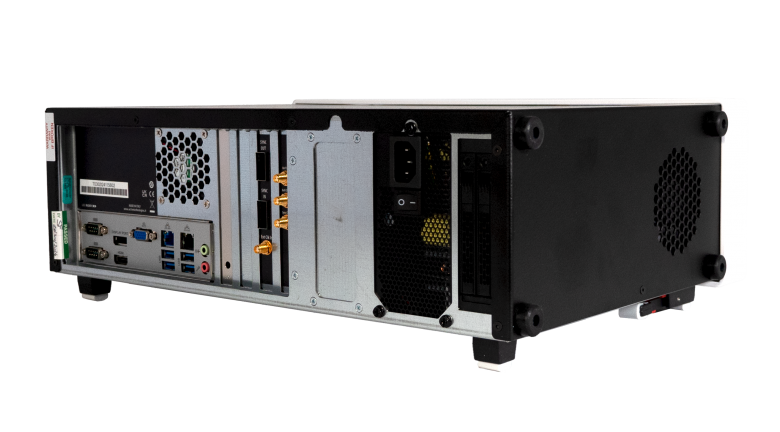

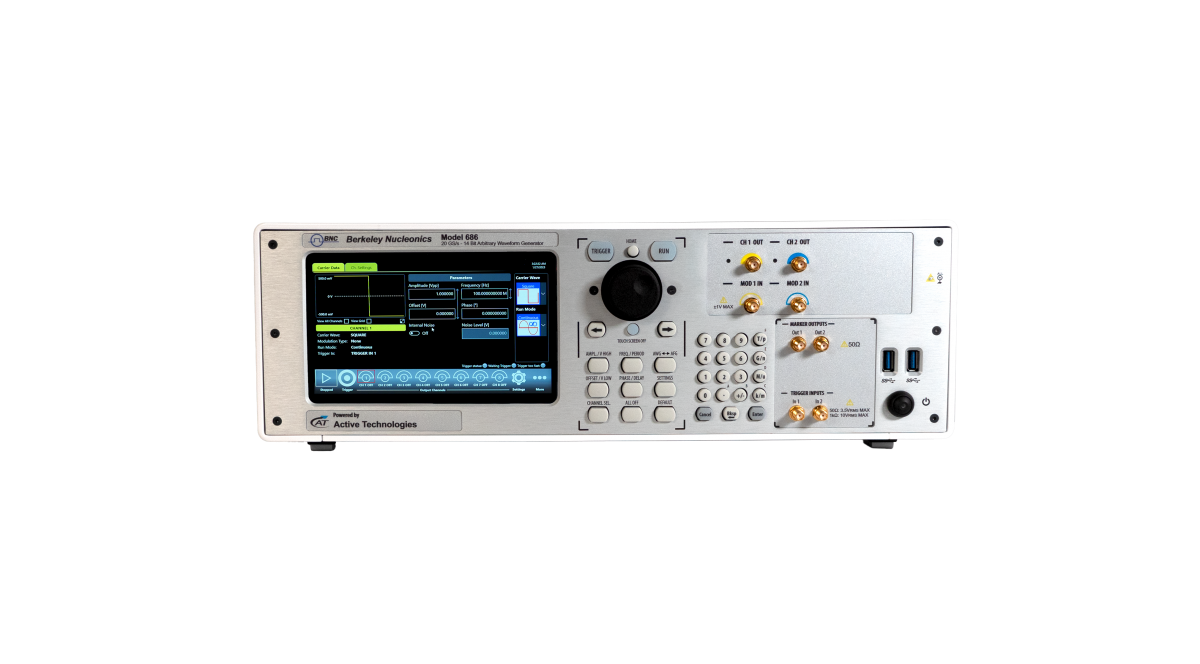
Model 686 Device Configurator
| Number of Channels: | Two Channels Four Channels |
 |
| Output Option: | 1.25Vpp/1.25Vpp Differential Output [-D] 5Vpp Single-Ended Output [-SE] | |
| Output Options: | Serial / Pulse Pattern Generator [-SPG] Fast Sequence Switch (8-bit D-SUB Connector) [-FSS] 8 Digital Channel [-DIG8] 16 Digital Channel [-DIG16] 32 Digital Channel [-DIG32] GPIB and USB-TMC Ports [-GPIB] | |
| Accessories: | 8-bit LVDS to LVTTL Converter [-DTTL8] Mini SAS HD to 16 SMA Cable (8 LVDS Output) [-LVDS-SMA8] Rackmount Kit [-RIDER-RACK] | |
|
Model 686-2C-10GS-D
2 Channel, 10 GSa/s AWG, 1.25Vpp Differential Output, Full Memory
|
||
| GS/s | Output | Model | Description |
| 20 GS/s | Single Ended | 686-2C-SE | 2 CH – 5Vpp Single ended outputs – Full memory |
| Differential | 686-2CD | 2 CH – 2.5Vpp (1.25Vpp single ended) Differential outputs – Full memory – 20 GS/s | |
| Single Ended | 686-4C-SE | 4 CH – 5Vpp Single ended outputs – Full memory – 20 GS/s | |
| Differential | 686-4CD | 4 CH – 2.5Vpp (1.25Vpp single ended) Differential outputs – Full memory – 20 GS/s |
User Interfaces
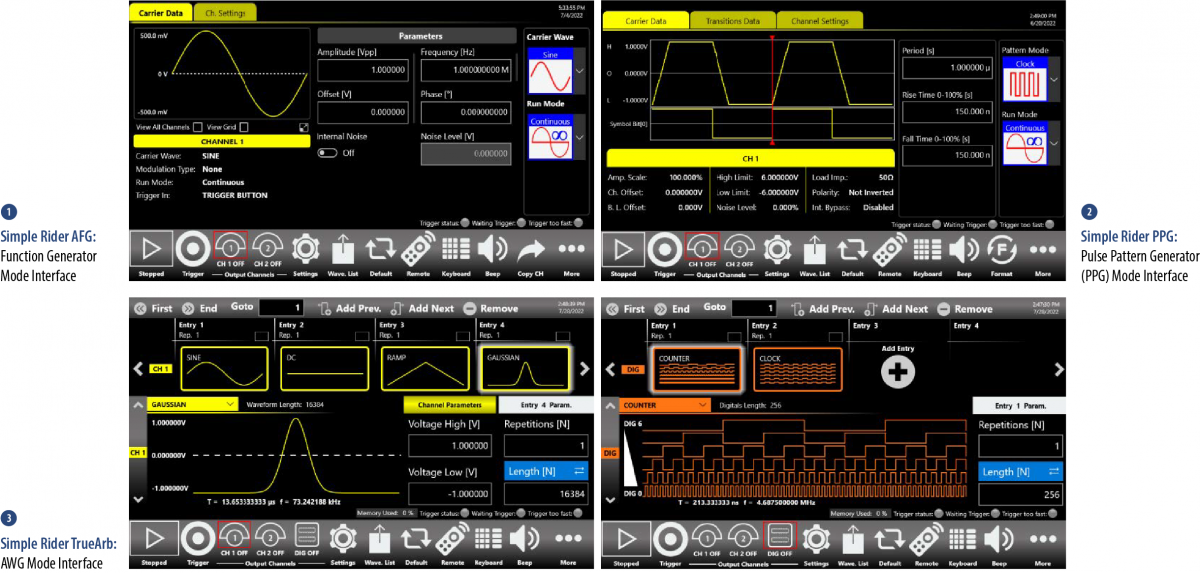
Simple Rider AFG: Function Generator Mode Interface
With its touch-sensitive design, Simple Rider AFG UI aims to provide effortless access to all the features of contemporary Waveform Generators. Engineers and scientists can create complex waveforms or digital patterns with just a few touches thanks to an intuitive user interface (UI) that is comparable to the simplicity of tablets and contemporary smartphones.
- A touch-friendly virtual numeric keypad has been designed to improve the user experience when entering the data.
- The swipe gesture gives easy access to the output waveform parameters
- Time-saving shortcuts and intuitive icons simplify the instrument setup
Simple Rider TrueArb: AWG Mode Interface
Users can define complex waveforms with up to 16,384 sequence entries of analog waveforms and digital patterns in the Simple Rider True-Arb interface. Loops, jumps, and conditional branches are used to define the execution flow of these waveforms.
A perfect tool for troubleshooting and verifying digital designs is digital output synchronized with analog output signals.
With up to 16,384 and 4,294,967,294 repetitions, as well as a waveform memory length of up to 9 GSamples on each channel, the Model 686 is the perfect generator for the most demanding technical applications.
The most challenging waveform scenarios can be created with a few screen touches thanks to the waveform sequencer’s simple and intuitive user interface. A 16 analog–128 digital channel generator can be produced by synchronizing up to 4 instruments. The intra-chassis synchronization is ensured by a dedicated synchronization bus. Simple Rider supports the industry-standard Ethernet interface for convenient, customized instrument programming and remote control.
Simple Rider PPG: Pulse Pattern Generator (PPG) Mode Interface
With just a few screen touches, the simplest touch screen display interface enables the creation of patterns and scenarios.
In conclusion, the Pulse Pattern Generator can produce custom patterns with up to 12 MSymbols and PRBS patterns. Bit transitions in these patterns can take on any shape the user needs. Up to 6.5 Gbaud of patterns can be produced with the Model 686 Pulse Pattern Generator.
The software architecture makes it simple to create patterns using various generation modalities and allows for the modulation of patterns using internal or external signals to produce various noise effects (jitter, ripple, etc.).
\
| 686-2C-SE | 686-2CD | 686-4C-SE | 686-4CD | |
|---|---|---|---|---|
| Analog Ch. | 2 | 4 | ||
| Digital Ch. | – | 32 (opt.) | ||
| Sample Rate | 1 Sa/s to 20 GSa/s | |||
| Record Length | up to 9 Gpts | |||
| Vertical Resolution | 14 bits | |||
| Max. Frequency | 10 GHz | |||
| Output Voltage (50 OHM) | 5Vpp 1.25V(D) | |||
| Output Voltage Window | 10Vpp 6.5Vpp (D) | |||
Optics & Photonics, RF Wireless
For cutting-edge challenges and experiments at the forefront of science and technology, such as high energy physics, optical, laser, and photonics, and radio frequency wireless communication, the Model 686 is the best option.
The Model 686 Series Instrument can create virtually any signal – analog or digital, ideal or distorted, standard or custom.
Complex RF/IF/IQ waveforms with very narrow widths and high amplitude pulses to drive electro/acoustic-optic modulators, pulsed laser diodes, or quantum optics experiments such as controlling the nitrogen-vacancy color center in diamonds can be readily constructed.
Highlights
- Drive electro-optic modulator
- Modulating and driving laser diode
- Quantum optics emitters testing
- RF wireless digital modulation
Quantum Applications
In the coming years, emerging quantum technologies like quantum sensing and quantum key distribution will continue improving life. They will be essential instruments for safe communication and for measuring, navigating, studying, exploring, seeing, and interacting with our surroundings through the senses of electric and magnetic fields, as well as changes in motion.
The study of light-matter coupling between groups of cold atoms and photons traveling through glass fibers with a diameter less than an optical wavelength has been conducted recently.These fibers have unique qualities that allow them to be used as a “quantum laboratory.”
With its ability to generate pulses with ultra-fast rise and fall times, Gaussian shapes, multi-level PAM and PRBS signals, complex pulse trains, and pulsed RF signals with impairments—all crucial components for these kinds of tests—the Model 686 is the ideal tool to tackle the challenges posed by these new technologies.
Highlights
- QKD and quantum sensing
- PRBS signal generation
- Manipulate nitrogen-vacancy color center in diamond
- Cold atoms
- Minimum delay between Trigger In Analog Out
- Up to 16 analog channels and 128 digital channels fully synchronized
- Built-in sequencer with conditional/unconditional/dynamic jump features, two independent Trigger inputs, up to 4 Marker outputs
Automotive
Many extremely complex electronic control units with highly sensitive electronic components are found in modern cars.The increasing demands of next-generation advanced driver-assistance systems (ADAS) necessitate higher resolution camera and radar systems. Devices like cameras, radar, LIDAR, and ultrasounds require more bandwidth, lower latency networking, and sophisticated automotive technologies in the future.
To meet the most recent automotive challenges, high-performance, and user-friendly tools are required for physical layer testing, transmit and receiver testing, and channel testing.
With its 20 GS/s and 14-bit vertical resolution, the Model 686 is the perfect tool for simulating the most rigorous testing scenarios by producing real-world signals.
Hightlights
- Physical layer testing
- Electrical standards emulation up to 5 V
- EMI debugging, troubleshooting and testing
- Sensor testing
Advanced Research Applications
When it comes to both signal amplitude and bandwidth, the Model 686 offers the best overall product on the market. It can produce 5Vpp pulses with an analog bandwidth of more than 6.5 GHz.
The ability to generate ultra-fast edges and minimum pulse widths, an excellent dynamic range, and an intuitive interface make it ideal for scientists and engineers working on large-scale experiments like synchrotrons, accelerators, or tokamaks to simulate signals without the need for specialized test boards.
Applications such as high power microwave modulation, flash X-ray radiography, lighting pulse simulators, and pulse electron beam or X-ray sources can all be easily generated using pulses.
Highlights
- Emulation of detectors
- Generation/playback of real world signals
- Emulation of signal sources adding noise
Semiconductors Test
Better performance in a smaller form factor with less power consumption is something that consumers are constantly demanding.
Devices with significantly smaller footprints, higher data throughput, and lower power requirements are the result of this. Numerous technologies that consumers use today, like SATA, USB, and PCI Express, are made possible by these features.
These high-speed devices can be tested thanks to the Model 686 Series, which supports PCI-Express Gen. 3 debugging and up to 16 analog output channels with a maximum data rate of 8 Gbps.
To assist semiconductor engineers, simulating complex signals that have noise or distortions added to them can be a great way to provide Compliance Components Test.
Characterization of fast power devices can be achieved through the use of fast edges and pulse generation.
Hightlights
- Semiconductors characterization
- High-speed serial testing
- High-speed clock generation
- Frequency response, intermodulation distortion and noise-figure measurements
- Pulse pattern generator
Aerospace and Defense
The Model 686 Series’ design and testing of radar, lidar, and sonar perfectly match with one another. Furthermore, the ability to produce high bandwidth signals can be applied to other I/Q signal modulation applications or digital modulation systems for radio applications.
Complex real-world signal scenarios can be simulated thanks to the advanced sequencer’s fast sequence switch feature and high-speed signal generation.
Highlights
- Electronic Warfare complex scenarios generation
- Radar and Lidar RF modulated signals emulation
- Avionics testing
Playlist
55:15

