Voltage Drift Is a Product Quality Problem
The corona discharge electrode in an electrostatic separator holds one job: maintain a precise DC potential while material passes through the field. Particles that acquire charge deflect. Particles that do not are thrown clear. The separation happens in milliseconds, and it happens based entirely on how stable your voltage is.
Most general-purpose high-voltage supplies spec line regulation at ±0.5% or wider. On a 10 kV electrode, that is a 50 V swing every time the mains fluctuates. The charge dose each particle receives changes. Separation efficiency drops. The process engineer notices it in purity data before the electrical team knows anything drifted. By then, the problem is downstream.
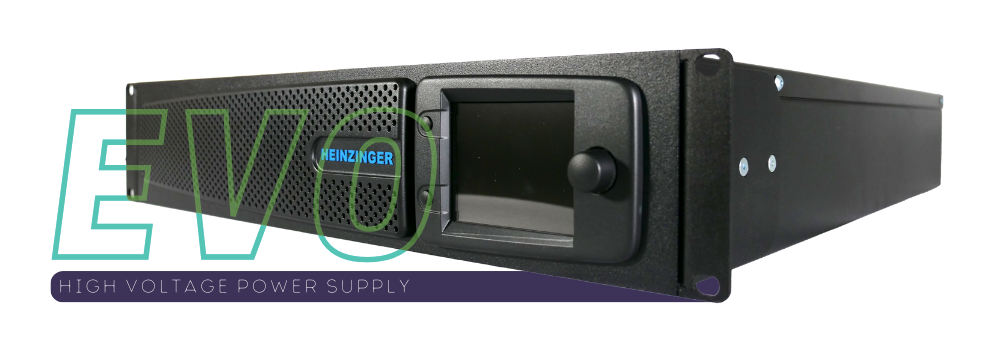
The EVO 10000–200 was built for exactly this duty: 10 kV, 2 kW continuous, ±0.01% line regulation across a full ±10% mains swing. Not a bench instrument pressed into a production role. A fully digital, FPGA-regulated supply designed to hold setpoint through changing loads, changing mains, and the kind of duty cycle that industrial separation actually demands.
What the EVO 10000 Delivers
Digital regulation via microcontroller and FPGA means the supply does not rely on analog trim pots or passive RC networks to hold output. It reads setpoint deviation in real time and corrects within 1 ms to 0.1% of the programmed voltage. Ripple stays at 0.01% peak-to-peak. Stability holds at 0.01% per eight hours of continuous operation. These are not marketing claims. They are the numbers that matter when your electrode has to charge the same material the same way, batch after batch, for a full production shift.
- 16-bit setpoint resolution across the full 0–10 kV range (0.15 V per step)
- ±0.01% line regulation across a ±10% mains swing (187 V–253 V AC)
- 0.01% ripple peak-to-peak on the DC output
- 1 ms response time to 0.1% of setpoint on load change
- Electrically reversible polarity: switch positive or negative corona configuration without rewiring the HV output
- Ramp control option: programmable HV ramp-up for safe startup sequencing from the PLC
- Arc detection option: output quench on fault, configurable I/O interlock for the control system
- SCPI command set over Ethernet and RS232: standard instrument protocol, no converter required
EVO 10000 vs. General-Purpose High-Voltage Supplies
| Requirement | General-Purpose HVPS (typical) | BNC EVO 10000–200 |
|---|---|---|
| Max output voltage | 10 kV (varies by model) | 10 kV |
| Continuous power rating | Variable; many derate at high voltage | 2 kW continuous |
| Line regulation (±10% mains) | ±0.1% – ±1% typical | ±0.01% Unom |
| Setpoint resolution | 12-bit or analog pot | 16-bit digital |
| Response time to setpoint change | 10 ms – 100 ms typical | 1 ms to 0.1% of Unom |
| Output ripple | 0.1% – 0.5% pp typical | 0.01% pp |
| Polarity reversal | Requires rewiring HV output | Electrically reversible, software-commanded |
| Arc fault handling | External crowbar or fuse | Arc detection option with configurable I/O interlock |
| PLC interface | Analog 0–10 V or proprietary serial | SCPI over Ethernet and RS232 |
| Form factor | Often benchtop only | 2U rack, 19″ or desktop with adapter |
| Multiple units, one line | Separate addressing schemes required | Each unit individually addressable on a shared Ethernet segment |
One Unit Per Stage. One Ethernet Segment for All of Them.
A single EVO 10000–200 powers one electrode stage. Multi-stage lines use one unit per stage, each independently addressed on the same Ethernet segment. The control system reaches every unit from a single PLC. No secondary controllers. No analog patch cables bridging stages.
The ramp control option lets the PLC bring each electrode from 0 V to operating voltage in a programmable sequence, which most safety protocols require before material enters the feed zone. When an arc event occurs, the arc detection option quenches the output immediately and signals through the configurable I/O block. The control system logs the fault, delays restart, and prevents the repeated arcing that damages electrodes and shortens supply life. Both options can be specified at order. Neither requires external hardware.
EVO 10000–200: Key Specifications
- Output: 0–10 kV DC, positive, negative, or electrically reversible
- Power: 2 kW continuous (200 mA max output current)
- Line regulation: ±0.01% Unom across ±10% mains variation
- Ripple: 0.01% peak-to-peak
- Setpoint resolution: 16-bit
- Response time: 1 ms to 0.1% of Unom
- Stability: 0.01% Unom per 8 hours
- Temperature coefficient: 0.01% Unom per Kelvin
- Interface: SCPI command set, Ethernet, RS232 (USB service port)
- I/O: Interlock, configurable I/Os
- Options: Ramp control, Arc detection
- Form factor: 2U rack, 19″ or desktop; 11.5 kg
- AC input: 187 V–253 V, 47 Hz–63 Hz, active power factor correction
Who This Is For
Electrical engineers and controls managers at electrostatic separator OEMs and system integrators. Teams specifying HVPS for new separator builds, or replacing aging supplies on production lines where voltage stability has become a documented quality variable.
The EVO 10000–200 fits corona discharge separators for mineral processing (titanium, zircon, rutile, ilmenite, rare earths), triboelectric belt separators for industrial mineral sorting, high-voltage plastics and e-waste recycling lines, and food and pharmaceutical electrostatic sorting equipment where purity specifications leave no room for voltage drift.