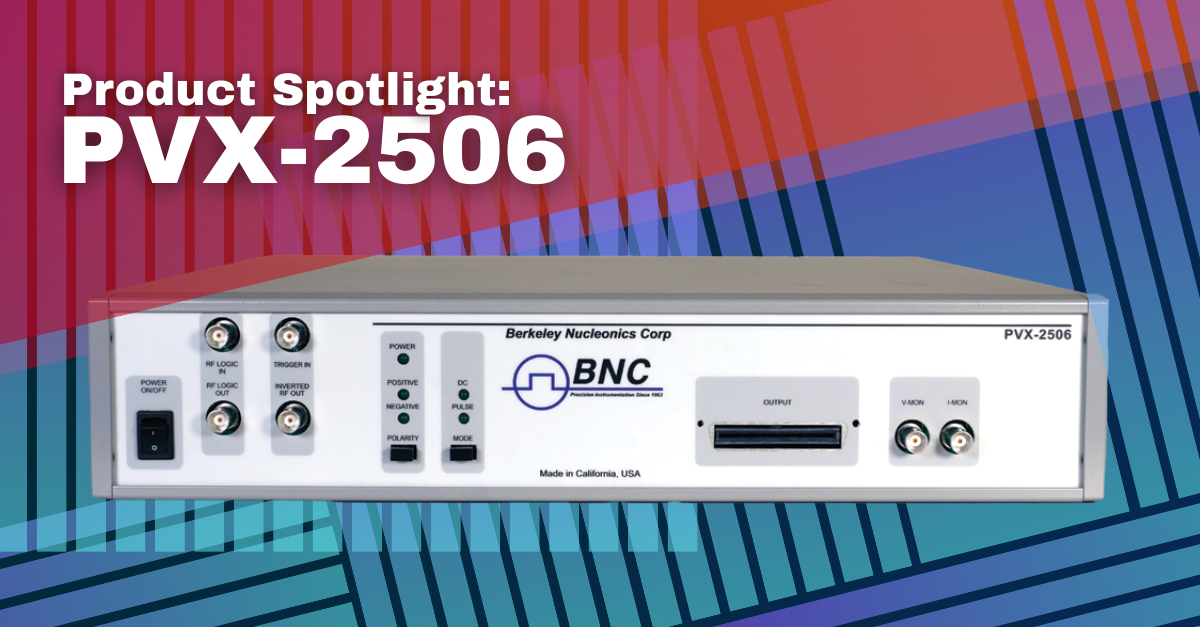
The following write up is a transcript of a video featuring BNC engineer Cameron Simmons. The video [linked here] covers the impressive features of the PVX-2506.
Hi there, my name is Cameron Simmons and I am an applications engineer here at Berkeley Nucleonics. Today I am going to do a video about one of our lesser known products – the PVX-2506. It is a hybrid voltage current pulser. We refer to it as a precision voltage pulser and it’s got a lot of cool features that may help your application. Today we’re going to show those off. Enjoy!
The PVX-2506 is what we refer to as a precision pulse generator, because we tune the overshoot and undershoot so that it never exceeds the pulse top and bottom voltage. This can be really good for semiconductor material testing because you know your material is never exposed to a voltage higher than required for your testing. You can get great data on it. The unit can do 50 volts at 10 amps which is extremely high for a voltage pulser of this type, and because of this the PVX-2506 can be used to test a lot of high voltage and high current semiconductor materials. Another great feature is that the 2506 accepts a high voltage power supply and a lower voltage power supply so that you can actually float it up to ten volts and again this can be really good if that is the voltages that you want tested at or if you just want a less noisy signal moving above ground like that will take out some of the noise and help you get cleaner data.
Here I’ll show you the cable that’s included with the 2506. As you can see it’s nice heavy duty connector. Gold pads. Very low inductance. The same thing with this cable can take a lot of voltage but it is also very low inductance so you’re not going to get any added overshoot and zero ringing, which makes this overall a very good cable for this application.
An interesting feature of the PVX-2506 is that it has sort of a utility section here that will help you invert and copy your trigger signal so you can take one trigger in from your source and instead put it in the RF logic input. Then you’ll get a TTL copy of that signal and an inverted TTL version of this signal. This will trigger RF as well. So you can put a sinusoidal wave form in and it will create a square trigger signal. Then perhaps you want to trigger your oscilloscope to this one to see other aspects of the signal; you can take the inverted RF out and then have that be your trigger signal for the output of the unit itself and then you can switch those two around. This makes testing and collecting data easier without having to have an external box that does this.
Here we can see the output of the voltage pulser on the oscilloscope. It’s a nice clean 30 volt pulse going into our 5 ohm load. No aberrations, no overshoots, very square pulse, low noise as well. Then we’ll go ahead and zoom in on the rising edge and you can see the overshoot tuning at work; you can see by the curser there that it’s right on the pulse top. The time scale is about 25 nanoseconds so there is probably about 10 to 20 nanoseconds of oscillation on the rising edge to get that nice fast rising edge. But you can see that the top never exceeds the actual pulse top, which means that it’s really a finely tuned rising edge and falling edge. The falling edge is the same thing – it never exceeds ground and you can get some very clean data with this.
The output of the PVX-2506 is floating and it actually has two voltage inputs. The good thing about that is you can bias it up just to reject noise if that’s the voltage that your experiment calls for. Here, I am at about 30 volts to ground and I’m going to engage the second power supply and bias it up about 10 volts. That’s what that looks like here! There you have it – the features of the PVX-2506.