


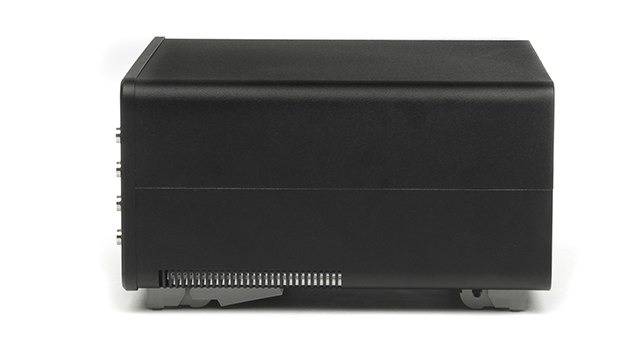
Model 745T | 1 ps Delay Resolution Femtosecond Digital Delays with 5 Picosecond Jitter
The Model 745T sets the benchmark for benchtop timing instruments, combining world-leading performance with modern features at a fraction of legacy costs (inspired by the classic Model 7095’s <25 ps jitter breakthrough from 25 years ago).
- 4 precision delay channels on front panel (rise time <2 ns)
- Optional +4 channels on rear panel (rise time <5 ns) → total 8 channels
- 1 ps delay resolution
- Jitter: <25 ps RMS (external trigger to channel; some configs ~5 ps at short delays)
- Accuracy: <250 ps + delay × 10⁻⁸
- Delay range: up to 20 seconds (or more in variants)
- Sync to external clock: 10 MHz, 80 MHz, or custom 10–80 MHz
- Outputs: 5 V into 50 Ω, fast rise times
- Rear-panel: Clock In, Clock Out, Ethernet for remote control (SCPI commands)
Control options:
- DDG-MUC software (controls up to 8 units / 64 channels)
- Included LabVIEW drivers
- Embedded web interface (browser-based on any PC/Mac/Linux via IP address)
- USB port (SCPI support)
Ideal for short time-domain delays, laser synchronization, precision research, and lab mobility.
Overview
Quick Specs
- Channels: 4 or 8 Independent Channels
- Resolution: 1 ps
- Accuracy: < 250 ps + delay x 10e-7
- Jitter: 25 ps + Delay x 10e-8 (External Trigger to any output)
- Voltage: 2 to 5 V, step < 0.1 V / 50 Ω
- Memory: 12 Memory Storage Slots
Applications
- Femtosecond Resolution
- ATE Applications
- Large Laser System Timing Control
- High Precision Timing
- Components Testing/QC
Jitter
The Model 745T virtually eliminates triggering indeterminacy by having a clock that is now in phase with an External Trigger. The resulting external trigger jitter is far better than instruments whose outputs are synched to an internal free-running clock. See the datasheet for exact jitter specification and additional details on “Achieving 2 Picoseconds Jitter in a DDG”. The following chart indicates typical jitter at various delays:
- Internal Trigger, Delays < 100 ns: 2 picoseconds
- Internal Trigger, Delays > 100 ns: 15 picoseconds + timebase
- External Trigger, Delays < 100 ns: 25 picoseconds
- External Trigger, Delays > 100 ns: 25 picoseconds + timebase

Triggering
The Model 745T Digital Delay Generator offers users several options for triggering timing channels: External, Internal, and Remotely (Remote trigger: only asynchronous Single-Shot). Externally trigger on the positive or negative slope of your trigger signal and select a level from 0.1 V to 5.0 V. Two internal trigger generators are adjustable from 0.25 Hz to 1 MHz in 1 Hz increments (note: it’s possible to set the period by step of 5 ns as well, the range is then 1 µs to 4 s by step of 5 ns). These internal rep rate generators may be started by front panel pushbutton or remotely via your software interface. Either trigger mode may be set as one-shot or repetitive.
BURST MODE, for instance: pulse number 2 to 216-1, period 1000 ns to 1 s (depending on the trigger rate)
TRIGGER PRESCALER, for instance: prescaler value applied to the external trigger goes from 1 to 216-1
GATE MODE, for instance: can be set to General or individual channel
*See the user manual for more details.
Packaging
The Model 745T Digital Delay Generator is housed in a compact design. The packaging dimensions are of 8.5″ X 9.6″ x 5.3″. The convenient design allows two instruments (up to 16 channels) to fit side-by-side in a 19″ rack mount (sold separately). This small footprint allows for many channels packed into a small space on a bench or in a rack system. Berkeley Nucleonics offers a variety of custom packaging options as well. For even tighter space constraints, ask about a cPCI card-level version of the Model 745T or a custom enclosure design. Multi-instrument applications may find that operating from a single master clock may be useful. The standard benchtop package can be mounted with one or two instruments in a 19″ rack.Outputs
On the front panel there are four standard Outputs, one external Trigger Input, and one Gate Input. Optionally, four more Outputs can be available on the front panel as well (total eight channel outputs) On the rear panel, there are Clock In, Clock Out, T0, and Auxiliary connectors.
Optional Channel Feature — Channel Grouping
Rise times below 1 nanosecond and Pulse Widths down to 10 nanoseconds are achieved by Channel Grouping. In this example, we group Channel 1 + Channel 2. The jitter is below 5 picoseconds and the delay and width resolution are both 250 femtoseconds. Contact the customer support for special output requirements.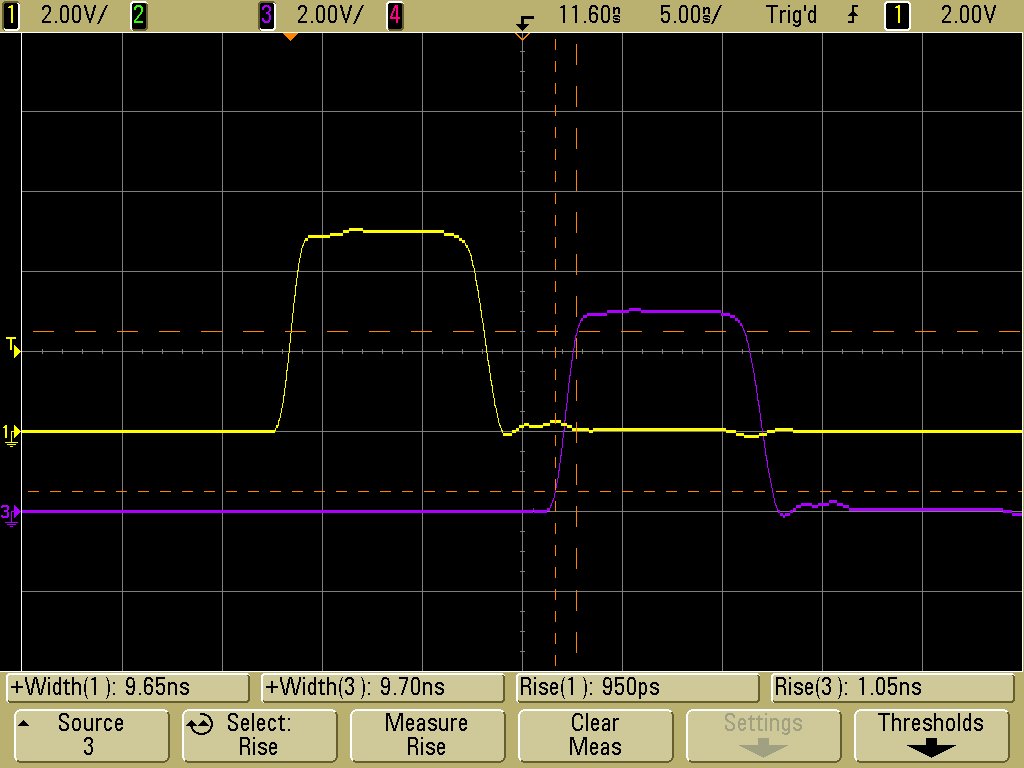
Trigger Source (Repetitive / Shots / Burst)
| Internal Rate Generator | Two Independent Timers, 0.25 Hz to 1 MHz |
| External Trigger | 1 Trigger Input Positive or Negative slope Minimum trigger delay < 65 ns Software Asynchronous Single Shot |
| Control | Front Panel or Remote (Ethernet or USB) |
| Clock Input | Standard 10 MHz and 80 MHz *contact factory for custom clock input frequency |
Outputs
| Number of Outputs | Four (A to D) plus T0 [Standard] Eight (A to H) plus T0 *OPTIONAL |
| Amplitude | T0: 5 V into 50 Ω [Fixed] A to D: 2 V to 5 V into 50 Ω [Adjustable] E to H: 2 V to 5 V into 50 Ω [Adjustable] *OPTIONAL |
| Transition Time |
Rise: < 2 ns Fall: < 2 ns |
| Pulse Width | T0: 100 ns to 100 µs A to D: 100 ns to 100 µs E to H: 10 ns to 25 us *OPTIONAL |
| Delay Range | 0 ps to 20 seconds |
| Delay Resolution | A to D: 1 ps E to H: 1 ns |
| RMS Jitter | 25 ps + delay x 10e-8 (T0 to any output) |
| Accuracy | < 250 ps + delay x 10e-8 |
| Clock Output | 10 MHz [Square ~ +7 dBm] |
| Time Base | 0.05 ppm stability |
| Connector | BNC |
General
| Interface Control | Front-panel, LAN ( Internal Webpage or SCPI) |
| Software | Web Browser (Firefox, Chrome, Internet Explorer) |
| Size | Rack 19″, 2U, D = 300 mm |
| Power | 90 to 220 VAC / 0.5 A |
Specifications
Options
| Model Number | Description |
|---|---|
| 745T-4C | Standard Touchscreen Model, 4 High Precision Channels |
| 745T-8C | Standard Touchscreen Model, 4 High Precision Channels, 4 Standard Channels |
| 745-RM | Rack Mount System. Accommodates one or two Model 745T units |
| GFT101 | Electrical to Optical Converter – Takes a 2.5 V to 10 V input and produces a 1310 nm output with 1 ns risetime and 30 ps RMS jitter. The converter connects to the front panel of the Pulse/Digital Delay Generator. The optical pulse is appx 0.3 mW and allows long-range transmission in remote locations. |
| GFT200 | Optical to Fast Electrical Pulse of 10 volts under 50 Ω – This unit takes 1310 nm wavelength pulses at -15 dBm or better, and converts them to 10 V output pulses with 30 ps RMS jitter. This unit enables long-range transmission of timing signals. |
| GFT632 | High Voltage Module – Offers fast output pulse 32 V amplitude under 50 Ω, < 3 ns rise time – This module is externally triggered and provides high voltage pulses with fast rise times. The device can be up to 20 meters from your pulse generator so it is closer to the device being triggered. A 70 V option is also available with widths of 1us and a rise time of 1.2 nanoseconds. |
Technical Resources
Downloadable Resources
Downloadable resources such as datasheets, firmware, software, drivers and products manuals. Alternatively, you can browse resources directly by visiting our downloads page.
Media
Playlist
3:10
4:21
2:22
3:56
1:07:44
Price Lists
Price lists are available to our registered users. To view pricing for this and other products, please log in or create a free account.

