


Cerium Bromide CeBr3 High Resolution / Low Background Scintillators
Cerium bromide (CeBr₃) scintillation detectors combine high light yield, fast decay times, and high density, making them effective for applications requiring good energy resolution and timing performance. A primary benefit over other high-resolution scintillators is the material’s very low intrinsic background noise, which improves signal-to-noise in low-count-rate or background-sensitive measurements. CeBr₃ also exhibits a fast response without slow tail components.
Key Properties of CeBr₃ Scintillation Detectors
- High Light Yield & Fast Timing – Supports excellent energy resolution and sub-nanosecond timing capabilities.
- Low Intrinsic Background – Reduces false counts and enhances detection limits in gamma-ray spectroscopy.
- High Density – Provides good stopping power for gamma rays and compact detector designs.
- Hygroscopic Material – Requires encapsulation to protect against moisture; available with entrance windows for direct radiation entry.
Available Configurations
- Encapsulated crystals with entrance window only.
- Integral coupling to light sensors such as photomultiplier tubes (PMT) or silicon photomultipliers (SiPM).
- Complete detector assemblies including crystal, light sensor, and front-end electronics (preamplifier, shaping, etc.).
Crystal sizes range from small pixels suitable for arrays to larger volumes up to 102 mm (4 in) diameter by 152 mm (6 in) length, allowing flexibility for single-detector setups or multi-detector systems.
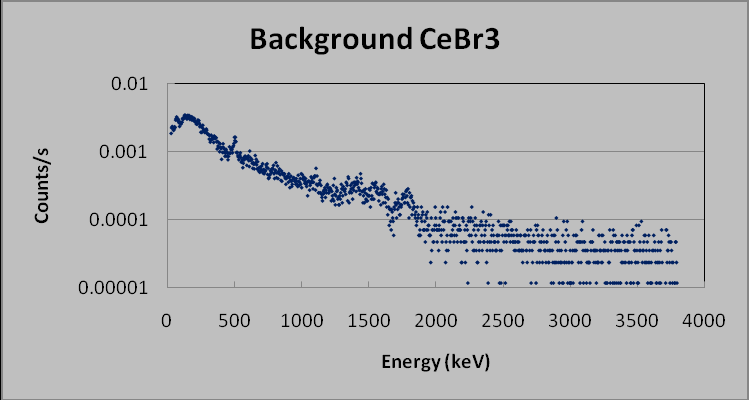
CeBr3 is characterized by its relatively high-density and its proportional response to gamma rays. The typical energy resolution provided by the material is 4% FWHM for 662 keV. Thanks to its fast light pulse rise time, CeBr3 detectors can provide sub-nanosecond time resolutions only slightly inferior to BaF2 detectors. In addition, the material exhibits fast decay times of 20 ns with negligible afterglow. With a background count as low as <0.002 c/s/cc in the Ac-227 complex (1500 to 2200 keV), CeBr3 presents a distinct advantage over other high-resolution scintillators which suffer from this or other intrinsic activity.
Applications
Security
Resolution/Background
Plasma Physics
Speed
PALS
Time Resolution
Environmental
Resolution/Background
Space Missions
Resolution
Energy Resolution
4% FWHM at 662 keV
Density
5.2 g/cc
Emission Max
380 nm
Decay Time
18-25 ns
Background
0.002 c/s/cc Ac-227
Typical Energy Resolution vs. Sodium Iodide
Energy (keV)
NaI
CeBr3
30
18%
20%
60
11%
13%
81
10%
11%
122
8.50%
8%
356
8%
5%
662
7%
4%
1332
5.5%
3%
2600
4%
2%
Free Online Training Module – An Introduction to Scintillation Crystals and Detectors
Visit our Training page to access the module or for more information
CeBr3 Fast Timing Study, Below 120 PS
Performance of CeBr3 – White Paper
Effects of Polarity on High Voltage Bias of Photomultipliers – Tech Note
Press Room – Scintillation Detectors: Attenuation Length Of Optical Emission
Press Room – Custom-Built Scintillation Detectors For Every Application
Press Room – Scintillator | What Are Scintillator Materials?
Press Room – From Crystal Growth To Assembly: The Manufacturing Process Of Custom Nal Scintillation Crystals
Press Room – The Role Of Cerium Bromide Scintillator CEBR3 In Real-Time Measurement While Drilling
CeBr3 Datasheet
Downloadable resources such as datasheets, firmware, software, drivers and products manuals. Alternatively, you can browse resources directly by visiting our downloads page.
Playlist
4:28
46:53

53:48
42:44

47:51
Price lists are available to our registered users. To view pricing for this and other products, please log in or create a free account.
Yes – an important aspect of your product selection. See https://www.berkeleynucleonics.com/february-23rd-2022-ruggedized-detectors-customized-scintillators-field for further reading.
The most widely used scintillation material for gamma-ray spectroscopy is Sodium Iodide, NaI(Tl). It is hygroscopic and is only used in hermetically sealed metal containers to preserve its properties. All water-soluble scintillation materials should be packaged in such a way that they are not attacked by moisture. Some scintillation crystals may easily crack or cleave under mechanical pressure whereas others are plastic and only will deform like CsI(Tl). See our Table of Properties or Table of Applications for material specific comments.
The light output (number of photons per MeV gamma) of most scintillators is a function of temperature. This is caused by the fact that in scintillation crystals, radiative transitions, responsible for the production of scintillation light, compete with nonradiative transitions (no light production). In most scintillation crystals, the light output is quenched (decreased) at higher temperatures. An example to the contrary is the fast component of BaF2 which the emission intensity is essentially temperature independent.
The scintillation process usually involves three stages, production, transport and quenching centers. Competition between these three stages and all three behaving differently with temperature creates a complex temperature dependence for scintillation light output.
Below is a chart with the temperature dependence of common scintillation crystals.
Temperature dependence of the scintillation yield of NaI(Tl), CsI(Tl), BGO and CeBr3
For most applications, the combination of the temperature dependent light output of the scintillator together with the temperature dependent amplification of the light detector should be considered.
The doped scintillators NaI(Tl), CsI(Tl) and CsI(Na) show a distinct maximum in intensity whereas many undoped scintillators such as BGO show an increase in intensity with decreasing temperature. The temperature dependence of the Ce doped scintillators LBC, CeBr3 and YAP:Ce is significantly less than that of other scintillators.
Radiation damage is defined as the change in scintillation characteristics caused by prolonged exposure to intense radiation. This damage manifests itself by a decrease of the optical transmission of a crystal which causes a decrease in pulse height and deterioration of the energy resolution of the detector. Radiation damage other than radio-activation is usually partially reversible; i.e. the absorption bands often disappear slowly in time; some damage can be annealed thermally.
In general, doped alkali halide scintillators such as NaI(Tl) and CsI(Tl) are rather susceptible to radiation damage. All known scintillation materials show more or less damage when exposing them to large radiation doses. The effects usually can only be observed clearly with thick (> 5 cm) crystals. A material is usually called radiation hard if no measurable effects occur at a dose of 10.000 Gray. Examples of radiation hard materials are CeBr3 and YAP:Ce.
