


Playlist

53:43
46:53

53:48
42:44

47:51
2:16

3:01
4:22
2:23
Each scintillation material has a characteristic emission spectrum, with wavelength and intensity. The shape of this emission spectrum is sometimes dependent on the type of excitation (photons/particles).

Emission spectra of NaI(Tl), CsI(Tl) and CeBr3, scaled on maximum emission intensity.
Also a typical quantum efficiency curve of a bialkali photocathode and a Silicon Photomultiplier (SiPm) are shown above.
This emission spectrum is of importance when choosing the optimum readout device (PMT / photodiode/SiPm) and the required window material. The graph above shows the emission spectrum of some common scintillation materials.
The light output (number of photons per MeV gamma) of most scintillators is a function of temperature. This is caused by the fact that in scintillation crystals, radiative transitions, responsible for the production of scintillation light, compete with nonradiative transitions (no light production). In most scintillation crystals, the light output is quenched (decreased) at higher temperatures. An example to the contrary is the fast component of BaF2 which the emission intensity is essentially temperature independent.
The scintillation process usually involves three stages, production, transport and quenching centers. Competition between these three stages and all three behaving differently with temperature creates a complex temperature dependence for scintillation light output.
Below is a chart with the temperature dependence of common scintillation crystals.
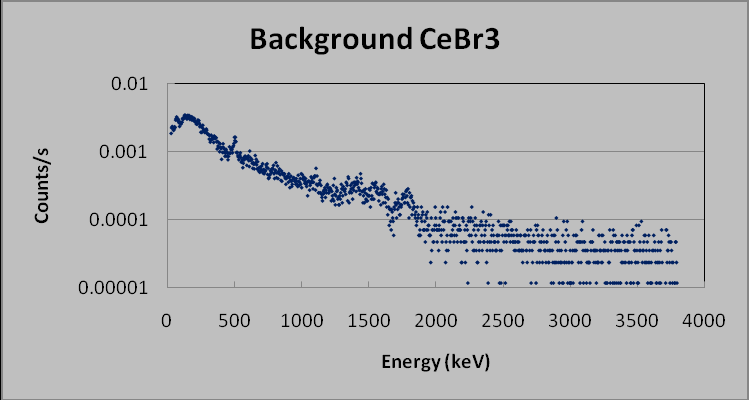
Temperature dependence of the scintillation yield of NaI(Tl), CsI(Tl), BGO and CeBr3
For most applications, the combination of the temperature dependent light output of the scintillator together with the temperature dependent amplification of the light detector should be considered.
The doped scintillators NaI(Tl), CsI(Tl) and CsI(Na) show a distinct maximum in intensity whereas many undoped scintillators such as BGO show an increase in intensity with decreasing temperature. The temperature dependence of the Ce doped scintillators LBC, CeBr3 and YAP:Ce is significantly less than that of other scintillators.
Yes – an important aspect of your product selection. See https://www.berkeleynucleonics.com/february-23rd-2022-ruggedized-detectors-customized-scintillators-field for further reading.

