This appendix is the working reference that maps applications to scintillator materials and detector configurations. The structure is: one section per application area, with the operational requirements, the dominant material choices, the typical configurations, and pointers back to the chapters where the underlying physics and engineering are covered. The cross-reference matrix at the end of the appendix is the single-page summary.
The applications are listed in roughly the order of detector volume in the global market, largest first.
The application. Detection, identification, and localization of radioactive material outside regulatory control, in contexts ranging from port-of-entry primary screening to law-enforcement search to emergency response after a radiological event. The market is dominated by US Department of Homeland Security and equivalent agencies in allied countries, with significant secondary deployment by border services, customs, and event-security organizations.
Performance requirements. Sensitivity to sources from special nuclear material (HEU, plutonium) through medical isotopes (mostly Tc-99m, I-131, F-18) to industrial sources (Cs-137, Co-60, Ir-192). Energy resolution sufficient to distinguish a medical patient leaving a hospital from a smuggled industrial source. Neutron detection capability for shielded SNM. Operating temperature -40 to +60 C outdoor. Drop and immersion ratings per ANSI N42 series.
Dominant materials. NaI(Tl) for cost-sensitive primary screening. CeBr3 and LaBr3:Ce for spectroscopic backup and secondary inspection. CLLBC for combined gamma-neutron handheld instruments. Plastic scintillator for vehicle and pedestrian portal monitors. 6LiF/ZnS(Ag) for thermal neutron sensitivity.
Typical configurations. Pedestrian portal monitor (plastic + 6LiF/ZnS(Ag)). Vehicle portal monitor (plastic at large scale). Handheld isotope identifier (CeBr3 or NaI(Tl) with SiPM). Spectroscopic personal radiation detector (NaI(Tl) with SiPM in pager-form-factor). Backpack search instrument (NaI(Tl) or CLLBC with PMT or SiPM, GPS-tagged readout).
Cross-references. Chapter 3 (materials), Chapter 4 (neutron detection), Chapter 8 Section 8.3.1 (handheld isotope identifier worked example), Chapter 12 Sections 12.8 and 12.9 (handheld and portal configurations), Appendix D (ANSI N42 standards).
The application. Functional imaging of patients using radioactive tracers and external detection. Three dominant modalities: positron emission tomography (PET), single-photon emission computed tomography (SPECT), and gamma cameras. A fourth, computed tomography (CT), uses scintillation detection of transmitted X-rays through the patient.
Performance requirements. Highest possible spatial resolution (sub-millimeter for the highest-end PET, a few millimeters for clinical SPECT). Sub-200-picosecond coincidence resolving time for time-of-flight PET. Dose efficiency, since dose to the patient is the binding constraint. High count rate capability for fast scanning. Long-term mechanical and electrical reliability over multi-year clinical service.
Dominant materials. LYSO:Ce or LSO:Ce for clinical PET (high density, fast decay, good light yield for SiPM readout). NaI(Tl) for clinical SPECT and gamma cameras (cost-effective, large area, mature). GAGG:Ce for emerging high-resolution PET designs and for some industrial radiography applications.
Typical configurations. PET ring (LYSO pixel arrays with NUV-HD SiPM readout, picosecond timestamping). SPECT camera (large NaI(Tl) crystal with PMT array). Cardiac SPECT camera (ring of CZT or scintillator detectors with collimator). CT detector array (CdWO4 or GAGG:Ce coupled to photodiodes).
Cross-references. Chapter 3 (materials), Chapter 6 (emission spectra), Chapter 8 Section 8.3.3 (TOF-PET worked example), Chapter 9 (photodetectors), Chapter 12 Section 12.6 (S-style configurations), Appendix C (medical imaging market trends).
The application. Downhole measurement of formation properties and the location of hydrocarbons during oil and gas exploration and production. Scintillation detectors measure naturally occurring gamma activity (gamma-ray logging) and induced gamma activity from a neutron source (neutron-gamma logging) to identify formation lithology, porosity, fluid content, and tool position.
Performance requirements. Operation at 100 to 200 C for 6 to 12 hours per logging run. Vibration and shock during deployment. Pressure to 20,000 psi or more. Compact form factor (tool diameter 1.75 inches typical). Detector volume traded against tool length and downhole logistics.
Dominant materials. CsI(Na) for general gamma logging (good high-temperature performance, mechanical ruggedness). NaI(Tl) for legacy tools and where temperature is lower. LaBr3:Ce and CeBr3 for spectroscopic logging where high resolution at depth resolves overlapping gamma lines. BGO for compact high-stopping-power applications.
Typical configurations. B-style or BD-style cylindrical detector, 25 mm diameter by 50 to 200 mm length, in stainless steel pressure housing with shock-mount, coupled to a high-temperature PMT or SiPM array. The cabling out of the tool is one of the harder engineering challenges.
Cross-references. Chapter 7 (temperature dependence), Chapter 8 Section 8.3.2 (down-hole logging worked example), Chapter 11 Section 11.9 (ruggedized configurations), Chapter 12 (specific configurations).
The application. Continuous or routine measurement of radioactivity in air, water, soil, and wildlife at facilities producing or handling radioactive materials, plus background monitoring at potentially affected locations. Includes power reactor effluent, processing facility releases, environmental remediation sites, and post-event radiological assessment.
Performance requirements. Long-term stability over months to years of unattended operation. Outdoor environmental rating (-40 to +60 C, rain, snow, dust). Low-background performance to detect trace activities. Network connectivity for continuous reporting. Tamper-evident operation for regulatory data.
Dominant materials. NaI(Tl) for general gamma monitoring (cost-effective, mature, low-background variants available). CsI(Tl) for compact stations where SiPM readout matters. 6LiF/ZnS(Ag) screens or boron-loaded plastic for any neutron monitoring. CeBr3 in spectroscopic monitoring stations where high-resolution isotope identification is required.
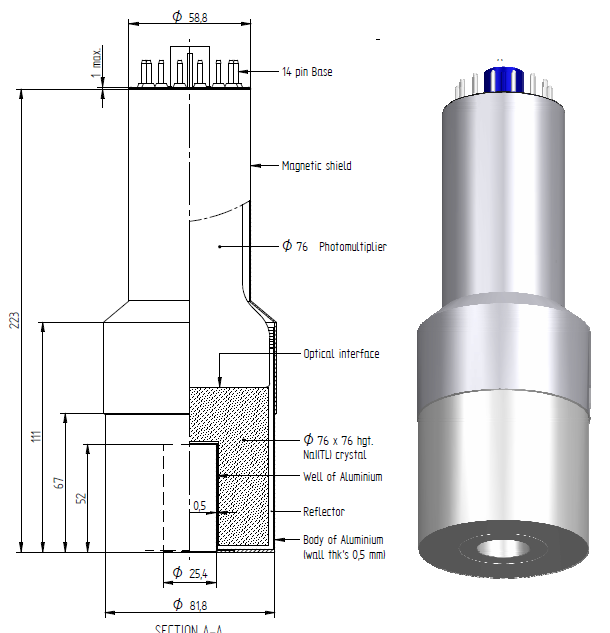
Typical configurations. Outdoor monitoring station with 76 mm by 76 mm NaI(Tl), low-background construction, weather-sealed enclosure, solar panel and battery, cellular telemetry. Stack effluent monitor with continuous air sampling and dedicated CsI(Tl) or NaI(Tl) detector. Mobile environmental survey instrument with handheld plus vehicle-mounted detectors and GPS tagging.
Cross-references. Chapter 3 (materials), Chapter 5 (long-term radiation tolerance), Chapter 7 (temperature compensation for outdoor use), Chapter 11 Section 11.8 (low-background detectors), Appendix D (regulatory standards).
The application. Measurement of cosmic and planetary radiation environments aboard spacecraft. Applications include solar physics, planetary surface composition, gamma-ray astronomy, cosmic-ray studies, and radiation-environment monitoring for spacecraft and astronaut safety.
Performance requirements. Survival of spacecraft thermal cycling (-150 to +150 C in some missions). Vacuum operation. Cosmic-ray and solar-particle-event background that varies with mission location. Mass and power budgets that may be measured in grams and watts. Multi-year unattended operation. Radiation hardness against multi-Gray accumulated dose.
Dominant materials. CsI(Tl) for general spacecraft gamma detection (good light yield with SiPM readout, mechanical ruggedness, vacuum compatibility). NaI(Tl) for legacy missions and specific applications. LaBr3:Ce and CeBr3 for high-resolution gamma-ray astronomy. Plastic scintillator for active charged-particle detection. GAGG:Ce for emerging compact spacecraft instruments.
Typical configurations. Compact gamma spectrometer with CsI(Tl) plus SiPM array, integrated digital pulse processor, vacuum-rated housing. Charged-particle detector with plastic plus PMT in active anti-coincidence with surrounding scintillators. Surface gamma spectrometer for planetary rover (e.g., Mars Curiosity uses CsI(Tl), NASA APXS adds LiF for neutron detection).
Cross-references. Chapter 5 (radiation damage), Chapter 7 (extreme temperature operation), Chapter 11 (vacuum-rated and ruggedized configurations), Chapter 14 Section 14.6 (space nuclear power systems).
The application. Radiation detection for military operations, ranging from CBRN reconnaissance and contamination monitoring to nuclear weapons stockpile stewardship to forward-deployed power-source monitoring (microreactors). Substantial overlap with homeland security applications but with additional requirements for ruggedization, security-critical software, and secure network operation.
Performance requirements. MIL-STD-810 environmental qualification (shock, vibration, temperature extreme, humidity, salt fog). Tamper-evident operation. Secure communication (encrypted, anti-jamming). Operation by personnel with limited radiation training. Sustained service in austere environments.
Dominant materials. Same materials as homeland security with stricter ruggedness requirements. CLLBC and CLYC for combined gamma-neutron forward-deployed detection. Plastic for area portal monitoring at forward operating bases. NaI(Tl) and CsI(Tl) for backpack and vehicle systems.
Typical configurations. MIL-spec drop-tested handheld isotope identifier. Backpack-mounted spectroscopic search instrument. Vehicle-mounted area survey kit. Forward-operating-base portal monitor for personnel and vehicles entering sensitive areas. Microreactor monitoring system (Chapter 14 covers this in more detail).
Cross-references. Chapter 11 Section 11.9 (ruggedized configurations), Chapter 14 Section 14.3 (microreactor deployment), Appendix D (military-specific certifications).
The application. Measurement of material properties in industrial processes using transmitted, scattered, or emitted radiation. Includes thickness gauging in steel and paper production, density gauging in concrete and asphalt, level measurement in tank farms, real-time radiography for weld inspection, and radioactive tracer studies in process flows.
Performance requirements. High stability over long operating periods. Good linearity over a wide dynamic range. Compact form factor for installation in process equipment. Resistance to industrial environments (vibration, temperature, dust, chemical exposure).
Dominant materials. NaI(Tl) and CsI(Tl) for general industrial gauging. BGO and CdWO4 for high-density compact applications including portable radiography backscatter. Plastic scintillator for in-line process monitoring at low cost. CdWO4 specifically for CT and radiography applications where low afterglow is required.
Typical configurations. Sealed-source-and-detector pair for thickness or density measurement, with the source on one side of the process material and the detector on the other. Backscatter geometry for one-sided measurement. Radiographic camera with scintillator-CCD arrangement. Tracer-flow monitoring with multiple detectors at known positions along a pipeline.
Cross-references. Chapter 3 Section 3.3.3 (high-density oxides), Chapter 11 (configurations), Appendix C Section C.3 (industrial market trends).
The application. Particle and nuclear physics experiments at colliders, accelerators, and underground laboratories. Includes calorimetry at colliders (CMS, ATLAS at CERN), fixed-target experiments, neutrino detection, dark matter direct detection, and nuclear structure studies.
Performance requirements. Highly application-specific. Calorimetry needs high density, fast decay, and radiation hardness. Dark matter detection needs low background, high purity, and often cryogenic operation. Neutrino detection needs very large active mass at low cost. Nuclear structure work needs high energy resolution.
Dominant materials. PbWO4 for collider calorimetry (high density, fast, radiation-hard with development). LYSO:Ce for fast-timing calorimeters and time-projection-chamber readout. BGO for high-energy gamma calorimetry. NaI(Tl) at very high purity for dark matter (DAMA, ANAIS, COSINE-100). CaWO4 for cryogenic dark matter (CRESST). Liquid scintillator at kiloton scale for neutrino experiments (KamLAND, JUNO).
Typical configurations. Highly customized. CMS electromagnetic calorimeter is 76,000 PbWO4 crystals each individually monitored. Dark matter detectors are typically a few hundred kg of highly purified scintillator in shielded cryostats. Neutrino detectors use spherical or cylindrical liquid-scintillator-filled vessels with thousands of PMTs viewing the volume.
Cross-references. Chapter 3 Section 3.5 (liquid scintillators), Chapter 5 (radiation damage including LHC environment), Chapter 11 Section 11.8 (low-background detectors), Chapter 12 Section 12.7 (specials).
The application. Quality assurance of radiopharmaceuticals before patient administration, calibration of nuclear medicine instruments, and contamination monitoring in hot labs and radiopharmacies. Distinct from medical imaging in that the patient is not in the system; the radioactive material is being measured before administration.
Performance requirements. High accuracy and traceability of activity measurement (typically 1 to 5 percent over the activity range used in nuclear medicine). Energy resolution sufficient to distinguish the prepared isotope from contaminants. Easy decontamination of the instrument exterior. Integration with hospital quality-system records.
Dominant materials. NaI(Tl) for dose calibrators (well-counter geometry achieves near 4-pi efficiency). CsI(Tl) and GAGG:Ce for compact bench-top measurement systems. CeBr3 for high-resolution radiopharmaceutical purity verification.
Typical configurations. Dose calibrator with well-shaped NaI(Tl) crystal and PMT, mounted in a lead pig with the assayed vial inserted into the well. Bench-top spectroscopic system for purity verification. Portable contamination monitor for hot lab surfaces and personnel.
Cross-references. Chapter 11 (well counters), Chapter 12 Section 12.7 (specials), Appendix D (radiopharmacy-specific standards).
Single-page summary mapping applications to materials and chapters.
| Application | Primary materials | Key configurations | Chapter refs |
|---|---|---|---|
| Homeland security primary | Plastic, NaI(Tl), 6LiF/ZnS(Ag) | Pedestrian/vehicle portals | 3, 4, 12.9 |
| Homeland security handheld | CeBr3, NaI(Tl), CLLBC | S-style with SiPM | 8.3.1, 12.8 |
| PET imaging | LYSO:Ce, GAGG:Ce | LYSO pixel arrays, dSiPM | 3.3.3, 8.3.3, 12.6 |
| SPECT imaging | NaI(Tl) | Large NaI plate, PMT array | 3.3.1, 12.6 |
| CT scanner detector | CdWO4, GAGG:Ce | Photodiode-coupled arrays | 3.3.3, 9.2 |
| Down-hole well logging | CsI(Na), LaBr3:Ce | High-temp B-style | 7.5, 8.3.2 |
| Environmental monitoring | NaI(Tl), CsI(Tl) | Outdoor low-background | 11.8, 7.4 |
| Stack effluent | CsI(Tl), CLLBC | Inline flow cell | 14.2 |
| Space gamma spectrometer | CsI(Tl), CeBr3 | S-style vacuum-rated | 5.4, 11.9 |
| Spacecraft charged particle | Plastic | Active anti-coincidence | 12.7 |
| MIL-spec backpack | NaI(Tl), CLLBC | Ruggedized B/S-style | 11.9, B.6 |
| Industrial thickness gauge | NaI(Tl), CsI(Tl) | Source-detector pair | 11.9 |
| Industrial radiography | BGO, CdWO4 | Backscatter or transmission | 3.3.3 |
| HEP calorimetry | PbWO4, BGO, LYSO | Pixel calorimeter modules | 3.3.3, 5.4 |
| Dark matter | NaI(Tl) high-purity, CaWO4 | Cryogenic low-background | 5, 8.4, 11.8 |
| Neutrino detection | Liquid scintillator | Multi-PMT large vessel | 3.5 |
| Dose calibrator | NaI(Tl) well counter | NaI well + PMT in pig | 11, 12.7, B.9 |
| HALEU verification | LaBr3:Ce, CeBr3, SrI2(Eu) | Spec'd for 185.7 keV | 14.3 |
| SMR containment | NaI(Tl), CsI(Tl) | Wall-mount area monitor | 14.2 |
| MSR off-gas | CLLBC, CLYC | High-temp inline cell | 14.4 |
| Fusion D-T diagnostics | Liquid (BC-501A), stilbene | TOF spectrometer | 14.5 |
| Fission surface power | CsI(Tl) | Compact integrated S-style | 14.6 |
| Decommissioning floor | Plastic, NaI(Tl) | Large-area paddle | 14.8 |
| Decommissioning waste scan | NaI(Tl), CsI(Tl) | Drum scanner | 14.8 |
| Datacenter SMR portal | NaI(Tl), plastic | Vehicle/pedestrian portal | 14.7 |
The matrix is the working document the applications engineer keeps on the bench. Read across a row to find the configuration; read across a column to find applications that share the same material; read down the chapter-references column to find the engineering depth on any choice.
BNC in Practice - The catalog covers 80 percent of jobs
The standard configurations in this appendix and in Chapter 12 cover roughly 80 percent of customer requests. The remaining 20 percent are custom designs that adapt the standard configurations to specific operational constraints. The 80/20 split has been stable across decades. The right starting point in a new conversation is always the closest standard configuration; the right ending point is whatever delivers the customer's actual requirements. The applications engineer's job is to bridge the two efficiently.
The applications above are the established categories. Three new categories are expanding rapidly enough to deserve their own attention.
SMR and microreactor monitoring (covered in Chapter 14) is creating demand for new standard configurations adapted to compact reactor environments, distributed siting, and software-company customer profiles.
AI datacenter co-located nuclear power (covered in Chapter 14) is bringing customers with very different procurement and support expectations into the radiation-detection market.
Distributed environmental monitoring networks are growing as post-Fukushima safety requirements and post-2022 supply-chain rebuilds drive deployment of larger fleets of network-attached sensors.
The applications catalog is not closed. The next edition of this book will likely have at least three new top-level sections.