


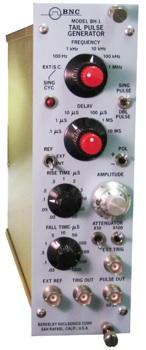
The Model BH-1 is a tail pulse generator which simulates the broad range of pulses encountered in the nuclear field. Typical applications of the Model BH-1 include: determining the proper timing of linear gates and coincidence units, linearity measurements of amplifiers, threshold setting of discriminators and single channel analyzers, and measuring resolution flow noise amplifiers.
Overview
- Repetition Rate: 10 Hz - 1 MHz
- Delay: -50 ns to 10 ms
- Rise Time: 20 ns - 50 µs (8 positions)
- Fall Time: 50 ns - 1000 µs (11 positions)
- Pulse Amplitude: to 9.99 volts into 50 Ω
- Amplitude Integral Linearity: ±0.1%
- Amplitude Jitter: < 0.002% RMS
Specifications
| Frequency | 10 Hz to 1 MHz, continuously adjustable. |
| External Trigger | Requires 1 volt, positive pulse. |
| Single Cycle | One pulse occurs each time the push button is pressed. |
| Single/Double Pulse | This toggle provides for a pulse pair whose separation is varied by the delay controls.
Minimum separation is 50 ns. |
| Rise Time of Output (10-90%) | 20 ns to 50 us (in 11 steps), exponential shape and independent of decay time. |
| Decay Time Constant of Output(100-37%) | 50 ns to 1000 us (in 11 steps), exponential shape and independent of risetime for decay/rise time >10. |
| Trigger Out | Positive 3 volt pulse, 10 ns rise time, 0.2 us witdh, 50 ohms output impedance. |
| Delay | -50 ns advance to 10 ms delay (between Trigger Out and leading edge of output pulse). |
| Output Amplitude | Zero to 9.99 volts maximum. Adjustable by ten-turn potentiometer. |
| Attenuator | X10 and X100 providing up to 1000: 1. |
| Integral Linearity of Output | ±0.1%. |
| Duty Factor Effect | Amplitude shift less than 0.1% below 30% duty factor. Duty factor in percent for tail pulses is defined as: (8 decay time constants/pulse spacing) X100. |
| Output Polarity | Positive or negative. |
| Output Impedance | 50 ohms. |
| External Reference Input | ±15 volts max. |
| Jitter of Frequency and Delay | Less than 0.1%. |
| Temperature Coefficient of Output | Less than 0.03%/°C. |
| Amplitude Jitter (Resolution) | Less than 0.01% peak, 0.002% rms of pulse amplitude. |
| Power Required | +24 V at 50 mA, -24 V at 50 mA, +12 V at 175 mA, -12 V at 80 mA. |
| Mechanical Dimensions | Double-witdh AEC module, 2.70 inches wide by 8.70 inches high. Conformsto AEC Report TID-20893 (Rev. 2). |
| Weight | 3.5 lbs. net, shipping 7 Ibs. |
| Shipping Dimensions | 18x12x9" |
| Shipping Weight | 5 lbs |

Downloadable resources such as datasheets, firmware, software, drivers and products manuals. Alternatively, you can browse resources directly by visiting our downloads page.
• Product Datasheets
• Product Firmware
• Product Software and Drivers
• Product Manuals
Price List
Price lists are available to our registered users. To view pricing for this and other products, please log in or create a free account.