The working vocabulary used throughout this book. Definitions are written for the bench, not the lecture hall: enough to read a datasheet and know what a specification means for your measurement.
ADC (Analog-to-Digital Converter)
Component that samples analog voltage at periodic intervals and produces a digital number representing each sample.
ADS-B
Automatic Dependent Surveillance-Broadcast. Aircraft positioning system on 1090 MHz.
AGC (Automatic Gain Control)
Feedback loop that adjusts amplifier or attenuator gain based on input signal level.
AOA (Angle of Arrival)
The direction from which a signal is received, typically measured in azimuth and elevation.
Aaronia
German manufacturer of real-time spectrum analyzers (SPECTRAN V6 family) and direction-finding antennas (IsoLOG 3D DF).
Aliasing
Spectral artifact that occurs when a signal is sampled at less than twice its highest frequency component.
Amplitude Imbalance
Difference in gain between I and Q paths in a quadrature receiver, producing image artifacts.
Analytic Signal
Complex-valued signal with a one-sided spectrum, constructed from a real signal via the Hilbert transform.
ASK (Amplitude Shift Keying)
Digital modulation that encodes data in carrier amplitude.
Bandwidth
The frequency span occupied by a signal or analyzer.
Beamforming
Signal processing technique that creates a directional response pattern from a multi-element antenna array.
BLE (Bluetooth Low Energy)
Low-power short-range wireless protocol using GFSK in the 2.4 GHz ISM band.
BPSK (Binary Phase Shift Keying)
Digital modulation with two phase states (0 and pi).
Carrier Aggregation
Cellular technique combining multiple frequency bands for higher throughput.
Channelization
Splitting a wideband digitized signal into multiple narrowband sub-channels via parallel decimating filters.
Chirp
Signal with frequency that changes monotonically over time. LFM (Linear Frequency Modulation) is the most common form.
Constellation Diagram
Scatter plot of received I/Q symbols against ideal modulation points; reveals modulation quality.
Counter-UAS
Counter-Unmanned Aircraft System. Detection, tracking, and where legal, neutralization of unauthorized drones.
dB (Decibel)
Logarithmic unit of power ratio (10 log10) or amplitude ratio (20 log10).
dBc
Decibels relative to the carrier; used to specify spurious or noise levels.
dBm
Decibels relative to 1 milliwatt absolute power.
DF (Direction Finding)
Determining the angular direction from which a signal arrives.
DFT (Discrete Fourier Transform)
Mathematical operation transforming N time-domain samples into N frequency-domain values.
DRFM (Digital Radio Frequency Memory)
EW jammer that captures, modifies, and retransmits incoming victim signals.
EVM (Error Vector Magnitude)
RMS error between received and ideal constellation points, normalized by reference power.
ENBW (Equivalent Noise Bandwidth)
The noise bandwidth equivalent to a window function's frequency response.
ENOB (Effective Number of Bits)
Realistic ADC resolution after accounting for thermal and quantization noise.
EW (Electronic Warfare)
RF operations to detect, characterize, jam, or otherwise affect enemy electromagnetic systems.
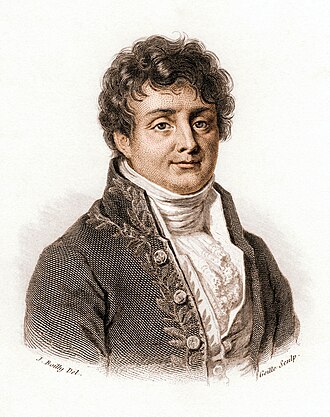
Joseph Fourier (1768-1830), French mathematician and physicist whose Fourier transform decomposes a time-domain signal into its constituent frequencies, expressed in Hz.
FFT (Fast Fourier Transform)
Efficient O(N log N) algorithm for computing the DFT.
FHSS (Frequency Hopping Spread Spectrum)
Modulation that rapidly hops the carrier across many frequencies in a pseudorandom pattern.
FMT (Frequency Mask Trigger)
RTSA capability that captures I/Q whenever the spectrum exceeds a user-defined envelope.
FSK (Frequency Shift Keying)
Digital modulation that encodes data in carrier frequency.
FR1
5G NR Frequency Range 1 (sub-6 GHz, up to 7.125 GHz).
FR2
5G NR Frequency Range 2 (mmWave, 24.25 to 71 GHz).
Friis's Formula
Equation describing how the noise figure of a multi-stage receiver depends primarily on the first stage.
GFSK (Gaussian FSK)
FSK with Gaussian pulse shaping for narrower spectral occupancy.
GNSS (Global Navigation Satellite System)
Generic term covering GPS, Galileo, GLONASS, BeiDou, QZSS.
GPSDO (GPS-Disciplined Oscillator)
Reference oscillator locked to GPS for high-precision frequency and time.
Hilbert Transform
Mathematical operation that produces a 90-degree phase shift across all frequencies.
IIP3 (Input Third-order Intercept Point)
Theoretical input power at which third-order intermodulation products equal the input signals.
I/Q (In-phase and Quadrature)
Pair of signals representing the real and imaginary parts of a complex baseband signal.
ISM (Industrial, Scientific, Medical)
Unlicensed RF bands available worldwide for general use; common bands at 2.4 GHz, 5.8 GHz, 433 MHz.
IsoLOG 3D DF
Aaronia's direction-finding antenna family with sectored arrays and elevation capability.
KML (Keyhole Markup Language)
XML format for geographic data, commonly used for Google Earth.
LFM (Linear Frequency Modulation)
Chirp with linearly varying frequency.
LNA (Low-Noise Amplifier)
First active stage in a receiver, optimized for low noise figure.
LO (Local Oscillator)
Reference signal mixed with the input to translate frequency.
LoRa
Low-power wide-area protocol using chirp spread spectrum.
MIMO (Multiple Input Multiple Output)
Wireless technique using multiple antennas at transmitter and receiver.
Modulation
Encoding information onto a carrier wave by varying amplitude, frequency, or phase.
NF (Noise Figure)
Ratio of input SNR to output SNR of a stage; expressed in dB.
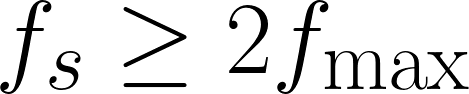
The Nyquist criterion: sample rate f_s (in samples per second) must be at least twice the highest signal frequency f_max (in Hz) to reconstruct the signal without aliasing.
Nyquist
Sampling theorem; minimum sample rate is twice the highest signal frequency.
OFDM (Orthogonal Frequency Division Multiplexing)
Wideband modulation using many orthogonal narrowband subcarriers, each modulated with QAM.
PDW (Pulse Descriptor Word)
Fixed-format record describing a single pulse: TOA, PW, frequency, amplitude.
Phase Noise
Random fluctuations in oscillator phase, expressed as dBc/Hz at offset frequencies.
Gap-free FFT frames give a real-time analyzer a high probability of intercepting brief signals, while a swept analyzer, busy elsewhere in the band, misses the same pulse.
POI (Probability of Intercept)
Minimum signal duration captured with near certainty by an analyzer. SPECTRAN V6 PLUS achieves 10 ns POI.
PRF (Pulse Repetition Frequency)
Number of pulses transmitted per second by a pulsed system.
PRI (Pulse Repetition Interval)
Time between consecutive pulse starts; PRI = 1/PRF.
PSD (Power Spectral Density)
Power per unit bandwidth, commonly expressed in dBm/Hz.
PSK (Phase Shift Keying)
Digital modulation that encodes data in carrier phase.
QAM (Quadrature Amplitude Modulation)
Digital modulation combining amplitude and phase, e.g., 16-QAM, 256-QAM, 1024-QAM, 4096-QAM.
QPSK (Quadrature Phase Shift Keying)
Four-state PSK encoding 2 bits per symbol.
RBW (Resolution Bandwidth)
The width of one frequency bin in an FFT, equal to sample rate divided by FFT length.
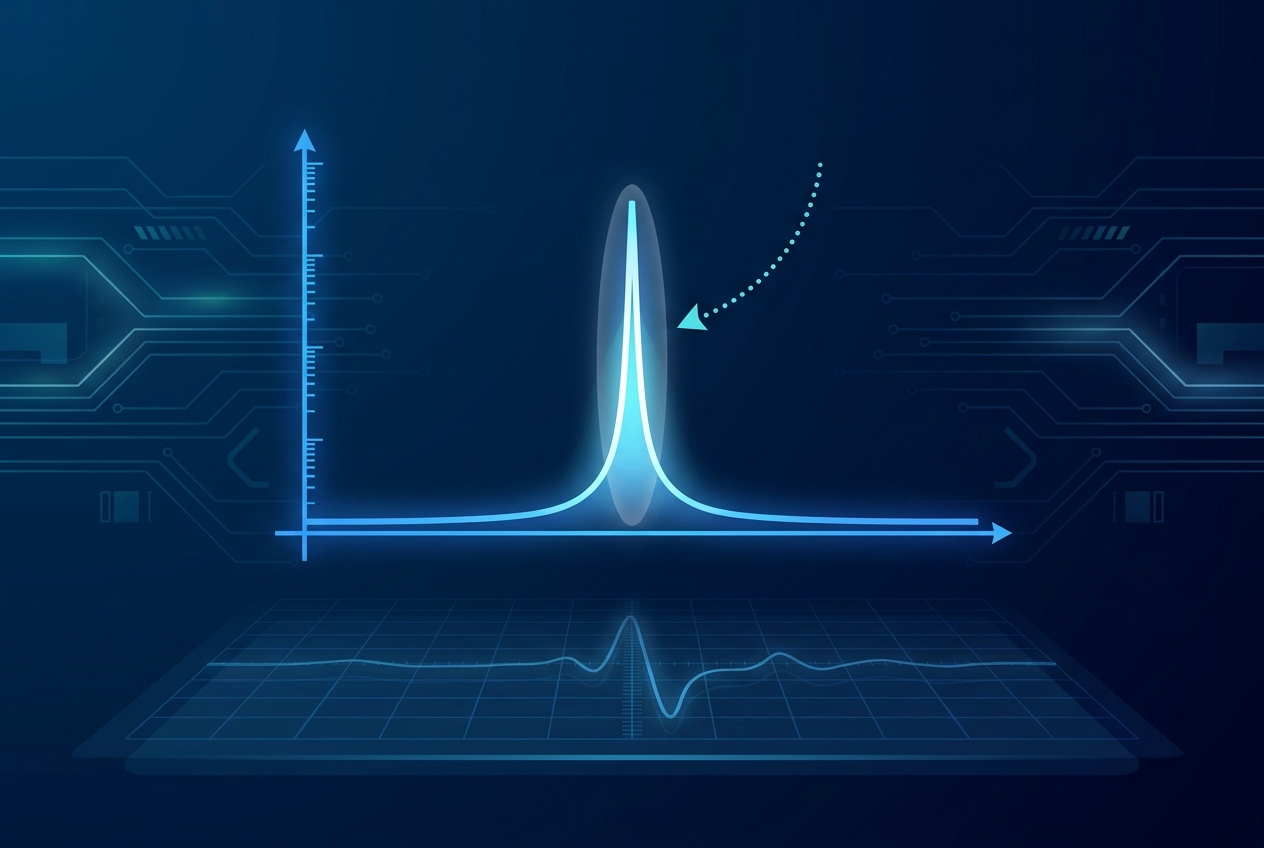
Real-time bandwidth is the span an RTSA digitizes with no gaps, so brief signals are not missed.
RTBW (Real-Time Bandwidth)
Width of spectrum that an RTSA digitizes simultaneously with no time gaps.
RTSA (Real-Time Spectrum Analyzer)
Instrument that captures wide spectrum continuously without sweeping.
Scalloping Loss
Variation in measured amplitude as a tone moves between FFT bin centers.
SDR (Software Defined Radio)
Radio system where most signal processing is implemented in software.
SFDR (Spurious-Free Dynamic Range)
Difference between strongest signal and strongest analyzer-generated spur.
SigMF (Signal Metadata Format)
Open standard for I/Q file metadata; JSON sidecar paired with a raw data file.
SPECTRAN V6 PLUS
Aaronia's flagship USB real-time spectrum analyzer family (250XA, 500XA, 2000XA models).
Spread Spectrum
Modulation technique that spreads signal energy across a wider bandwidth than data alone requires.
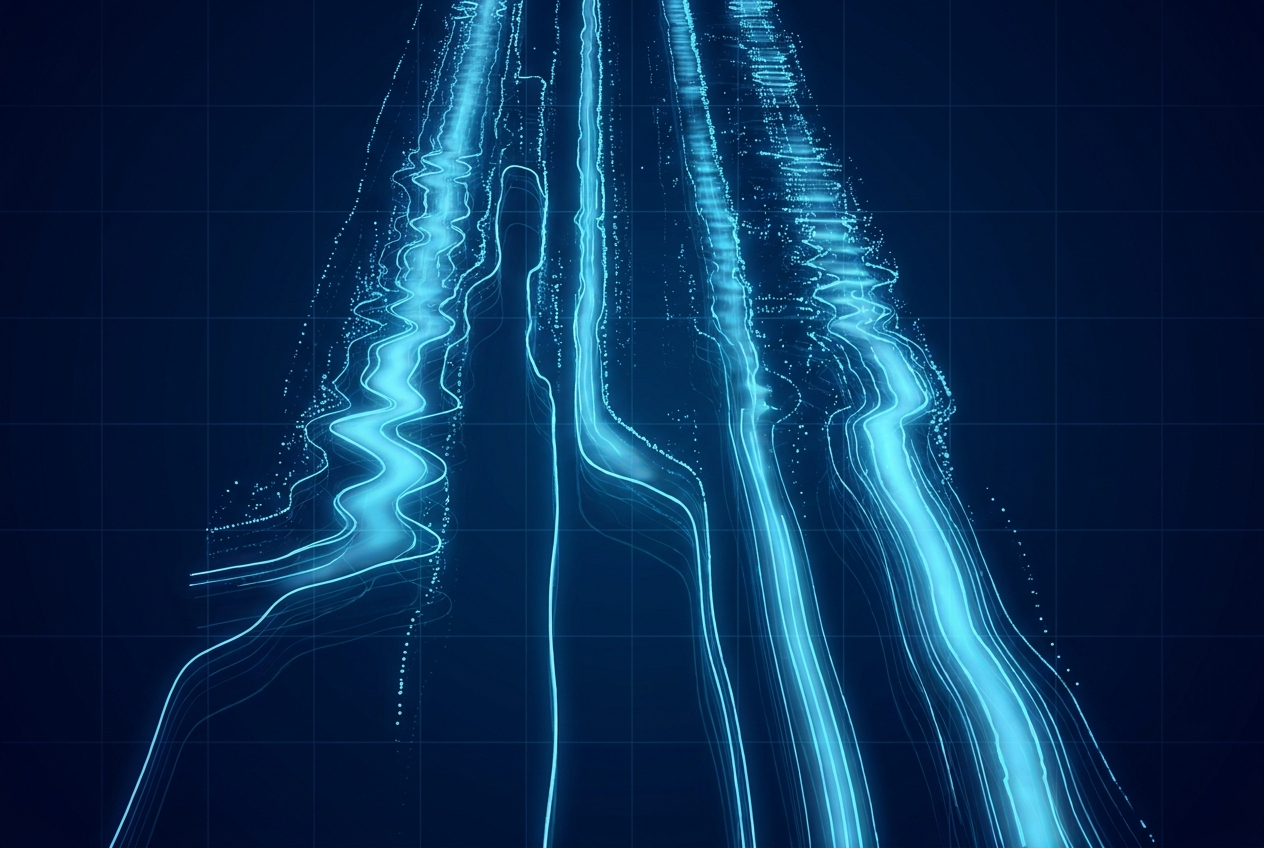
A spectrogram, or waterfall, plots frequency against time with amplitude shown as color.
Spectrogram
Time-frequency-amplitude plot, commonly displayed as a waterfall.
TCXO (Temperature-Compensated Crystal Oscillator)
Reference oscillator with temperature compensation, typically 1-5 ppm accuracy.
TDOA (Time Difference of Arrival)
Geolocation technique using arrival time differences across spatially separated sensors.
Type Approval
Regulatory certification confirming a wireless device meets emissions requirements before authorization.
UAS (Unmanned Aircraft System)
Drone or other unmanned aerial vehicle.
VSG (Vector Signal Generator)
Test instrument that generates arbitrary modulated waveforms.
Waterfall
Spectrogram display with frequency on the X-axis, time on the Y-axis, and amplitude as color.
Window Function
Tapering function applied to FFT input to reduce spectral leakage.
Wrapped Spectrum
Aaronia patented display that stacks the frequency axis across multiple lines for high-resolution wide-span monitoring.