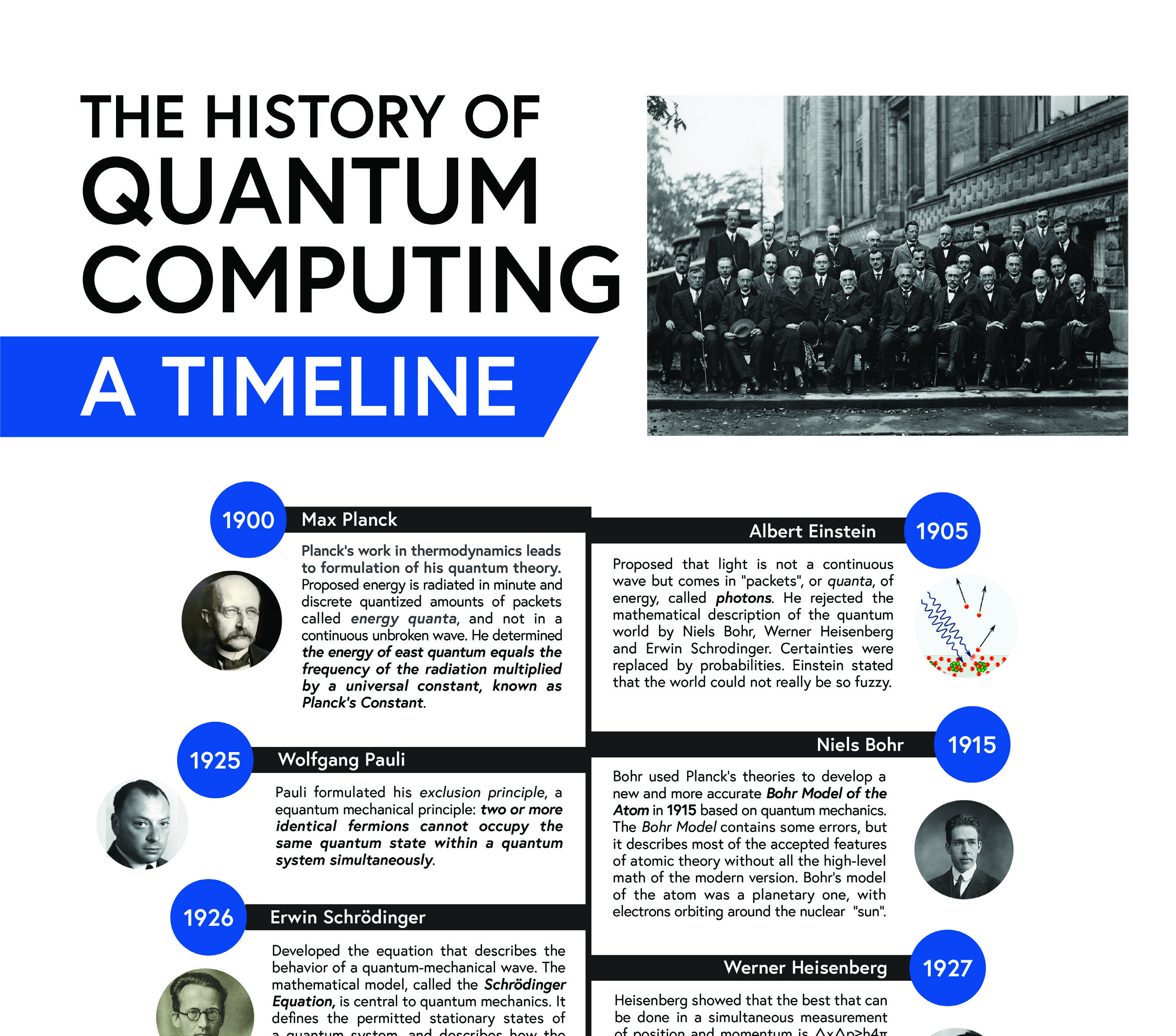
This timeline traces quantum computing from its theoretical origins to the hardware and error-correction milestones of the mid-2020s. The early entries belong to physics: the idea that nature is quantum, and that a machine built on quantum rules might compute things a classical machine cannot. The later entries belong to engineering: qubit counts, fidelities, cloud access, and the long climb toward fault tolerance. Dates mark the year a result was first announced or published. Where companies have announced future systems, those are listed separately as roadmap targets rather than achieved milestones.
The original first edition of this book opened with a visual "History of Quantum Computing" timeline poster. Figure B.1 reproduces part of that artwork. The text timeline below carries the same story forward and brings it current to 2026.
The conceptual groundwork for quantum computing was laid by the founders of quantum mechanics, decades before anyone imagined a quantum machine.
| Year | Milestone |
|---|---|
| 1900 | Max Planck introduces the idea that energy is radiated in discrete packets (quanta), giving rise to quantum theory. |
| 1905 | Albert Einstein proposes that light itself comes in quanta (photons), explaining the photoelectric effect. |
| 1925-1927 | Heisenberg, Schrodinger, Born, Dirac, and others formalize quantum mechanics: matrix mechanics, the wave equation, and the uncertainty principle. |
| 1935 | The Einstein-Podolsky-Rosen (EPR) paper sharpens the puzzle of entanglement, later called "spooky action at a distance." |
| 1936 | Alan Turing defines the universal computing machine, the abstract foundation of all later computation. |
| 1970s | Quantum information begins to take shape as a discipline, with early work on the physics of information and the limits of measurement. |
In the 1980s the central question flipped. Instead of asking how classical computers simulate physics, researchers asked whether a computer built from quantum parts could do something fundamentally new. The answer turned out to be yes, and by the late 1990s the first algorithms and the first crude hardware demonstrations had arrived.
| Year | Milestone |
|---|---|
| 1980 | Paul Benioff describes a quantum mechanical model of a Turing machine, establishing that computation can be done within quantum mechanics. |
| 1981-1982 | Richard Feynman argues that simulating quantum systems is intractable for classical computers and proposes building computers that are themselves quantum. |
| 1985 | David Deutsch formulates the universal quantum computer and the notion of a quantum algorithm, defining the gate (circuit) model. |
| 1992 | The Deutsch-Jozsa algorithm gives the first clear example of a problem a quantum computer solves faster than any classical one. |
| 1994 | Peter Shor publishes a quantum algorithm that factors large integers efficiently, threatening the cryptography that secures modern communication. |
| 1995 | Shor and (independently) Steane introduce quantum error correction, showing that fragile quantum information can in principle be protected. |
| 1996 | Lov Grover publishes a quantum algorithm for unstructured search with a quadratic speedup. |
| 1998 | The first working quantum algorithms run on small nuclear magnetic resonance (NMR) systems, demonstrating 2-qubit and 3-qubit operations in the laboratory. |
The 2000s and early 2010s turned theory into engineering. NMR demonstrations gave way to superconducting circuits, trapped ions, and other platforms. A commercial quantum annealer appeared, the cloud opened access to real devices, and qubit counts began their steady climb.
| Year | Milestone |
|---|---|
| 2001 | An NMR quantum computer runs Shor's algorithm on a tiny instance, factoring 15, a landmark proof of concept. |
| 2007 | D-Wave Systems demonstrates an early quantum annealer aimed at optimization, beginning the commercial quantum hardware era. |
| 2011 | D-Wave One, marketed as the first commercially available quantum annealer, ships with 128 qubits. |
| 2016 | IBM puts a 5-qubit gate-model processor on the cloud (IBM Quantum Experience), giving the public hands-on access to real quantum hardware for the first time. |
| 2017-2018 | IBM, Google, Rigetti, IonQ, and others race past 50 physical qubits on superconducting and trapped-ion platforms; the term NISQ (Noisy Intermediate-Scale Quantum) enters common use. |
The most recent stretch is defined by two parallel races: more physical qubits, and better error correction. Google's 2019 "supremacy" experiment proved a quantum processor could outrun classical machines on a contrived task. IBM then scaled past 1,000 physical qubits. The deeper shift came in 2024 and 2025, as error correction crossed from theory to demonstrated practice and the first reliable logical qubits appeared.
| Year | Milestone |
|---|---|
| 2019 | Google reports "quantum supremacy" with the 53-qubit Sycamore processor, completing a sampling task far faster than the best classical estimate. [1] |
| 2021 | IBM unveils Eagle, a 127-qubit superconducting processor, the first to cross 100 qubits. [2] |
| 2022 | IBM announces Osprey, a 433-qubit processor, more than tripling Eagle's count. [2] |
| 2023 | IBM unveils Condor, a 1,121-qubit processor, the first gate-model chip to surpass 1,000 qubits, alongside the modular 133-qubit Heron. [3] |
| 2024 (Sep) | Microsoft and Quantinuum demonstrate 12 entangled logical qubits on the H2 system, with logical error rates well below the physical rate. [4] |
| 2024 (Nov) | Microsoft and Atom Computing report creating and entangling 24 logical qubits on a neutral-atom system, the most entangled logical qubits on record at the time. [4] |
| 2024 (Dec) | Google announces Willow, a 105-qubit chip that demonstrates "below-threshold" error correction: as the qubit array grows, the logical error rate falls exponentially, a long-sought milestone. [5] |
| 2025 | Quantinuum introduces Helios, a next-generation trapped-ion system designed to support at least 10 high-reliability logical qubits, as logical-qubit demonstrations become a primary industry benchmark. [6] |
| 2025 (Nov) | IBM unveils Nighthawk (a 120-qubit advantage-focused processor) and Loon (an experimental chip validating the components for fault-tolerant error correction), reaffirming targets of quantum advantage by end of 2026 and fault tolerance by 2029. [7] |
| 2026 | The field's focus settles on useful quantum advantage and scaling logical qubits; vendor roadmaps point toward fault-tolerant machines later in the decade. Specific 2026 results should be verified against primary sources before publication. [7] |
These are publicly stated vendor goals as of early 2026, included for context. They are targets, not accomplishments, and the dates frequently move.
| Target Year | Stated Goal |
|---|---|
| 2026 | IBM targets demonstrable quantum advantage; multiple vendors target tens of reliable logical qubits. [7] |
| 2029 | IBM targets Starling, described as the first large-scale fault-tolerant quantum computer (roughly 200 logical qubits, 100 million gates). [7] |
| 2030s | Industry-wide goal of fault-tolerant machines with thousands of logical qubits capable of running Shor-scale algorithms. Verify before publication. |
A note on reading this timeline: physical qubit counts and logical qubit counts measure very different things. A processor with 1,000 noisy physical qubits may encode only a handful of error-corrected logical qubits, or none at all. The shift from celebrating physical-qubit records to demonstrating reliable logical qubits is the single most important trend in the 2024-2026 entries above.
[1] F. Arute et al., "Quantum supremacy using a programmable superconducting processor," Nature, vol. 574, 2019. Verify before publication.
[2] IBM Quantum, processor announcements for Eagle (127 qubits, 2021) and Osprey (433 qubits, 2022). Verify before publication.
[3] IBM Quantum, "Condor" 1,121-qubit processor and "Heron" announcements, December 2023. Verify before publication.
[4] Microsoft Azure Quantum and Quantinuum / Atom Computing logical-qubit demonstrations, September and November 2024. Verify before publication.
[5] Google Quantum AI, "Quantum error correction below the surface code threshold" (Willow), Nature, December 2024. Verify before publication.
[6] Quantinuum, "Helios" H-Series system announcement, 2025. Verify before publication.
[7] IBM Quantum roadmap update, "Nighthawk" and "Loon" processors and path to fault tolerance, November 2025. Verify before publication.